



News


Why does the US think S'pore deserves more tariffs? We read the 168-page report for you.
And what does CPF have to do with any of this?
November 28, 2026, 12:38 PM
Photo from White House Gallery and Google Maps


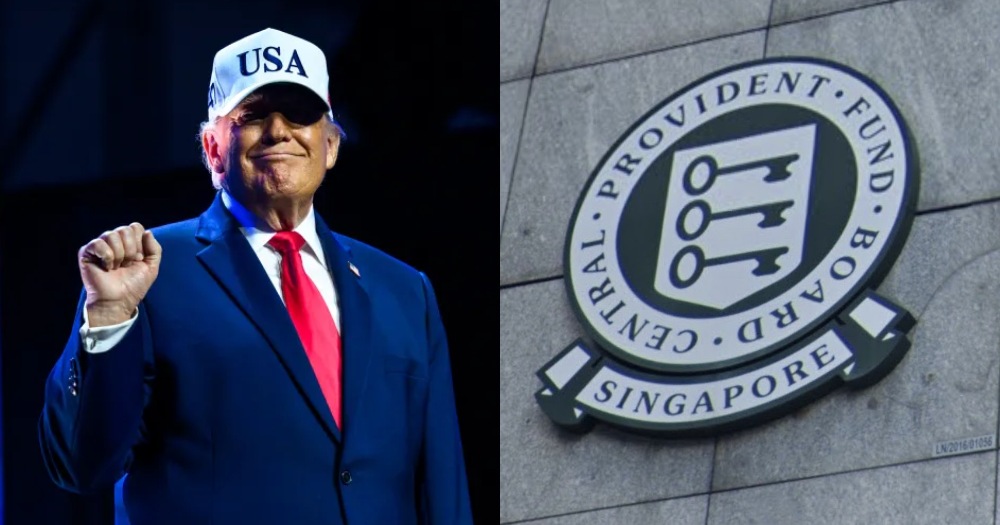
The U.S. unveiled a new set of tariffs aimed at Singapore, amongst 14 trading partners on Nov. 25.
The proposed tariffs of up to 20 per cent will not be stacked on top of the existing 12.5 per cent Section 301 tariffs imposed on Singapore in July 2026.
Not all Singapore exports to the U.S. are subject to the same tariff rate, with some products exempt from the tariffs.
However, should the maximum proposed rate take effect, Singapore's effective tariff rate on exports to the U.S. could still increase from 7.8 per cent to 10.3 per cent, according to Deputy Prime Minister Gan Kim Yong.
According to Gan, who is also the Minister for Energy, Trade and Industry (Trade), the proposed tariff would affect about S$9.4 billion of Singapore's exports and raise the effective tariff rate on Singapore goods from 7.8 per cent to 10.3 per cent.
Unlike the tariffs imposed on Singapore in July 2026 over alleged shortcomings in addressing forced labour, the latest proposed tariffs are being justified by the U.S.' assessment of Singapore's manufacturing and industrial policies and their alleged adverse effects on the U.S. economy.
In its report, the U.S. Trade Representative (USTR) makes several references to Singapore's "structural excess capacity", and names a few of Singapore's policies as exacerbating factors, such as the CPF savings scheme and its migrant worker policies.
What does that even mean?
Structural excess capacity
The USTR defines structural excess capacity as "capacity or production in an economy that is persistently in excess of the amount that would exist under market-oriented conditions and is created, sustained, or contributed to by governmental policies or interventions."
It is not necessarily saying that Singapore has too many factories or is producing goods that nobody wants to buy.
Rather, it believes Singapore is producing more than it otherwise would because of government support and policies.
However, the USTR itself acknowledges later in the report that there is "no single metric that determines the existence or extent of structural excess capacity and production in a sector or economy".
So how does the USTR determine how much Singapore should be producing in the first place?
US argues S'pore can do more to increase US export opportunities
The USTR writes that excess capacity in other countries generates "large and/or persistent trade surpluses" for them, and therefore affects manufacturing and innovation in the U.S., and "[displace] U.S. exports" in other markets.
It also claims that concentrating production in places outside the U.S. poses a risk, as geopolitical events could prevent the U.S. from accessing critical goods from geopolitically distant trading partners.
In Singapore's case, its global goods trade surplus stood at more than 5 per cent of its GDP in 2025, which the USTR considers an indicator of structural excess capacity.
Curiously, it admits that Singapore actually has a trade deficit with the U.S., ranging from US$4.4 billion to US$17.3 billion between 2021–2025, but claims that Singapore could do better in allowing US to enjoy greater export opportunities:
"If Singapore did not have acts, policies, and practices contributing to structural excess capacity and production in manufacturing, then the United States would enjoy greater export opportunities beyond existing aerospace, semiconductors, and energy or energy-intensive products."
Or, taken another way, the U.S. is looking to gain more export opportunities either from Singapore or those countries where Singapore has a trade surplus.
What did Singapore do?
The USTR proceeds to name certain policies by the Singapore government that supposedly maintain structural excess capacity:
1. Claims CPF suppresses domestic consumption
The USTR argues that mandatory CPF contributions increase Singapore's already high savings rate and reduce the amount of disposable income available for household spending.
Speaking at a media doorstop on Nov. 26, Gan said the CPF scheme was critical to Singapore, given its ageing population and lack of natural resources.
"We don't want to overburden our younger generation. That's why we have this scheme to make sure that we are all self-reliant," he said.
Gan also highlighted that the Singapore government encourages domestic consumption through measures such as CDC vouchers, countering the USTR's argument that Singapore's policies suppress household spending.
2. Claims limited social protection keeps labour cost low
The USTR also takes issue with Singapore's "low levels of social protection coverage", citing areas such as unemployment benefits, disability benefits and retirement pensions.
It argues that inadequate social protection keeps labour costs artificially low and "distorts labour markets", giving manufacturers in Singapore a competitive advantage.
The USTR also claims that recruitment fees charged to migrant workers expose them to debt bondage and suppress wages.
Taken together, the USTR argues that Singapore's policies keep domestic consumption low, leading manufacturers to rely more heavily on overseas markets to sell their goods.
In effect, it is arguing that the Singaporean government suppresses domestic demand with CPF and social policies such that Singaporean companies look towards exporting instead — to countries such as the U.S.
The USTR suggests that this competes with U.S. firms, both in the American market and in other export markets worldwide.
3. Enterprise Singapore and other financial support
The report also suggests that Singapore's financial support for its domestic firms harms U.S. firms.
For one, it singles out Enterprise Singapore, a statutory board under the Ministry of Energy, Trade and Industry (METI), which helps enterprises access financing by sharing lending risks with participating financial institutions.
It also named the Singapore Manufacturing 2030 and the RIE2030 plans, two initiatives which have seen the government dedicate several billion dollars to manufacturing and R&D.
Included in the report are several other schemes that either directly provide credit to firms or reduce taxes, such as those by Economic Development Board (EDB) and Inland Revenue Authority of Singapore (IRAS), with even the Johor-Singapore Special Economic Zone (JS-SEZ) being placed under this umbrella.
But how does this affect U.S. firms?
For one, U.S. firms do not receive the same support, so they are unable to compete, resulting in global markets being "flooded with lower-priced goods", it claims.
Interestingly, the same report acknowledges that American firms are among the biggest players in some key industries in Singapore.
For instance, Micron and GlobalFoundries are two of the largest wafer producers in Singapore's semiconductor industry.
4. Chinese investments and exports from China
The USTR also pointed fingers at Singapore's "encouragement of or failure to address" foreign direct investment (FDI) and imports from "non-market economies".
The non-market economy in question refers to China.
It suggests that Singapore's free trade agreement with China and participation in the Belt and Road Initiative means that it receives substantial investment and imports greatly from China.
The USTR claims that this not only sustains China's structural excess capacity but also allows Singaporean firms to produce goods more cheaply by using allegedly undervalued Chinese materials.
'Unreasonable'
Does all of this warrant tariffs?
According to the USTR, it does.
It cites Section 301 of the Trade Act under U.S. law, which states that it can take action against "practices of a foreign country that are unreasonable or discriminatory and burden or restrict U.S. commerce."
And in the eyes of the USTR, Singapore's policies promote export-led growth, distort competition, suppress domestic consumption, and undermine workers' welfare at the expense of the U.S.
"It is unfair and inequitable for Singapore not to contribute proportionately to global demand growth and instead to rely substantially on net-importing economies, like the United States, which can suffer from strong disincentives to invest or produce in manufacturing sectors."
METI said on Nov. 26 that it was "very disappointed" with the USTR findings.
Singapore has yet to begin talks with the U.S. on a reciprocal trade agreement, but Gan says it would continue to engage the U.S. to lower the tariffs.
In the meantime, you can read Mothership's take on the situation.