News


Law Minister Edwin Tong outlines plans for AI council & legal education review
Tong noted that despite having only 6,400 Singapore-qualified lawyers, Singapore is today the second-most preferred seat of arbitration in the world.
July 30, 2026, 03:05 PM
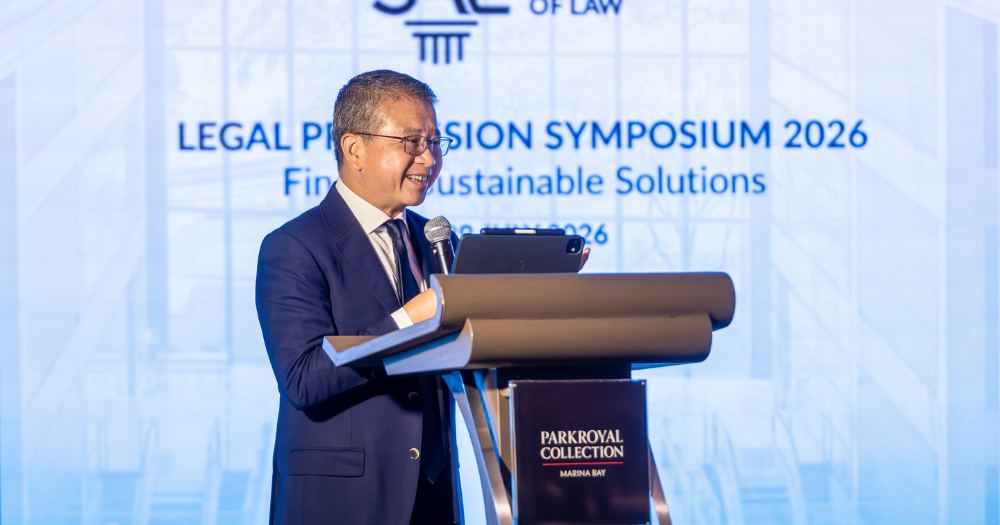
Top image via Lumiere Photography Singapore


Chief Justice Sundaresh Menon and Minister for Law Edwin Tong both used the Legal Profession Symposium 2026 on Jul. 29 to call for collective action on the sustainability of Singapore's legal profession, with Menon describing it as a "rule of law concern" and Tong outlining plans to review legal education and launch a new AI council for the legal sector.
Menon: Five interconnected pressures
Speaking at the symposium, Menon outlined five interconnected pressures facing the profession and described three workstreams within the Future of the Legal Profession Committee (FLPC) to address them.
Menon said the sustainability of legal practice had been examined over several years through surveys, consultations and direct engagement with the profession, including the 2023 SAL Young Lawyers Survey and the more recent Anthro-LawSoc Legal Profession Sustainability Study.
He said: "Sustainability is not a single issue problem. It is the cumulative product of interconnected pressures across the legal ecosystem."
He identified five pressures deserving particular attention: the intensity of legal work, incentive structures, workplace culture, gaps in leadership and mentorship, and a generational divide within the profession.
The five pressures
On the intensity of legal work, Menon said earlier generations could only take home as much work as their briefcases could carry, while today, work follows lawyers everywhere and constant availability has become an expectation, largely because of technology.
On incentive structures, he questioned whether the billable hours model remains relevant in the age of AI, and whether young lawyers were being held to targets and business development expectations before they had adequate support or guidance.
On workplace culture, he was unequivocal: "Abusive emails, humiliation, and persistent disrespect towards colleagues have no place in our profession."
On mentorship, he noted that only about one in 10 respondents to the Young Lawyers Survey had participated in a structured mentorship programme, and said technical excellence as a lawyer does not automatically produce the ability to lead, supervise or develop people.
On the generational divide, he said the tensions between senior and junior lawyers should not be reduced to stereotypes: "If each generation reduces the other to stereotypes, one as unwilling to endure the demands of the craft, and the other as indifferent to the adverse cost of prevailing customs and practices, mutual misunderstanding will deepen disengagement."
Why this is a rule of law concern
Menon warned that these pressures could lead to chronic stress, burnout and anxiety, with consequences that extended beyond the individual.
He said: "A lawyer worn down for long enough, stops asking whether to change firms and starts asking whether to remain a lawyer at all."
He added that younger lawyers today had more options than previous generations: taking an in-house role, entering public service, going overseas or leaving the law altogether, making the opportunity cost of remaining in practice far more visible.
He added: "Sustainability is therefore not merely an employment or organisational concern. At its core, it is a rule of law concern. The justice system cannot remain strong if the profession on which it depends is unable to sustain meaningful careers."
Three workstreams described
Menon announced three workstreams under the FLPC, which is co-chaired by Justice of the Court of Appeal Hri Kumar Nair, Deputy Attorney-General Valerie Thean and Ministry of Law Permanent Secretary Luke Goh.
The first, a Business and Leadership Skills workstream, will build practical programmes and frameworks for supervision, communication and talent development.
The second is a Bridging Legal Education and Industry workstream, which will build a closer feedback loop between law schools, the Singapore Institute of Legal Education and the industry. This will be complemented by a Future Lawyers Network, giving law students earlier exposure to professional life.
The third is a Sustainability and Well-being workstream, which will rethink how legal work is structured, supervised and valued, and promote healthier workplace cultures through platforms such as the Lawyers Sustainability Alliance.
The judiciary must also play its part
Menon acknowledged that the Sustainability Study had raised concerns about some interactions between lawyers and the bench. While judicial officers must uphold exacting standards, he said they must always do so with courtesy.
He said: "Let me say without reservation that discourtesy or abusive conduct will not be tolerated."
Edwin Tong: Attrition figures stable, but quality of departure matters
In his closing address, Tong said attrition in the legal profession had remained broadly stable, with around 60 per cent of lawyers staying in practice after five years and 40 per cent after 10 years, between 2015 and 2024.
He also noted that in Singapore Academy of Law's (SAL) recent survey of newly qualified lawyers, about one in three expected to leave their current firm within the next three years.
However, of the 289 respondents working in law firms, only eight, or less than three per cent, said their sole intention was to leave the legal profession altogether.
He said: "The vast majority still want careers in the law. They simply see themselves contributing in different ways — as in-house counsel, academics, Government lawyers, or judges. I see that not as a loss, but as one of the profession's strengths."
But he said the key question was not whether lawyers were leaving, but why.
He said: "If talented lawyers are leaving because parts of legal practice have become unnecessarily unattractive or unsustainable, then we need to understand why, and do something about it."
Tong's three focus areas: Workforce, workplaces, work
Tong said he believed the focus should be on three areas.
On workforce, he said his ministry would undertake a broader review of legal education, and floated the idea of law students spending one or even two semesters in a law firm or another legal setting before entering the profession full-time.
For litigators, he suggested that certain categories of simpler proceedings or cases below a prescribed value could ordinarily be argued by junior lawyers, giving them the first chair experience.
On workplaces, Tong said his ministry was considering a Legal Profession Sustainability Guide, similar to the GenAI Guide.
The guide would set out professional norms and workplace behaviours the profession should aspire to, illustrated through practical examples of good practice.
It would complement work already being done by SAL through the Lawyers Sustainability Alliance.
He also said mentorship was not optional: "To me, mentoring is not simply something experienced lawyers do if they have time. It is a professional obligation."
On work, Tong announced that under the FLPC, his ministry would establish the Singapore Council on AI for Legal Excellence (SCALE), bringing together leaders from across the profession, academia, technology companies, in-house practice and the public sector to build a clearer, evidence-based understanding of how AI is reshaping legal work and what the profession should do in response.
He also said Singapore's domestic market alone was not enough, and that when Singapore firms succeeded overseas, the benefits extended to the wider profession, strengthening Singapore's reputation as a legal hub and attracting more work and talent.
He added: “I don't believe that lawyers will be replaced by AI. But the lawyer who harnesses AI better than the next will replace that lawyer, and I think it's important that we all understand how AI can best be integrated into our own workforce.”
Singapore's strengths
Tong noted that despite having only 6,400 Singapore-qualified lawyers, Singapore is today the second-most preferred seat of arbitration in the world.
He added that rankings and accolades, while important, were not what truly defined a profession's strength.
He said: "What matters more to me is whether the best and the brightest young legal talent will still continue to aspire to join the profession here in Singapore. Whether lawyers remain proud to belong to it, whether clients continue to place their trust in our lawyers, and whether society continues to see the legal profession as a force for good."