Abroad


Derided as India’s “cockroaches”, youth protesters have shaken Modi’s grip on power
Watch who you're calling cockroach.
July 30, 2026, 10:38 AM
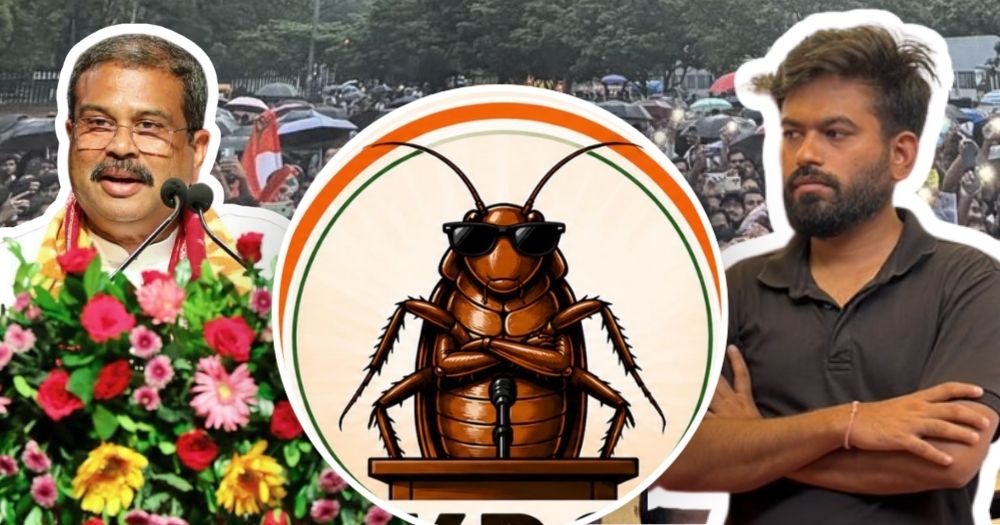
Dharmendra Pradhan, former Indian Education Minister, Logo of the Cockroach Janta Party, Abhijeet Dipke, leader of CJP. Image via Dharmendra Pradhan/Facebook & Abhijeet Dipke/X


On July 25, Dharmendra Pradhan, India's Education Minister, resigned.
His resignation comes after nearly three months of scandal and protest, notably by the youth movement Cockroach Janta Party (CJP).
But how did a parody political party named after an offhand putdown of a generation strike the hardest blow against a dominant Indian government in almost two decades?
Employment and examinations
This most recent protest movement stems from a broad trend, but also a specific moment.
The broader trends are worries by India's youth about its relatively high youth unemployment rate, particularly amongst university graduates, with the BBC saying that of those aged between 15 and 25, 40 per cent are jobless.
Between the ages of 25 and 29, the number improves but still remains at 20 per cent.
Demand for the best jobs is high, as is the the competition to enter the best universities or the best courses.
NEET leak
This has put a spotlight on the National Eligibility Cum Entrance Test (NEET), a university entrance exams that has been riven with scandal for several years, particularly relating to accusations that examination questions were being leaked for the benefit of a few students.
In 2026, accusations of further leaks surrounded the NEET-UG examinations, which are the entrance exams for India's medical schools.
The New York Times described the examinations as gruelling, but also a gateway to a coveted spot in India's medical education system, for which students spend years preparing for.
But a leak of nearly 120 out of 180 questions saw the May 3 exams cancelled on May 12, with a re-examination scheduled for Jun. 21.
The nature of the examinations and the intense pressure related to the results saw as many as 21 students potentially having taken their own lives in the run-up to the re-examination date.
Parasites
In the midst of the scandal on May 15, India's Chief Justice, Surya Kant, got caught up in a controversy when during a speech about lawyers with bogus degrees, Kant referred to unemployed youths in India “cockroaches” and “parasites.”
“There are already parasites of society who attack the system, and you want to join hands with them?
“There are youngsters like cockroaches, who don’t get any employment and don’t have any place in the profession.
“Some of them become media, some of them become social media, some of them become RTI (Right to Information) activists, some of them become other activists, and they start attacking everyone…and you people file contempt petitions!”
The next day, Kant clarified that he was only referring to lawyers with bogus degrees, and that he had been misquoted, but this failed to mollify many.
Party time
One of those youths spurred into action was Abhijeet Dipke, a political communications strategist who was then studying at Boston University.
Taking “inspiration” from the Chief Justice's remark, he started the Cockroach Junta Party, a satirical take on the Bharatiya Janata Party, the political party of Prime Minister Narendra Modi.
It features an AI-generated cockroach with sunglasses as its mascot.
Initial posts on social media platforms like X displayed its four-point criteria for joining: Had to be unemployed, lazy, chronically online, and be able to rant professionally.
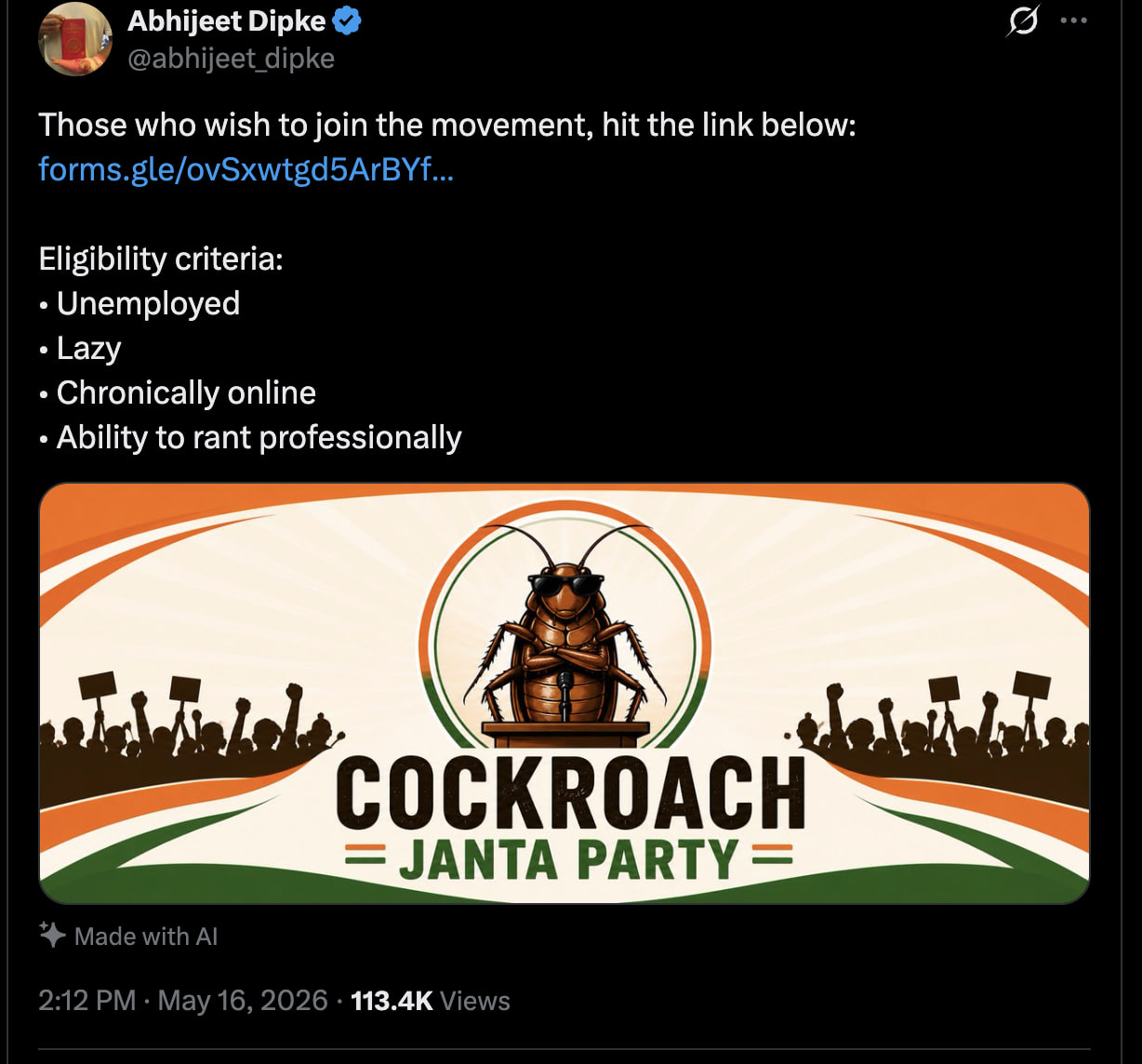 Image via @abhijeet_dipke/X
From its start it asked a simple question: What if all the "cockroaches" came together?
From the screen to the street
What began as a joke began to take a life of its own, and within a week, the CJP’s social media accounts had millions of followers, more than even the BJP.
By the start of June, Dipke had returned from the U.S. to head street protests, which over the course of two months morphed from a single-day protest to a multi-week sit-in along with a hunger strike by prominent activist Sonam Wangchuk, who subsisted on nothing but salt and water, as well as Dipke himself.
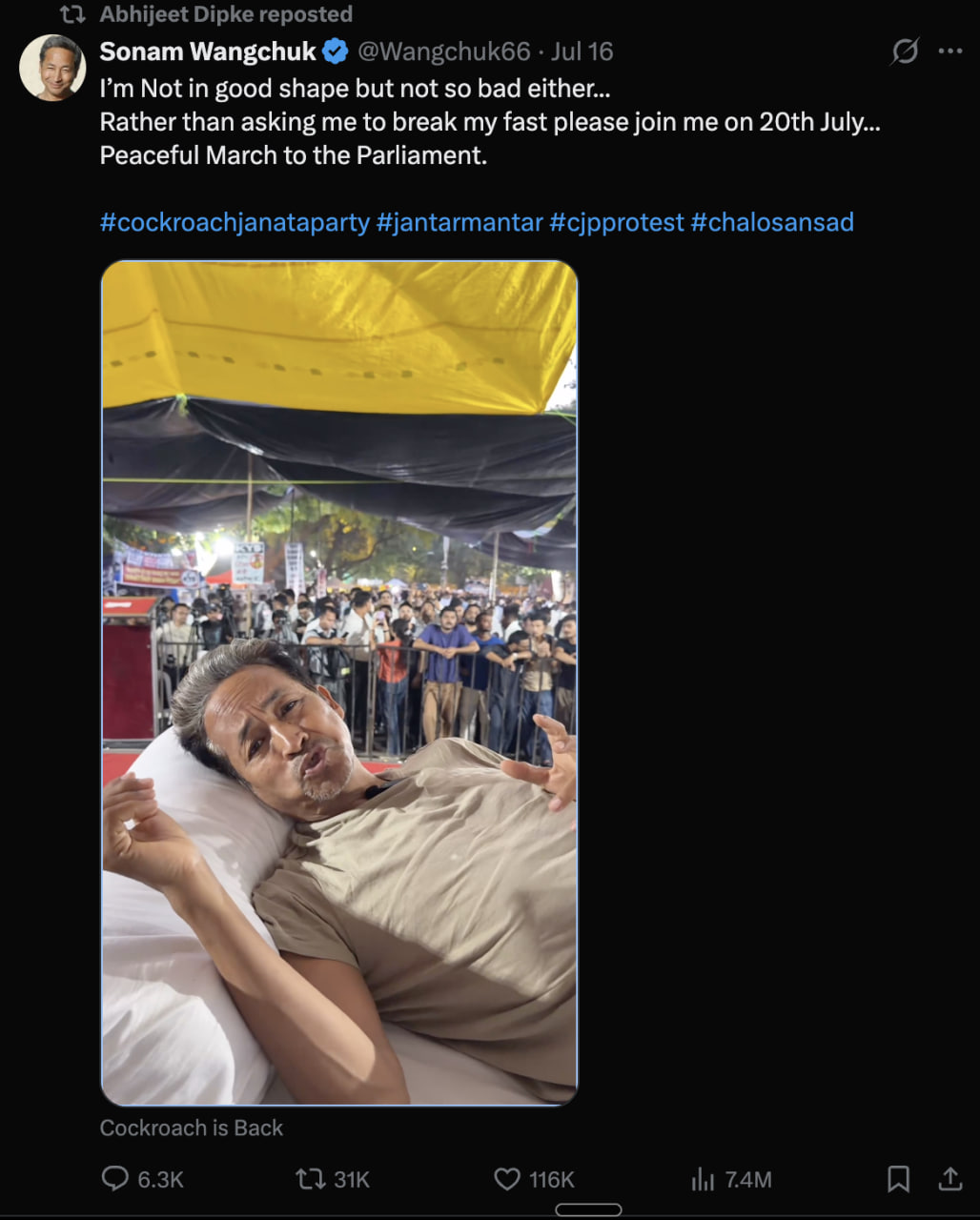 Image via @Wangchuk66/X
The sit-in protest site was located at Delhi’s Jantar Mantar, and came to a head on Jul. 20, when thousands of protesters at the site attempted to march to India’s parliament.
The Guardian estimated that “tens of thousands” attended the march; estimates were between 10 and 50 thousand, who subsequently clashed with Delhi police, resulting in hundreds of injuries and arrests.
The police erected metal barriers across the road in order to prevent the protesters from making progress, and reportedly hit protesters with batons and used tear gas against them.
The BBC estimated 300 persons were injured and taken to hospital, and 70 protesters were arrested.
And while protests were most pronounced in Delhi, other cities also saw notable turnouts, with organisers calling the young, and particularly those affected by the examination resits, to join the protest, in the latter case, after their exams were completed.
Resigned to it
But the pressure on the government appears to have paid off.
On Jul. 25, about five weeks since the sit-in protest started in earnest, and almost three months after the CJP was started as a joke, India’s education minister Dharmendra Pradhan resigned.
On social media, Pradhan said that he “respected the aspirations, dreams, and expectations of the youth” and that he was resigning so “anti-nationalist” forces didn’t exploit the CJP protest, and to "preserve national unity”, he had handed in his resignation to Modi.
His resignation was met by Dipke announcing to the crowd, “We have done it!”
Opposition occlusion
This marks the most successful recent challenge to Narendra Modi’s power.
While the protest site was visited regularly by opposition politicians, those opposition politicians have struggled to make an impact, both before and during this incident.
Some will claim they are ineffective; others will say that they are being suppressed.
But when the official leader of the opposition, India National Congress chief Rahul Gandhi, was pictured being hauled away by the police while visiting the protest during its march to parliament, it was some of the most effective publicity he had in a while.
Gandhi was detained, but released on the same day.
Thanks for name
The CJP, however, is not done.
It has its sights set on making sure that those affected by the NEET scandal are compensated, particularly the families of those who took their lives.
Its manifesto has five points, directed at improving India’s democracy and empowering its younger generations.
Its leader, Dipke, was also cognisant of who he owed appreciation to, citing Chief Justice Kant, thanking him for calling his generation “cockroaches.”
Otherwise, “this movement would not have started.”