





Branded
Is AI really coming for my job? Or can it make my work easier?
For some professionals, it is a useful tool. For others, it is still confusing and worrying.

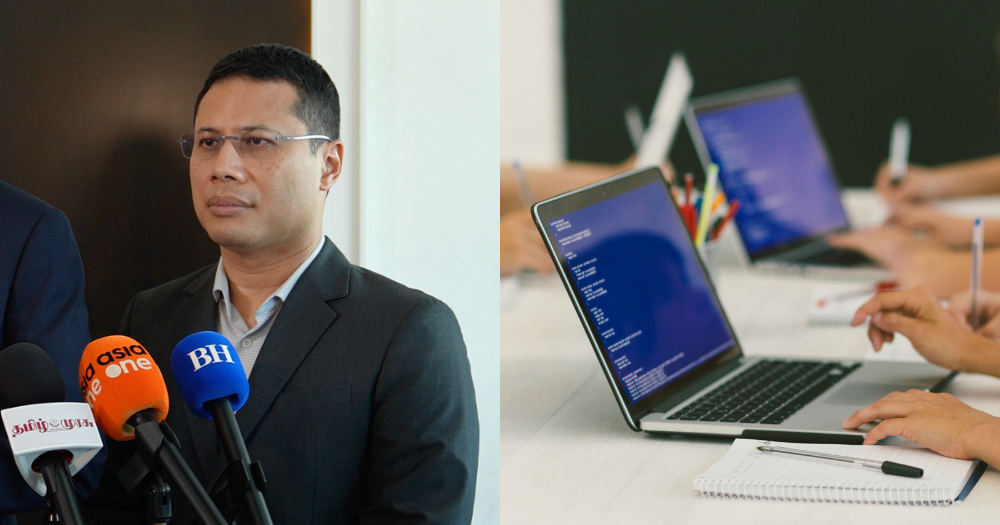
Photo by Mothership
Of late, Artificial Intelligence (AI) has quickly emerged as one of the biggest conversations at work.
For some workers, it has been a helpful assistant — checking grammar, summarising information, keeping track of deadlines or helping them get started on unfamiliar topics.
For others however, the concern with AI goes beyond having to learn a new tool.
Rather, it is the fear that parts of their role could be automated, that their experience might be less valued or that they may even find themselves eventually displaced by AI one day.
Anxiety of job loss has been acknowledged by PM Wong
Such fears have been acknowledged by Prime Minister Lawrence Wong.
In his May Day speech, PM Wong acknowledged that “not everyone feels ready” and that many are anxious.
He said, "I cannot promise that there will be no disruption. Jobs will change. Some will disappear. And the pace of change will be faster than anything we have seen before."
There have also been at least a few job losses amidst a drive to adopt AI.
In June 2026, Shopee began cutting hundreds of developer jobs amidst its push towards AI, with eight per cent of its developer workforce affected.
And in May 2026, Standard Chartered announced that it plans to reduce its support workforce by more than 15 per cent, which is equivalent to about 7,800 jobs, by 2030, as the bank accelerates its adoption of AI in a move to improve operational efficiency.
Such instances are an indication of how AI is changing the way work gets done, with some jobs likely to be reshaped, some tasks to be automated, and some workers needing to pick up new skills in the process.
Will AI eventually replace me as it becomes better?
Among the professionals we spoke to, a common worry was that AI is no longer just a tool to learn, but something that could eventually take over parts of their work.
For Shannon, a 35-year-old senior manager in branded services, this anxiety has already surfaced in a core part of her role: vetting content.
She said, “AI is already so good at grammar checks, rewriting, and reviewing content. It feels like more and more of what I do can be automated.”
Her concern has grown as AI becomes capable of handling more complex work.
“My role is more about coordinating with colleagues, managing projects, and following up on tasks.
But then I started thinking: what if AI eventually becomes good enough to coordinate work, summarise discussions, track action items, and even manage projects?”
Raymond, a 37-year-old physical fitness coach, shared a similar concern. He noted that AI can already help create fitness and dietary plans, raising questions about how much clients may still rely on human coaches.
“Clients might eventually see less need for coaches when AI can provide the information they need, and all that is left is to execute the AI-planned workouts,” he said.
“In such a scenario, the role of a physical fitness coach is reduced to counting reps at best,” Raymond added.
Unclear expectations over AI, while still needing to worry about how it factors into my performance
For Samuel, a 63-year-old executive director of a charity, the anxiety is less about whether AI should be used, and more about the lack of clarity on how it should be used.
He said his organisation has signalled that teams should stay lean by tapping AI, but without a clear roadmap.
“The difficult part is that the expectation to be ‘lean and light’ is not always matched with a clear plan for how the team is supposed to become AI-savvy.”
Staff have generally been left to their own devices to figure out how to use AI, which has been a source of frustration and anxiety for him, as it means AI is now a new, unknown factor in his performance.
“Are we even doing the right thing, according to what the organisation wants? Do they want us to use AI to help analyse reports?”
Thus far, his use of AI has been self-directed, largely through online tutorials.
Samuel said, “There is a difference between saying ‘use AI to be more productive’ and actually investing in structured training, workflow redesign, responsible-use policies, and practical support for staff to learn how to use AI properly.”
Even then, he worries about how any productivity gains may be interpreted.
“In principle, if I use AI well, that should make my role more valuable because I am helping the organisation become more effective.
But if AI adoption is discussed mainly in terms of staying lean, reducing cost, or doing more with fewer people, it can feel as though the better I become at using AI, the more I may be proving that fewer people are needed.”
The AI disruption can therefore leave workers caught between two worries: not wanting to be left behind, but also not knowing what meaningful upskilling looks like.
For some workers, AI has made work easier though not always in dramatic ways
That being said, it is not all doom and gloom, however.
For Shannon, AI has still made a key task easier, keeping track of her deadlines.
And for Raymond, AI has helped to automate many repetitive administrative tasks such as answering enquiries, following up with prospects and scheduling consultations.
“AI has allowed our team to focus more of our energy on coaching and member engagement,” he said.
In the case of Daniel, he highlighted how providing a ChatGPT Pro subscription to each of his staff has improved the quality of their reports as they can use it to quickly provide information on unfamiliar topics.
He said, “My staff no longer have any excuse that they do not know how to do a piece of work.”
This in turn means he can focus on developing their critical thinking skills, Daniel pointed out.
What does the Tripartite Jobs Council have to do with all of this?
The bigger question then, is not whether AI is good or bad.
It is whether workers, employers and the wider system can manage the transition in a way that gives people confidence, rather than leaving them to figure it out alone, or worse, only after displacement happens.
On Apr. 30, 2026, the creation of the Tripartite Jobs Council to help workers and businesses was announced.
The council brings together NTUC, the Ministry of Manpower (MOM), and the employers’ trade union, Singapore National Employers Federation (SNEF), to look at how jobs are changing, where workers may need support, and how companies can adopt AI without leaving people behind.
Speaking at the launch of the council, NTUC Secretary General Ng Chee Meng said the aim of the council is to address concerns such as PMEs lacking full AI workplace application awareness, a growing perception amongst youth that skills and qualifications no longer guarantee employment, and increasing anxiety by seniors’ over skills obsolescence.
According to The Straits Times, the council will focus on providing coordinated support for transformation of the workforce in tandem with AI adoption.
It will also provide targeted transition support for workers and occupations that are at risk due to the AI disruption, and help to raise public awareness about AI so that more members of the public will go for training.
That means looking at broad-based and sector-specific training, identifying roles that may be more exposed to disruption, and giving workers clearer pathways to adapt.
So, where can I start?
For a PME who is unsure whether AI is relevant to their role, the first step may not be to sign up for the nearest course.
Instead, it may be to understand how their work is likely to change, which parts of their role can be supported by AI, and what skills would help them stay useful in that new environment.
This is where initiatives such as NTUC’s AI-Ready SG can come in handy.
Launched in February 2026, the AI-Ready SG initiative involves making structured AI training pathways available to all workers and will offer more than a million places through NTUC LearningHub for training over the next few years.
These pathways include courses in using AI for sales, marketing and human resources, as well as managing workplaces and workflows amidst AI-driven digital transformation.
NTUC members will also be able to receive subsidies of up to 50 per cent for the subscription costs of eligible AI tools such as ChatGPT, Claude and Github Copilot, among others, under the Union Training Assistance Programme.
At the same time, the transition cannot fall only on workers.
If AI is introduced by employers without proper job redesign, employees may experience it as a threat rather than a tool.
According to NTUC Secretary General Ng Chee Meng in his May 5 speech in Parliament, NTUC will work with companies, through the Company Training Committees (CTCs), to identify jobs that may be affected by transformation, close skills gaps and map out clearer progression pathways.
This is to help ensure that AI adoption can lead to better jobs and not just leaner teams.
What if my job is already being affected?
For workers whose roles are already being affected by AI or business transformation, the support needed may be more immediate, as it may no longer be enough to simply be told to “upskill”.
Such workers may need help to understand what is changing in their job, identify transferable skills, explore new roles, and access career guidance or training support.
Here, NTUC has provided support for workers via its Employment and Employability Institute (e2i).
Affected workers can seek out career coaching services to help identify their career moves and join employability workshops to enhance their job search, resume writing and interviewing skills.
For professionals who are pressed for time, or prefer a “self-help” option, they can make use of NTUC’s AI Career Coach which can analyse their resume, identify strengths and gaps and recommend additional job possibilities based on their skills and experience.
Workers can also make use of the NTUC LearningHub Career Mentorship Programme to connect to certified mentors who will provide guidance through an AI‐enabled match‐scoring system that pairs mentees with mentors aligned to their career goals.
The Tripartite Job Council, which supports the National AI Council, is also stepping up to make sure you are not left behind as AI changes the workplace.
The council will continuously study the impact of AI, review policies and introduce programmes aimed at helping workers and businesses, especially SMEs, adopt AI with confidence, strengthen career conversion pathways, and ensure workers have access to skills that they need for new opportunities.
Through these, NTUC can help workers take practical next steps to navigate into a new area of work.
Should workers panic?
Probably not. But they should not ignore AI either.
The professionals we spoke to show that AI’s impact is not the same for everyone.
Some workers are already using it confidently. Some are curious but unsure. Others are worried that the technology may reduce the value of their experience or make their roles more vulnerable.
All of these reactions are valid.
What matters however, is whether workers receive practical support — not just broad messages that AI is important, but clear guidance on what to learn, how to apply it, and where their jobs may be heading.
Fortunately, help exists in the form of initiatives under AI-Ready SG, so you do not have to figure this out alone.
This sponsored article made the author consider looking up a course in AI