News


Self-radicalised S'porean youth, 14, was planning school attack, arrested just weeks before June holidays: SM Shanmugam
"He had gotten quite close to carrying out his plans."
July 27, 2026, 05:32 PM
Photo by Mothership.


A 14-year-old self-radicalised youth in Singapore who had planned a mass-casualty attack on his school during the June holidays earlier this year was arrested just weeks before the school break began.
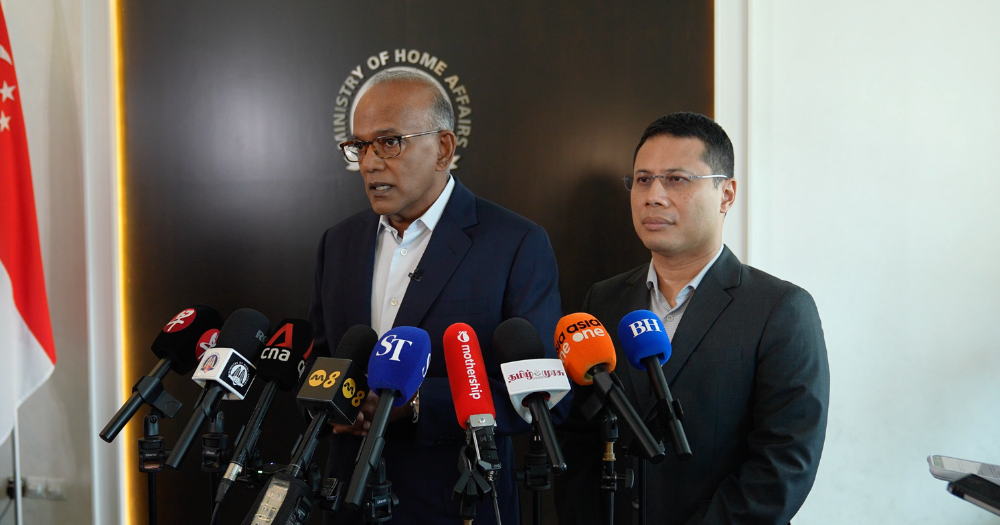
This was revealed by Senior Minister K Shanmugam, who is also the Minister for Home Affairs and Coordinating Minister for National Security, at a media doorstop on Jul. 27.
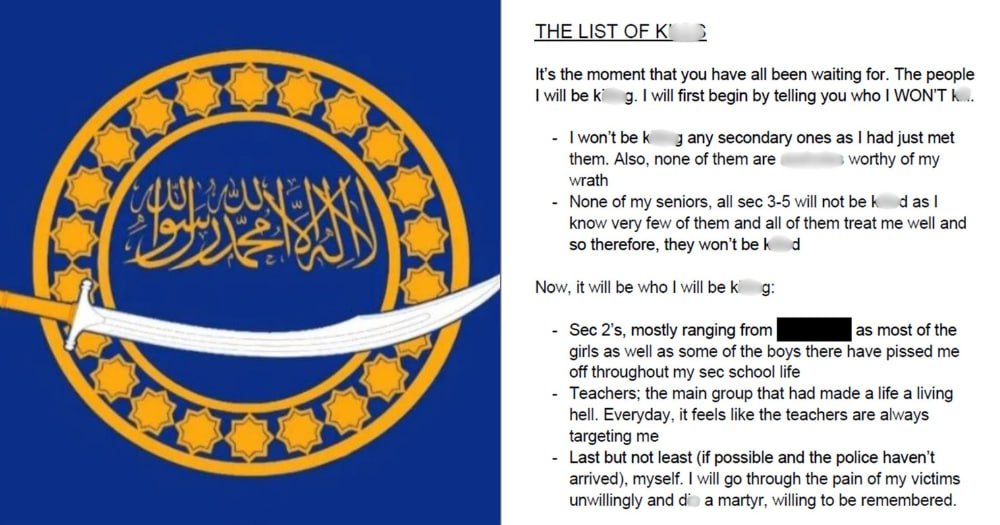
The youth had been radicalised by Composite Violent Extremism (COVE), after being exposed to violent content online and through first-person shooter games via Roblox.
"He had gotten quite close to carrying out his plans. It is worrying, but every case is worrying," SM Shanmugam said.
"I've said this many times before. The Internal Security Department (ISD) and the Ministry of Home Affairs (MHA) have got to get it right every single time. The would-be attacker needs to get it right only once."
The 14-year-old was one of three self-radicalised male Singaporean youths issued Orders of Detention (ODs) under the Internal Security Act (ISA) in April, May and June this year.
All three were self-radicalised online by violent extremist ideologies and had made preparations to carry out attacks in Singapore.
They were at varying stages of planning and preparing their attacks when they were arrested.
All 3 youths had planned attacks in Singapore
The youths who are under 18 years of age were not named.
The first case involved a 15-year-old Secondary Four student who was self-radicalised online by Islamic State in Iraq and Syria (ISIS)’s extremist ideologies.
He believed that ISIS-inspired attacks were justified as revenge for the deaths of ISIS fighters and planned to carry out an attack in Singapore.
He had researched methods of making improvised explosives and looked into obtaining materials needed for such devices.
Fortunately, he was arrested while still in the early stages of planning.
At that point, he had not identified a specific location, target or timeline for the attack, but had envisioned carrying it out in an urban setting and causing multiple civilian casualties.
The second case involved 19-year-old Tan Jun Jie, a Muslim convert who began practising Islam in 2022 after being introduced to the religion through social media content.
He saw himself as a member of ISIS, and in late 2025, made plans to attack two groups in Singapore: Singapore Armed Forces (SAF) personnel stationed at the entrance of Sembawang Air Base, and LGBTQ students at his school.
He also admitted to attempting DDoS cyberattacks in mid-2025 against the websites of several local and foreign Muslim organisations, which he regarded as "deviant".
The third case involved the 14-year-old youth, who was 12 when he began to radicalise.
He is the third individual and the first youth dealt with under the ISA to have been radicalised by Composite Violent Extremism (CoVE), and the first detention involving CoVE ideologies.
This was through First-Person Shooter (FPS) games on Roblox and consuming violent content online.
Fuelled by grievances over being bullied by schoolmates and academic stress from teachers, the youth subsequently planned a mass-casualty attack at his school against non-Muslim schoolmates during the June 2026 school holidays.
He drafted a 21-page manifesto detailing his plans, and intended to livestream the attack, pledge allegiance to ISIS and then take his own life.
Family and friends best placed to spot signs of radicalisation: Shanmugam
Since 2015, a total of 23 young people aged 20 and below have been dealt with by ISD, Shanmugam said, noting the concerning trend of younger people becoming radicalised.
He added that MHA is working with the Ministry of Digital Development and Information (MDDI) and other agencies to tackle harmful extremist content online.
However, it is impossible to block everything, he said.
As such, tackling harmful extremist content must involve the wider community, with family and friends playing an important role in spotting signs of radicalisation.
In all three cases, the youths had shared their extremist views with people around them.
"It takes less and less time for people to become radicalised and decide to become violent. That is why it is extremely important to report early, and that allows for early intervention," Shanmugam said.
Early reporting can allow the individual to receive the help they need and keep society safe.
In some cases, early intervention can also allow the individual to be managed without the use of the ISA.
Asked whether such cases could affect perceptions of Singapore's Malay-Muslim community, Shanmugam said it was important not to associate the actions of a small extremist minority with the wider community.
"For 25 years, our mantra has been, and we have been successful in telling people, those who want to do you harm are a very small extremist minority. The majority are law-abiding Singaporeans," he said. "They are the same as us, and you don't draw artificial lines."
Drawing lines based on race or religion could have serious consequences for Singapore's social cohesion, he said.
"The moment you draw these lines, that's when it becomes self-fulfilling.
We have been working very hard to build the bonds between the communities, make sure our Malay-Muslim Singaporeans feel the same as everybody else in every aspect of society at life, and for Singaporeans of all races, religions... to recognise that we are all one."
"If we go down that route of looking at somebody else with suspicion based on skin colour or religion or race, we are asking for trouble," he said.
MOE to support youths' education while in detention
Separately, Minister for Education Desmond Lee said while ISD would focus on the youths' rehabilitation, the Ministry of Education (MOE) would support their education while they are in detention.
"We will work together to try to help them to recover and move on positively and purposefully," he said.
He added that MOE will work with MHA to tackle youth online radicalisation through three areas: education, prevention and emergency response.
Lee said one of the three cases was reported by someone in a school who had picked up signs of radicalisation and alerted the authorities.
"We are encouraged by this, as it shows that counter-radicalisation efforts are bearing fruit on the ground, and we will work with MHA to do more on this front," he said.
Schools to balance security with open learning environments
When asked if security measures in schools would be stepped up, given that two of the three youths had planned attacks in schools, Lee said schools would not respond to the threat of radicalisation by simply increasing physical security measures.
"It is very natural that when you have something like this happen, the people's instinct is: 'Let's tighten up. Let's put perimeter fences. Let's do 100 per cent checks. Let's go around and check every bag'," he said.
However, that cannot be the main approach the government takes when it comes to this, Lee said.
Instead, schools would continue to adopt multiple layers of vigilance, training and contingency planning.
On the security front, measures include closed-circuit television cameras and trained security staff who can identify matters or people of concern.
Selective bag checks and other checks can also be carried out where necessary, he said.
But schools must remain places where students can learn comfortably, Lee added.
He noted that not all institutes of higher learning are gated, closed communities, with some operating as open campuses where people can move in and out freely.
"We want to make sure that we strike the right balance, and put in place the right measures to getting people more aware of what they need to look out for and strengthening this overall community of vigilance, so that we look out for one another, care for one another, and take the necessary steps to protect the community."