Abroad


On a shoal in the South China Sea, China & Philippines officers whack each other with sticks
Another confrontation in the South China Sea.
July 27, 2026, 12:45 PM
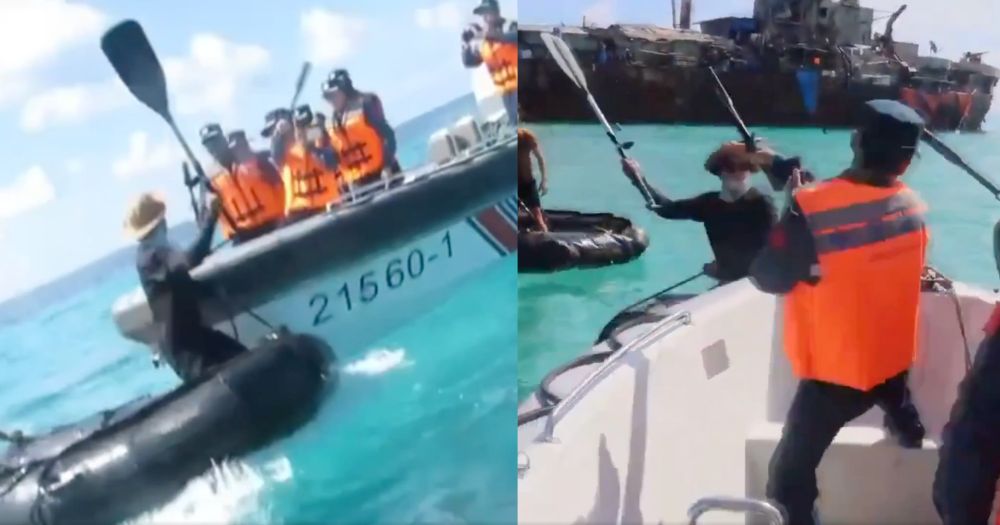
Image via China Coast Guard & Team AFP/X


It would be comical if it weren’t so alarming.
A video, published on Jul. 21, shows a motorboat with several members of China’s Coast Guard (CCG) seemingly approaching the BRP Sierra Madre.
The CCG boat was then intercepted by two inflated rubber motor boats, manned by members of the Philippine Navy (PN).
This meeting got heated, and the two sides came to blows, with CCG and PCG personnel hitting each other with oars and other weapons.
Boating incident
Both China and the Philippines had different interpretations of what had occurred.
ABC reports that the CCG accused the Philippines of deliberately distorting facts by making false accusations.
China Coast Guard claims
The CCG claimed that the vessel was on a routine patrol and that the Filipino rubber boats had approached rapidly, encircled them, and rammed them in a dangerous manner.
It also accused the Philippine military personnel of having initiated the physical attacks by striking CCG personnel with oars, long sticks, and other tools.
Video published by the CCG seemingly showed the PN boats approach them while they were at a stop, but that the CCG boat was in the vicinity of the Filipino outpost on the BRP Sierra Madre.
It showed CCG personnel using a loudspeaker to warn the approaching rubber boat in Mandarin, and the two boats coming together and PN personnel pointing using an oar, while one CCG member appeared to brandish what appeared to be a baton.
The CCG said that its actions were in "accordance with laws and regulations" and included verbal warnings, collision-avoiding manoeuvres, and proportional countermeasures to control the situation on the spot while "exercising maximum rationality and restraint."
Philippine Navy's reply
The Filipino military defended their actions, saying that the Philippine Navy personnel had acted with professionalism and in accordance with their rules of engagement.
The Armed Forces of the Philippines (AFP) said that the deployment of two rubber boats was a measured, non-confrontational effort to direct the CCG vessel away, and that their personnel had not initiated any confrontation.
However, they claimed that the incident escalated after the CCG had ignored repeated instructions to leave and struck a Filipino sailor with a wooden baton.
After this, Filipino troops exercised restraint and defended themselves within established rules, they said.
They also said that the CCG boat had been circling the area around the BRP Sierra Madre, in what the CCG said was a routine patrol, which the AFP said they had no right to patrol.
Video released by the AFP showed the previously mentioned incident from the other perspective. While the PCG member had a raised oar, he did not appear to attack CCG staff, and was swatted at by a CCG member with a baton.
Previous incidents
This most recent incident took place around the Second Thomas Shoal, known as the Ayungin Shoal to the Philippines and Ren Ai Jiao to China.
To strengthen its claim to the shoal, the Philippines ran a vessel, the BRP Sierra Madre, aground on the shoal's reef in 1999, and the vessel has been manned by a contingent of AFP personnel ever since.
The AFP statement referenced a 2024 incident where the CCG, along with People's Liberation Army Navy (PLAN) vessels, had confronted an inflatable boat in an incident that saw a Filipino soldier lose a thumb in the confrontation.
In the video of that incident, a member of the CCG could be seen brandishing an axe.
In that year's edition of the Shangri-La Dialogue, hosted in Singapore, Philippines' President Marcos Jr responded to a question about increasing tensions and aggressive acts taking place in the area.
He said that any incident that ended up killing a Filipino serviceman or citizen, if it was by a "wilful act", that would be "I think, very, very close" to what the Philippines considered an "act of war".
In such a case, the Philippines would respond appropriately, and he believed the Philippines's treaty partners would hold the same standard.
However, Marcos Jr expressed his thanks that a fatal incident had not yet occurred.
Confrontations between the Philippines and China in the South China Sea also escalated to violence in 2025.
In an incident that took place in a different part of the South China Sea, the Scarborough Shoal, a Philippines Coast Guard (PCG) vessel appeared to be pursued by a CCG vessel and a PLAN vessel.
A video taken from the PCG vessel showed the two Chinese vessels shooting water cannons towards the PCG vessel, as well as weaving behind it.
But what appeared to be a miscalculation on the part of the Chinese vessels resulted in the PLAN vessel seemingly chopping the CCG vessel in two.
Competing claims
Both China and the Philippines claim the shoal, with the shoal falling within the 200 Nautical mile exclusive economic zone mandated by the United Nations Convention on the Law of the Sea.
China's claim on the shoal is, on the other hand, a result of its nine-dash-line claim to large parts of the South China Sea, and the shoal is about 600 nautical miles away from China's coastline.
Both the Philippines and China have signed and ratified UNCLOS, but have very different interpretations of how it applies to their claims.
In 2016, the Philippines tried to take China before the Permanent Court of Arbitration, which China said had no jurisdiction and refused to take part in the proceedings.
The court ruled in the Philippines' favour, but China has refused to accept the ruling, repeatedly saying that the ruling is “null and void”, and that the Philippines is under the influence of “certain external powers.”
The South China Sea isn't the only area where tensions over territory have taken place.
In 2020, videos of Chinese and Indian troops fighting with fists and sticks in the Galwan Valley in India's Ladakh region went viral, which left at least 20 Indian soldiers dead.