Abroad


Hantavirus-affected cruise ship MV Hondius passengers disembark in Spanish port of Tenerife
Disembarked passengers will not be allowed to contact members of the public, and are being evacuated using chartered aircraft.
May 10, 2026, 07:16 PM

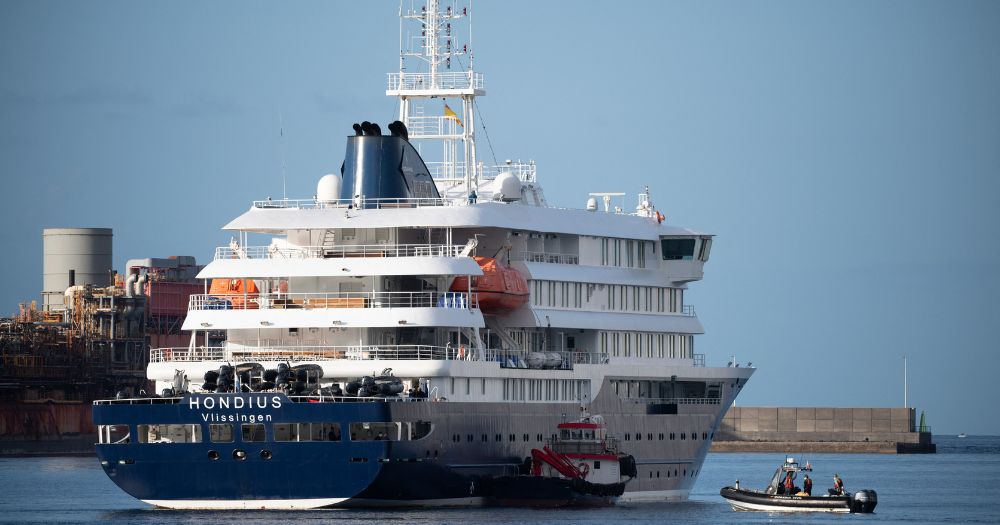
 Passengers aboard the hantavirus-affected cruise ship, the MV Hondius, are beginning to be evacuated from the ship to the Canary Islands, Spain.
Disembark
The ship reached the port city of Tenerife on May 10, according to Reuters, but will not be docking there.
Instead, the roughly 150 passengers and crew will be ferried to shore in groups of five using small boats.
Reuters reports that Spanish nationals will be the first to disembark, and they will be flown to the Spanish capital of Madrid aboard a Spanish military plane.
Government officials have said that the group will have no contact with members of the public.
As a precautionary measure, all passengers on the Hondius have been classified as "high-risk contacts" as a precautionary measure, according to Europe's public health agency.
It also noted that the ship had been inspected by experts who boarded the ship.
The experts were satisfied with the ship's hygiene and environmental conditions, and thus allowed the ship to lay anchor in Tenerife.
They added that they had not detected rodents, the hantavirus is primarily rodent-borne, and "transmission by exposure to rodents on board is not likely."
Evacuation
Other countries, such as the U.S., UK, and other European countries, such as France and Germany, have said that they will send aircraft to evacuate their citizens.
As of the morning of May 10, not all nations’ aircraft have arrived in Tenerife, and local authorities have said that passengers will not be allowed to disembark the Hondius until their allocated evacuation plane had arrived.
The final evacuation flight is expected to be from Australia, and is expected to pick up six passengers from Australia, New Zealand, and other Asian countries.
The remaining 30 crew members will remain on the Hondius afterwards, and sail the ship to the Netherlands, where the ship will be disinfected.
Cruise to nowhere
The Hondius left Argentina at the beginning of April, eventually arriving at the island of Cape Verde on May 3.
In the intervening time, two passengers had died on board, with one dying in South Africa after disembarking with the body of her husband.
All three deaths were later confirmed to be caused by hantavirus, a rodent-borne disease with a very rare history of human-to-human transmission.
The deceased couple had gone on a birdwatching expedition in Argentina prior to the ship leaving, and visited a local landfill, and it has been suggested that they may have contracted the disease there.
The strain of virus has been confirmed to be the “Andes strain”, the only strain to have any recorded history of human-to-human transmission.
A few other passengers disembarked prior to the hantavirus confirmation, and authorities are seeking those individuals out in order to quarantine them.
Quarantine
Two Singaporean residents were on board the Hondius during this time, and flew to South Africa from St Helena with one of the eventual fatalities.
They have since returned to Singapore, and have been quarantined at the National Centre for Infectious Diseases (NCID) where they have tested negative for hantavirus.
They will continue to be quarantined for a further 30 days after last exposure, and tested again before being released.