News


S'porean commentators reject notion M'sia was target of Strait of Hormuz parliamentary statement
Neither country has commented on the comments.
April 10, 2026, 02:57 PM
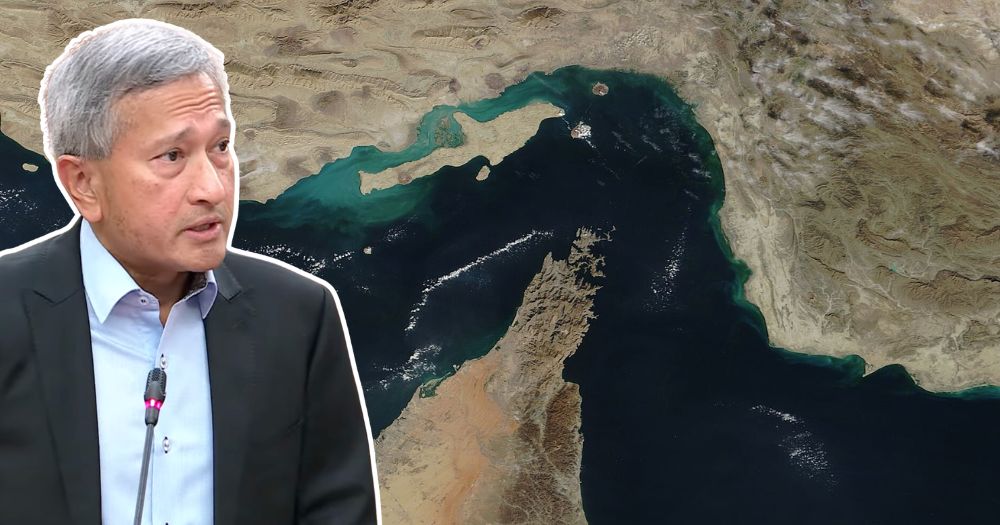


Remarks by Foreign Minister Vivian Balakrishnan in Parliament—that Singapore would not negotiate for safe passage through the Strait of Hormuz—have sparked reactions on both sides of the causeway.
Vivian had described at length Singapore’s position (Apr.7) that negotiating for safe passage through the Strait of Hormuz, as doing so would undermine fundamental principles of international law
He stated Singapore considered the right of transit passage and freedom of navigation to be a right, not a privilege for ships and planes, and this interpretation was "of profound importance to Singapore".
As a result, Vivian explained that although he had spoken to his Iranian counterpart before the crisis, and expected to do so again after it had ended, Singapore could not engage in negotiations for safe passage or on toll rates.
"To do so would be implicitly eroding this legal principle."
Reactions
Nurul Izzah Anwar, Deputy President of one of Malaysia’s governing parties, Parti Keadilan Rakyat (PKR), has critiqued Singapore’s position regarding the ongoing Strait of Hormuz Crisis.
Nurul Izzah, who is also the eldest daughter of Malaysia’s incumbent Prime Minister Anwar Ibrahim, published the media statement on PKR’s website on Apr. 9, as well as its social media platforms.
Nurul Izzah’s media statement said Vivian’s parliamentary speech was a "refusal to engage in negotiations with Iran concerning safe passage through the Strait of Hormuz" and characterised it as "both revealing and regrettable".
She said that the position did not reflect prudence, but a narrow strategic posture that prioritises alignment over regional responsibility and international law.
Nurul Izzah was writing in her capacity as a party leader in PKR, having lost her seat in the previous general election, and does not currently hold any governmental-level positions in Malaysia.
Her comments focused on Malaysia's decision to engage with Iran, stating that the Malaysian Prime Minister, her father Anwar Ibrahim, had chosen dialogue as it was felt that "disengagement invites escalation", and that the Malaysia position was to focus on Iran, which she said was the "target of war crimes", and that its "control on the straits (sic) are an attempt to seek a durable peace."
Nurul Izzah said the Malaysian government was engaging in diplomacy as a way to safeguard regional stability, energy security, and "the broader interests of Southeast Asia".
Articulating Singapore's position
Mothership spoke to Joseph Liow, Dean of the Lee Kuan Yew School of Public Policy, who said that it was unlikely that Vivian was referring to Malaysia directly, as many countries had spoken to Iran regarding transit for their ships.
He acknowledged that while the question initially asked by Workers' Party (WP) Member of Parliament (MP) Fadli Fawzi had mentioned Malaysia, Vivian's response, which occurred nearly 2 hours later because of how Speaker Seah Kian Peng had arranged parliamentary questions, did not mention Malaysia at all.
Liow said that the reality of international affairs meant that Malaysia was "entitled to pursue whatever means it deems necessary to secure its interests".
As Liow saw it, Vivian "only wanted to articulate Singapore's position" with regards to the situation in the straits.
It was necessary, Liow said, "to understand that context, and not be drawn into the politics of it."
Liow also said that while there were obviously some differences, it should not be forgotten that "as far as the importance of the international nature and character of the straits are concerned, I think both countries are very much on the same page".
Reactions to reactions
Nurul Izzah’s reaction is just one of a few surrounding that of Vivian's remarks.
Former NMP Calvin Cheng's reaction was reacted to by Democratic Action Party (DAP) Vice President and Member of Parliament (MP) Syahredzan Johan.
Syahredzan felt that Cheng's response had referenced Malaysia, although Cheng later stated that his own reaction had not referenced Malaysia.
Syahredzan's remarks did not reference Vivian's comments other than stating that "we respect Singapore's position in this conflict".
The comments by Malaysian politicians in turn garnered reactions on the Singaporean side.
Former Member of Parliament (MP) Irene Ng had first given a reaction to Vivian's speech, saying that she was glad to note "that Singapore continues to be consistent in its diplomatic posture: upholding international law, being careful not to be caught up in the great power struggles and ethno-nationalist conflicts around the world,"
Ng, during her time in Parliament, was a member of the Government Parliamentary Committee (GPC) for Foreign Affairs and Defence.
When noting Nurul Izzah's statement, she called for those on either side of the Causeway to "please cool it", as Southeast Asian governments needed to work together to ensure the region remained an "oasis of peace and progress", adding that her words were directed at Singaporean commentators too.
At the time of writing, neither Singapore’s Ministry of Foreign Affairs nor a Malaysian government entity has publicly addressed the comments.
Image via Wikipedia & MDDI/YouTube