Court


'Disappointing' that a journalist could write in such a manner: Tan See Leng on Bloomberg article
The two ministers had previously filed lawsuits on Jan. 6, 2025, against Bloomberg and Low De Wei over the article.
April 10, 2026, 09:41 PM
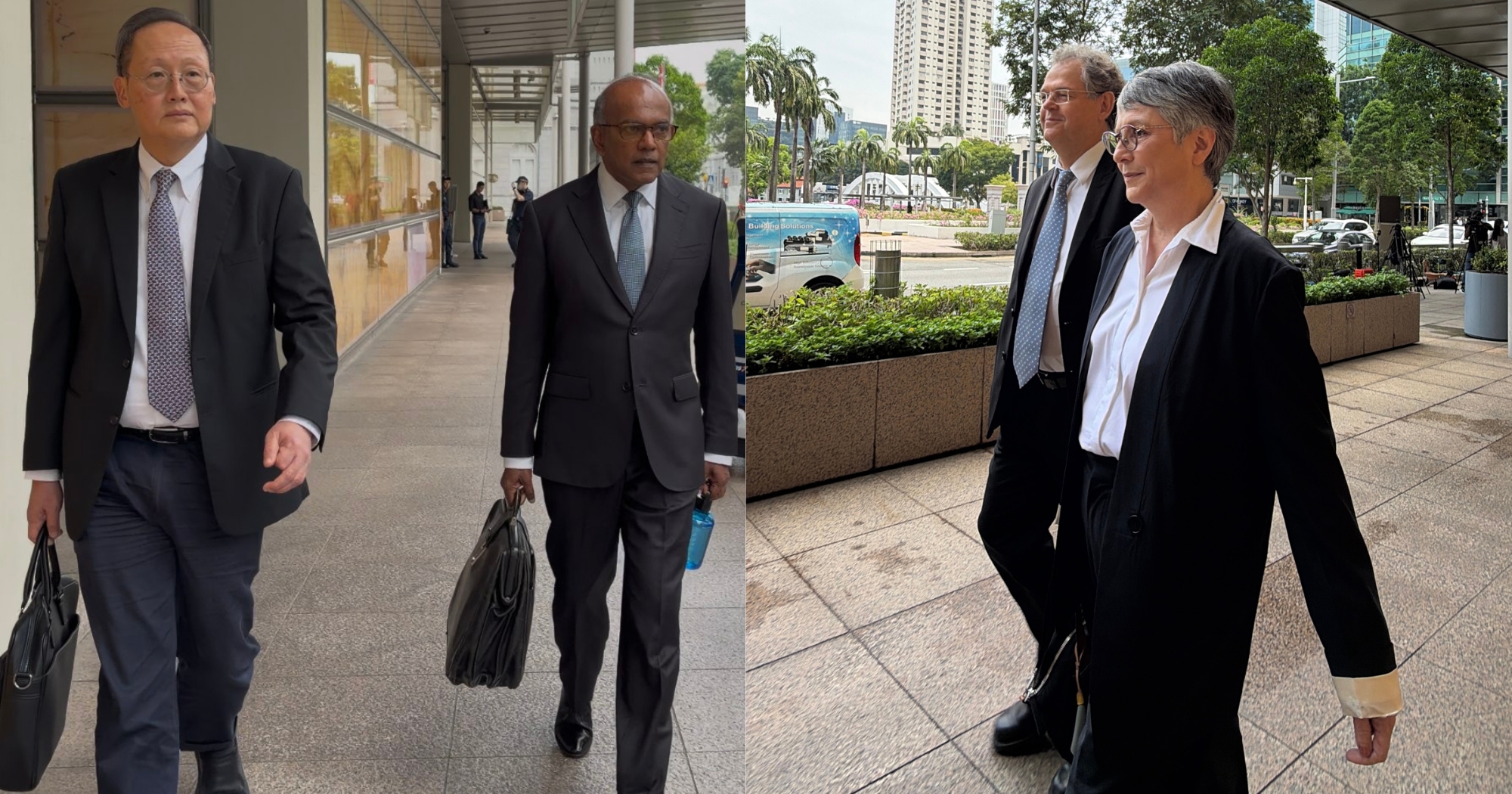


Saying it was "disappointing" that a journalist could "write in such a manner", Manpower Minister Tan See Leng told the court on Apr. 10, 2026 that he felt the Dec. 12, 2024 Bloomberg article, "Singapore Mansion Deals Are Increasingly Shrouded in Secrecy", had targeted him.
Tan took the stand on the fourth day of the civil suit trial.
Tan and Home Affairs Minister K Shanmugam sued Bloomberg and one of its reporters, Low De Wei, over the article.
Disappointment
Responding to Senior Counsel Sreenivasan Narayanan, who represents Bloomberg, Tan said he too believed he had been targeted when asked whether he agreed with Shanmugam’s position that the article was aimed at him.
Tan added that his disappointment stemmed from the fact that the journalist was writing for such a reputable agency, Bloomberg, "whom I have always respected all this while", he said.
The article in question, which focused on Good Class Bungalow (GCB) transactions in Singapore, referred to Shanmugam's S$88 million sale of his GCB in the Queen Astrid Park area and Tan's purchase of a Brizay Park GCB for almost S$27.3 million.
Article in question
The two ministers had previously filed lawsuits on Jan. 6, 2025, against Bloomberg and Low over the article.
Shanmugam said in court on Apr. 8, 2026, that it was a "lie" that Bloomberg's article about Good Class Bungalows (GCBs) was not targeted at him.
The ministers are of the view that the article was defamatory, arguing it falsely implied they had taken advantage of a lack of transparency in property transactions in Singapore to act non-transparently, and to hide their transactions from scrutiny, including over the possibility of money laundering.
'Rich individual'
Tan argued that when the article mentioned uncloaking the "secrecy of the rich", it must be referring to him.
Sreenivasan, during cross-examination, later asked Tan if he was concerned about being positioned as a "super privileged" and "rich" individual, to which Tan said "no".
Variety of opinions
Following this, Tan was released from the stand after answering questions from both sides.
Bloomberg's senior executive editor Madeleine Lim next took the stand, where she explained that newsrooms operate in a way where story ideas and tips get "tossed around", and that stories evolve over time with input from a variety of opinions.
This was in response to Senior Counsel Davinder Singh, who represents Tan and Shanmugam, asking Lim during his cross-examination of her about the emails exchanged within the Bloomberg team that discussed writing about Shanmugam's sale of his house a year after the transaction.
Singh noted that this case is about the article having "defamed" the claimants, and had "named and shamed" them.
To this, Lim agreed that they had been "named", but disagreed that they had been "shamed".
She said: "We write about wealthy people, that is what we do."
"We wanted to be fair and accurate. Shaming is not what we do," she added.
The court also heard that another Bloomberg editor had asked via email if the newsroom was "OK with the tone" and if the article had a "bias against rich Chinese".
The other editor had also asked if the story could be put past lawyers first.
Lim said in response that she did not know why the editor had framed it that way.
Singh countered that Lim had previously been certain that some emails were immaterial to the case, but she was now unsure if this email was material to the case.
Paywall
Following publication of the article in question, Bloomberg received a Protection from Online Falsehoods and Manipulation Act (POFMA) correction order.
Lim pointed out that removing a paywall for the mobile site was a "straightforward" way to allow all readers, not just subscribers, to view the correction notice in its entirety, including the link to the Singapore government's Factually article.
However, taking down the paywall had nothing to do with it being an easy option, Singh said, arguing that it was instead about publishing the article as widely as possible.
In doing so, "Bloomberg aggravated the libel", Singh said.
Lim disagreed.
Singh also argued that removing the paywall was so that Bloomberg "could tell the world" that it was challenging the Singapore government's position.
Lim again disagreed with the characterisation.
Lim's affidavit stated that the paywall was lifted to comply with the correction directions.
She testified that the notice was not visible as the paywall would cut most of it off.
The trial will resume on Apr. 13, 2026, with Sreenivasan re-examining Lim.
Related articles
Top photos by Khoo Wen-en/Mothership