


Explainers


Thailand goes to the polls again on Feb. 8: what you need to know
Old and new faces on the cards.
February 06, 2026, 05:32 PM

 Thai voters will go to the polls on Feb. 8 to vote on who will next run their government, and in turn choose their next prime minister.
In case you're not caught up on how we got here, or what to expect, here's a quick and easy cheat sheet on what you need to know.
Who's running?
Three main blocs are competing for control of parliament, all of whom have at some point held power in Thailand.
Bhumjaithai Party
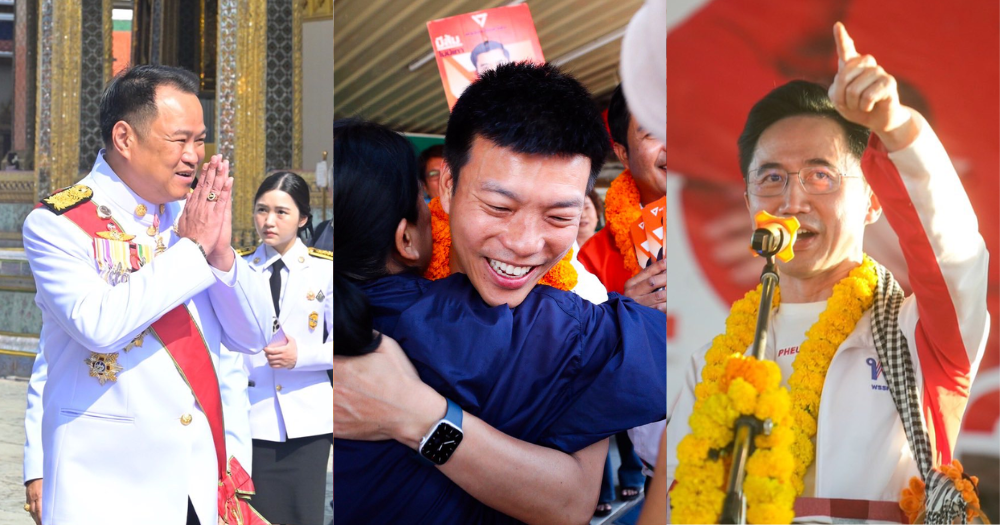
Bhumjaithai is home to incumbent prime minister Anutin Charnvirakul, who dissolved parliament and called for a snap election in December 2025, just three months into his term.
It is the third largest party in parliament and former coalition partner of the Pheu Thai party, which Anutin replaced following the ousting of former PM Paetongtarn Shinawatra.
It holds 71 out of 500 seats in parliament.
A nationalist and military supporter, Anutin gained the position of PM in September 2025 after securing the backing of the People’s Party, the main opposition and parliament’s largest party, to form a minority government.
He successfully persuaded a number of highly influential politicians to defect to him, including Varawut Silpa-archa, son of former prime minister Banharn Silpa-archa, who walked away from his own family's party.
Known as the "Cannabis King", Anutin's term was marked by his support for the drug’s decriminalisation, which has seen moves to walk back those efforts in recent years.
His short months in power also saw back-and-forth re-escalations of the Thailand-Cambodia border conflict, which he notably took a hardline on.
"I promise you I will protect our soil with my life," he once told a crowd at a rally in Bangkok, according to BBC.
"If you want a prime minister the enemy cannot intimidate, choose my party."
His decision to call for an election to secure a four-year mandate was seen by some as a "gamble", betting on his incumbency and momentum from the country's realignment.
Pheu Thai Party
The populist Pheu Thai Party is Thailand's "legacy" party, with 141 seats, having largely dominated Thai politics in the last century and homed three former prime ministers from founder Thaksin Shinawatra's family.
The second largest party in parliament and once an ally of Anutin's Bhumjaithai, it has been in government as the majority leader in the ruling coalition since 2023.
Its later years have grown increasingly rocky, however, in an evident fade of influence.
Thaksin's deposing and exile was followed by a number of his successors being ousted from power, including his sister Yingluck Shinawatra's own arrest and exile, and Srettha Thavisin's removal by the constitutional court.
Thaksin's daughter, former PM Paetongtarn Shinawatra, was similarly removed from power following her now-infamous phone call with Cambodian former prime minister Hun Sen during the Thailand-Cambodia conflict.
Yet the Shinawatra family's influence continues this election, with Thaksin's nephew Yodchanan Wongsawat, 46, taking the helm of his family's legacy as one of the party's three candidates for PM.
People's Party
The third major bloc in this election is the People's Party, which, being founded in 2017, is the youngest in the competition.
But its shorter history in politics in comparison to its rivals does not appear to have mattered, as its previous incarnation, the Move Forward Party, won the majority of votes and seats, 151, in the 2023 general elections.
Despite previously being blocked from forming a government and later being dissolved by the constitutional court, the People's Party, according to opinion polls, is Thailand's most popular party.
The "orange movement" is the face of reform and progressiveness, with its mastery of social media drawing a huge appeal among younger voters.
An economics professor at Thammasat University told the BBC that he believes the party to be the only one thinking long-term, instead of only about what is needed to win the election like its competitors.
Despite the party's strong performance in 2019, its founder and former leader, Thanathorn Juangroongruangkit, was disqualified as an MP for owning media shares while running as a candidate.
His loan of 191 million baht (S$7.7 million) led to several party members getting banned from political office for 10 years.
But this only ignited large-scale student protests that same year, with calls for reform of the monarchy for the first time.
The party's victory in the 2023 election proved that public hunger for change had grown larger, said BBC.
First past the post and party list
Something to know about Thai elections is that there are two different types of seats up for grabs.
The first is a straightforward first past-the-post-system that Singaporeans will be used to, where the politician who wins the most votes in a constituency will be its representative; about 70 per cent or 350 seats are decided this way.
The remaining 150 seats are decided through party lists, where seats are divided by a proportion of the total votes cast in the election, regardless of whether a voter's choice wins in their constituency.
What the polls are predicting
Surveys indicate that the People's Party has lost little of its momentum since 2023, according to Reuters.
With the backing of 36 per cent of surveyed respondents in a Jan. 16-28 poll, it appears set to claim another victory in the upcoming elections.
But the BBC reported that the Thais are expecting yet another move by the constitutional court to block the party should they win, preventing them from forming a government again.
"They are afraid of us," Thanathorn told the news outlet.
"They are afraid of change. They want tomorrow to be just like yesterday. They think dissolving our parties, banning our leaders from politics, would make us smaller. In fact, we are getting bigger."
Natthaphong Ruengpanyawut, 38, the party's current leader and face for the role of PM, said he believes that the political landscape is shifting in their favour, CNA reported.
The party's leaders also said that they are recalibrating further from the streets and aim to grow into a more mature party that can attract the votes and trust of the entire party.
Meanwhile, the Pheu Thai party and Bhumjaithai, who had 22.1 per cent and 18.9 per cent of support from the same survey, are also gearing up to attract young urbanites with fresh faces, according to CNA.
Pheu Thai, however, seems to be sticking to its brand of populism with cash handouts and a declaration of "war on poverty", including a promise of one million baht (S$40,152) to nine Thais each day.
Bhumjaithai also appears to be doubling down on its nationalist elements, drawing upon the ongoing conflict with Cambodia to emphasise its name, which translates to "Proud to be Thai".
To form a majority government, a party would have to secure 250 of 500 seats in parliament.
The vote of prime minister, meanwhile, will only be by the lower house of 500 members of parliament, with the senate no longer taking part in the PM's selection, unlike in 2023.
Top images via Anutin Charnvirakul/Facebook, Natthaphong Ruengpanyawut/Facebook & Yodchanan Wongsawat/Facebook