



News


Japan's new beat - What you need to know about Japan's Feb. 8 snap election
Will Sanae Takaichi take her party from low point to landslide?
February 07, 2026, 08:57 AM

 Japan goes to the polls again on Feb. 8, the second snap election in a row for Japan.
Incumbent Prime Minister Sanae Takaichi, in power for just over 100 days, hopes to build on her personal popularity in order to buoy her unpopular party, the Liberal Democratic Party (LDP).
The timeline
Japan's leadership has moved on from the eight years of stability enjoyed under the late Shinzo Abe, to having three PMs in five years, as the ruling LDP suffer from numerous political scandals.
Abe was succeeded by Yoshihide Suga, Fumio Kishida, and Shigeru Ishiba, with Kishida the only one able to last substantially longer than a year.
The LDP lost its parliamentry majority in a 2024 snap election called by Ishiba, and that coupled with disastrous upper house elections, resulted in his resignation.
This paved the way for Sanae Takaichi to the first woman to hold Japan’s Prime Minister’s office in October 2025, winning an internal LDP competition.
But after 100 days in power, Takaichi has defied the odds, with high personal approval rates despite the LDP's remaining uppopular.
Takaichi has decided to take advantage, and called for snap elections on Jan. 19.
Who’s important?
Sanae Takaichi
Takaichi is a protege of the late Abe, and has adopted several of his stances: boosting national defence, aggressive spending to revitalise Japan’s economy, and a more muscular foreign policy.
Bloomberg spoke with her peers, who describe an assertive, ideologically conservative, but diligent politician, with a “near-obsessive attention to policy detail” from a working-class background.
Takaichi recognises the need for Japan to make “bold investments to rebuild” a stagnant economy, but some have branded her rhetoric as being hostile to foreigners, to the point of being xenophobic
She is as assertive in her foreign policy as she is in economic policy, clearly articulating a need for a stronger national defence establishment, as her mentor Abe did.
She has also renewed the Japan-U.S. alliance, literally embracing U.S. President Donald Trump, despite his "America first" policy threatening to freeze out key allies.
China relations
She has not shied away from controversial statements, and in November said that an attack on Taiwan by China could trigger a military response from Japan.
China did not take kindly to the statement, demanding a retraction, and when not satisfied, it has taken steps to limit trade and reduce Chinese tourism to Japan, recently further cutting the number of flights from China to Japan.
But rather than affecting her popularity, she has defied expectations, with unusually high personal and government approval rates in the sixtieth percentile.
It is particularly high with Japan’s youth, with the Japan Times reporting that young Japanese voters have been taken with both her savvy approach to social media and her policies.
The Liberal Democratic Party
Takaichi’s party, however, is nowhere close to as popular as its leader. At the end of 2025, its approval rating was hovering in the 20th percentile.
It currently holds 199 of the 465 seats in Japan’s parliament.
Bloomberg reports that despite Takaichi’s popularity with the youth, many see the LDP as one dominated by older politicians.
However, the LDP is seen as the “natural” party of government, having ruled Japan since 1955, with the exception of two occasions of about six years in total.
The Japan Innovation Party (Ishin)
Ishin is the LDP’s right-wing coalition partner, which took up the role vacated by the Komeito party in 2025.
With 34 seats, it allows the LDP-Ishin coalition to maintain a one-seat majority in parliament.
It is expected to maintain its coalition with the LDP past this election, but there are worries that it might split the vote and allowing opposition parties to claim seats.
Centrist Reform Alliance
The CRA represents the main opposition to Takaichi’s government, and is a coalition between the mainly centre-left Constitutional Democratic Party and the centrist former LDP ally Komeito.
The CDP is a pacifist party, opposing moves by the LDP to reform Japan’s anti-war constitution, and is led by a true rarity, one of the few non LDP PMs of Japan, Yoshihiko Noda.
Komeito similarly opposes constitutional changes and favours welfare policy targeting lower-income households.
It quit a coalition with the LDP in 2025 due to dissatisfaction with the LDP's handling of political scandals, and joining the CRA has cemented the schism.
The CDP holds 148 seats in parliament, and Komeito holds 24, for a total of 172.
Whisper it quietly: “Landslide”
What began as a surprise and uncertain snap election may be a masterstroke by Takaichi.
Media outlets analysing polls no longer ask if the LDP and partners can take back a majority in parliament, but if they can win a supermajority, which would enable them to circumvent a hostile upper house more easily.
Takaichi’s positions and youth support appear to be sapping support from more right-wing parties, such as the foreigner-hostile Saneito party, which made a splash in 2025 with an outstanding upper house election performance.
Polling by the Asahi Shimbun indicates that the LDP coalition might be able to win more than 300 seats, with the LDP possibly hitting that number alone.
If it does so, it might be able to surpass the 310 two-thirds majority threshold.
Impact
A renewed mandate for a Japanese PM will have an outsized impact on Asia, including Southeast Asia and Singapore.
At its most basic level, Japan is one of the most popular tourist destinations for Singaporeans, with nearly 700,000 Singaporeans travelling there in 2024, and a similar number of Japanese visiting Singapore.
Senior Minister Lee Hsien Loong spoke at the Expo 2025 Osaka, lauding Singapore-Japan relations, saying both were amongst each other's top 10 investors, and that Singapore was Japan’s top investor in 2023.
Singapore and Japan are partners both at a bilateral level, with 2002’s Japan-Singapore Economic Partnership Agreement, but also at several multilateral agreements such as the CPTPP, which Japan salvaged after the failure of the TPP, a trade deal that Singapore, and SM Lee himself, advocated strongly for.
An economically sound Japan is clearly in Singapore’s own interest, but there surely must be worries if Japan-China ties continue to worsen.
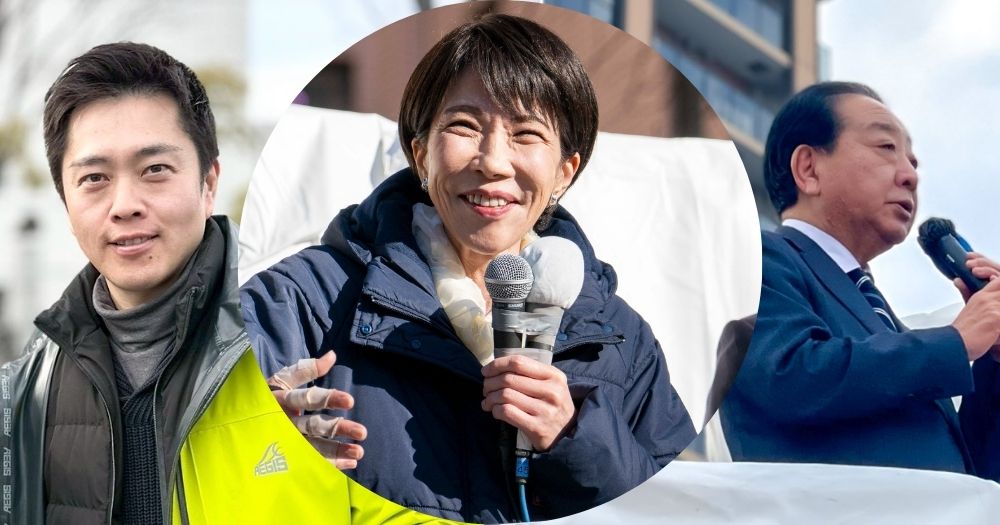
Top image via Sanae Takaichi/X, @hiroyoshimura/X & Yoshihiko Noda/X