News


Total lunar eclipse on Mar. 3, 2026: S'pore Science Centre to host free viewing
The eclipse will coincide with the 15th day of the Lunar New Year.
February 06, 2026, 06:02 PM
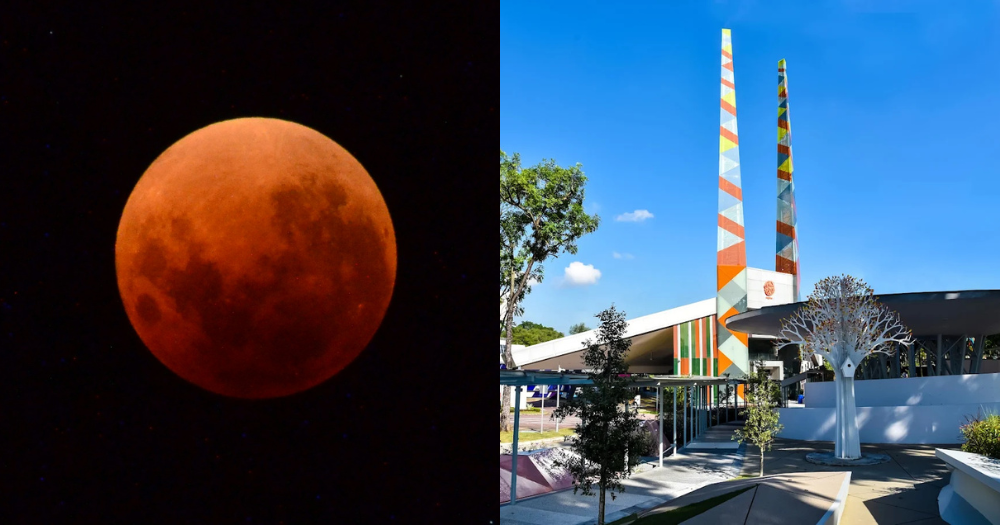


Mark your calendars for Mar. 3, 2026: a total lunar eclipse will be visible in the night sky from Singapore, offering a celestial spectacle not to be missed.
This eclipse will be the last one visible worldwide until Dec. 31, 2028, and to make things more special, it will coincide with the 15th day of the Lunar New Year.
Free viewing session at Science Centre
Science Centre Singapore will be hosting a free, expert-guided public viewing session from 7:30pm to 9:30pm.
Visitors can also look forward to high-powered telescope viewing, live commentary by astronomy educators, planetarium shows, and a line-up of family-friendly activities.
The event is open to the public on a first-come, first-served basis.
Pre-registration will open on Feb. 20 at this website, while onsite registration will begin at 6pm at the Science Centre’s main entrance on the day itself.
A total of 15 telescopes offering 30x magnification will be available for the public to use, with additional telescopes to be set up progressively as the moon rises.
Live screens set up along the queue lines will also project the eclipse in real-time, accompanied by commentary from Science Centre educators.
If you can't make it, fret not as a livestream of the eclipse will be available on the Science Centre Singapore’s YouTube channel.
Visitors can also opt for a special S$4 bundle, which includes telescope viewing and a live planetarium show at the Omni-Theatre.
Showtimes are scheduled for 5pm, 5:40pm, 8:10pm and 8:50pm.
Beyond the eclipse, visitors can expect to see constellations, such as Taurus, Orion, Canis Major and Gemini and even planets — Jupiter is expected to be visible till late evening, while Saturn can be spotted in the western sky until around midnight.
What is a total lunar eclipse?
According to The Observatory at Science Centre Singapore, a lunar eclipse occurs when Earth moves directly between the sun and the moon, casting its shadow across the moon’s surface.
This differs from a solar eclipse, which happens when the moon passes in front of the sun, briefly blocking its light.
A total lunar eclipse, which is what will be taking place on Mar. 3, will see the moon becoming fully immersed in Earth’s umbra — the darkest part of its shadow.
As sunlight filters through Earth’s atmosphere, shorter wavelengths like blue are scattered, allowing warmer red and orange hues to illuminate the moon.
The more dust in the atmosphere, the deeper the reddish glow.
The eclipse happening that Tuesday is expected to occur from moonrise at 7:15pm till 9:17pm, when the partial phase ends.
The best viewing window from the Science Centre would begin at 7:47pm.
You can take a look at the key timings here:
- 7:15pm: Moonrise
- 7:33pm: Maximum eclipse; the moon will be very low on the horizon, requiring a clear, unobstructed view
- 7:47pm: Fully eclipsed moon visible from the Science Centre
- From 8:02pm: Moon gradually brightens as it exits Earth’s inner shadow
- 9:17pm: Full visibility of the moon returns as it moves through Earth’s penumbra
Top photo from Unsplash and Google Maps