News

4 unidentified coffins unearthed at construction site behind KKH, LTA looking for next-of-kin
The area where the coffins were found used to be a Christian cemetery.
December 05, 2025, 12:13 PM
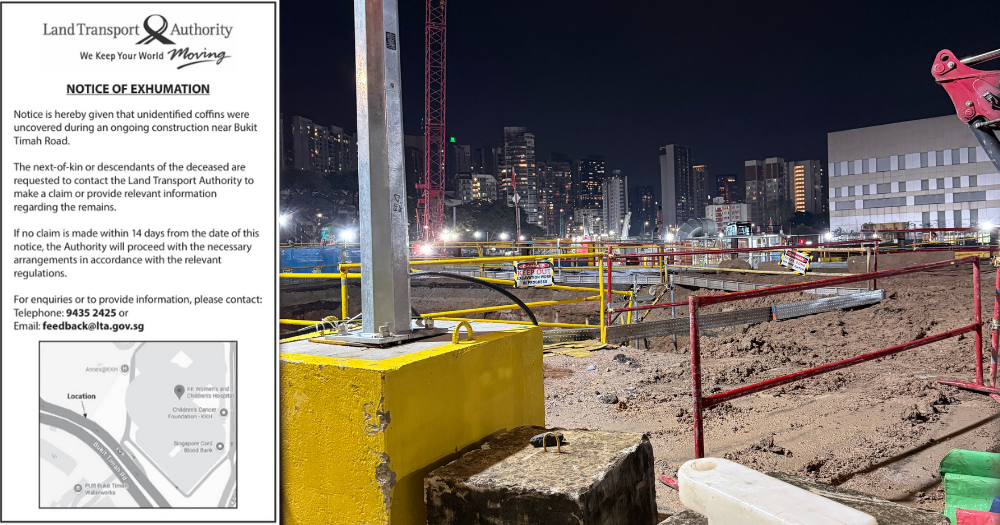


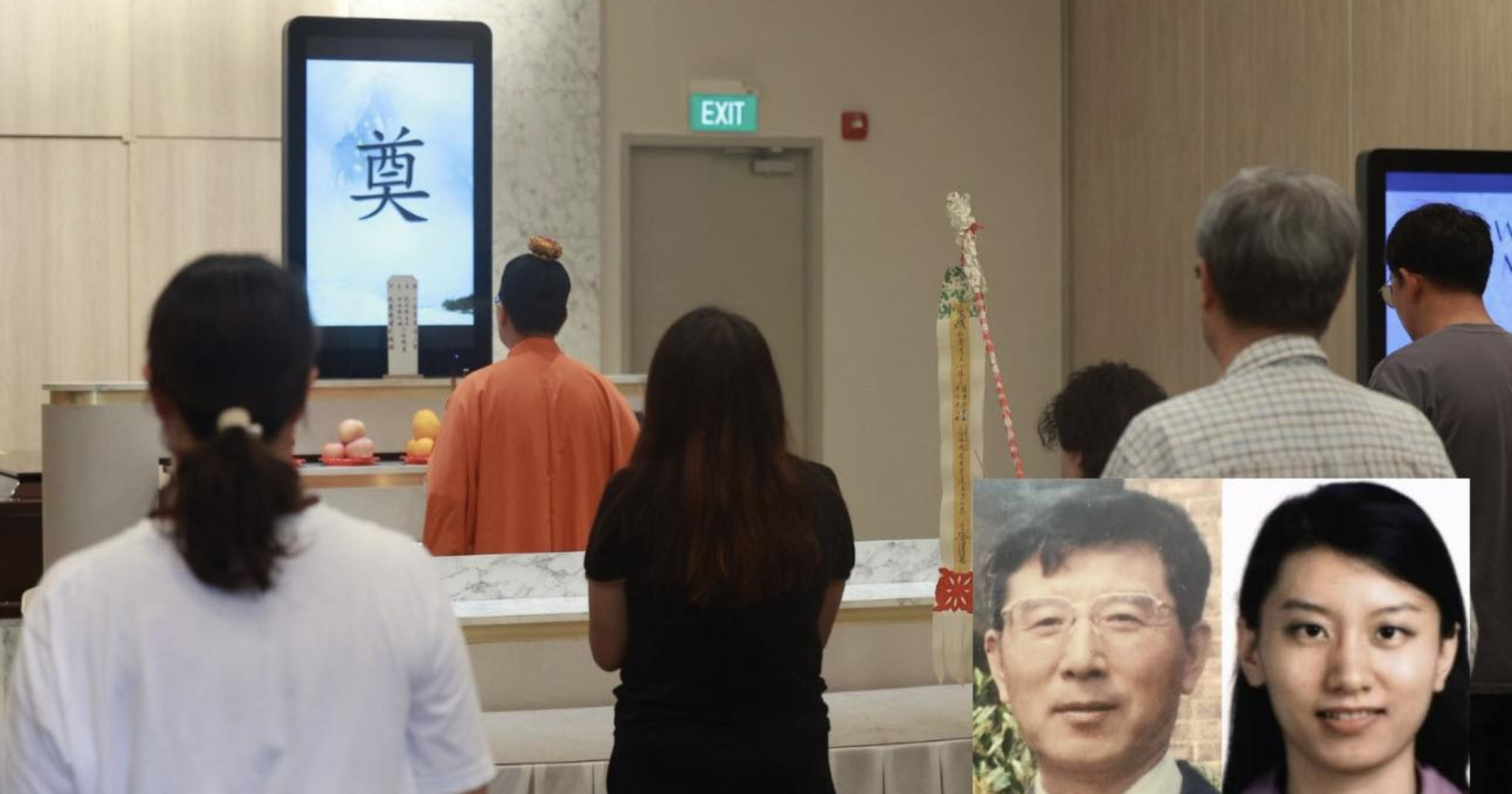
Four coffins without tombstones were unearthed in October and November 2025 at an ongoing construction site near Bukit Timah Road, behind KK Women's and Children's Hospital (KKH).
The discovery was shared by the Land Transport Authority (LTA) in a Notice of Exhumation and published in The Straits Times's Classified section on Dec. 3.
Four coffins discovered
In the notice, LTA informed the next-of-kin or descendants of the deceased to contact them to make a claim or provide relevant information regarding the remains.
LTA said it will proceed with necessary arrangements, in accordance with relevant regulations, if no claim is made within 14 days of the notice.
 Screenshot via The Straits Times.
Responding to queries from Mothership, LTA confirmed that a total of four coffins without tombstones were uncovered.
LTA said it has since filed a police report.
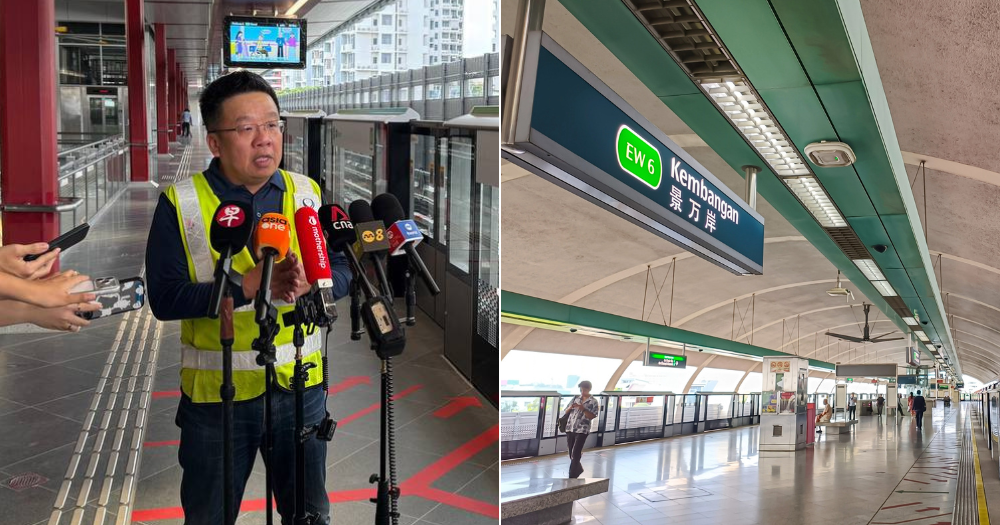
The construction site where the coffins were found is part of the North-South Corridor development, where a tunnel is being built.
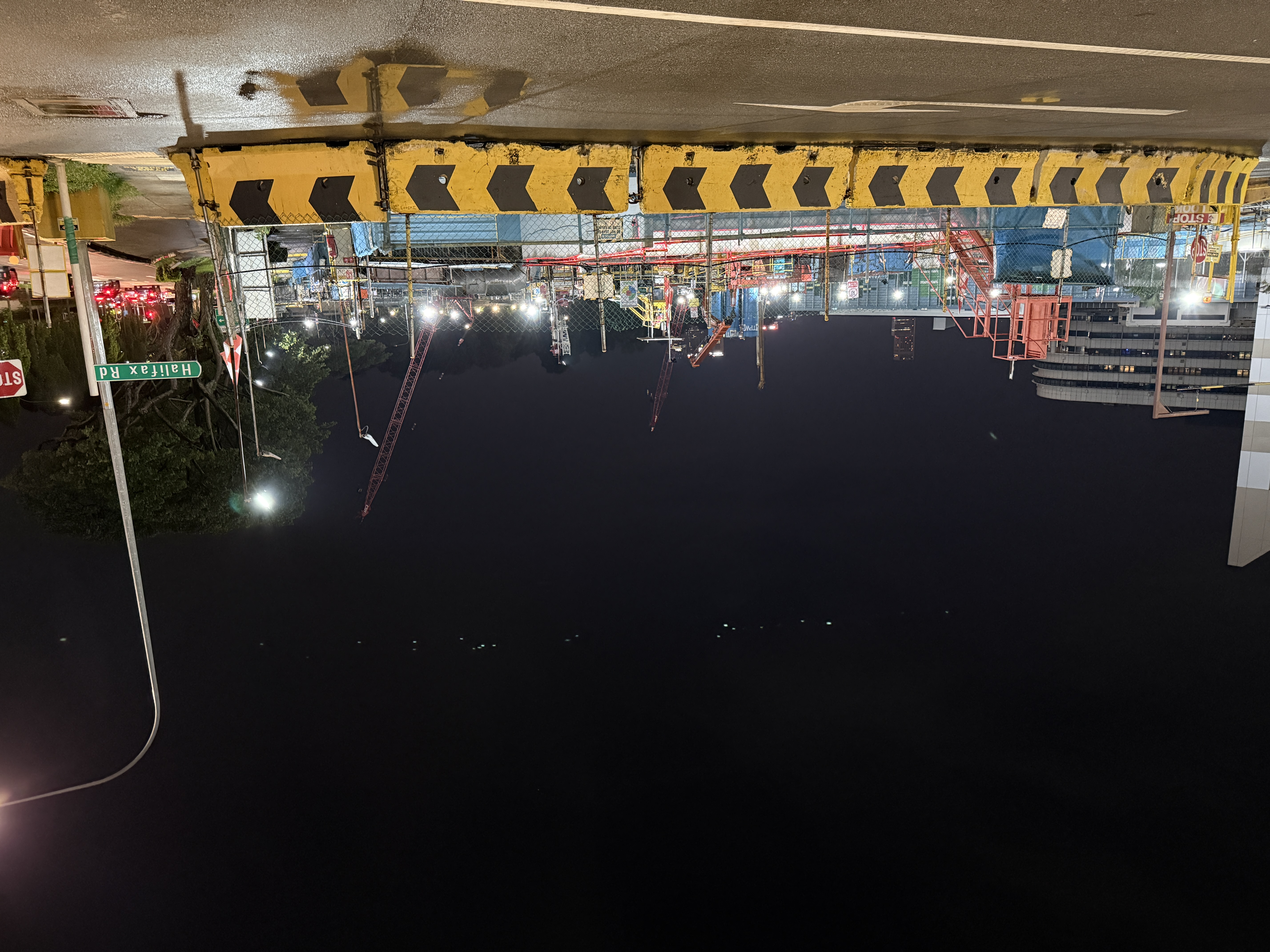 Photo via Mothership.
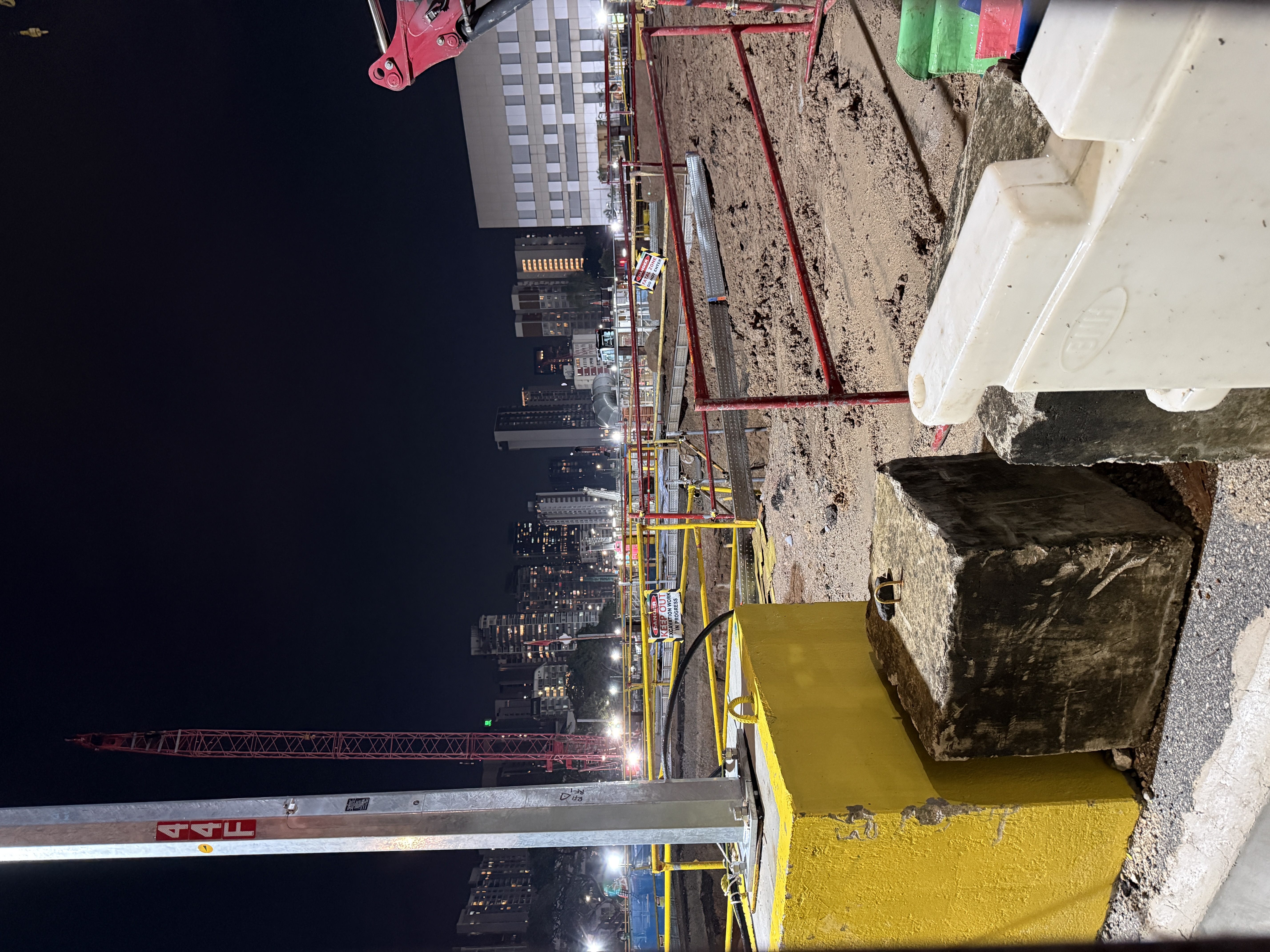 Photo via Mothership.
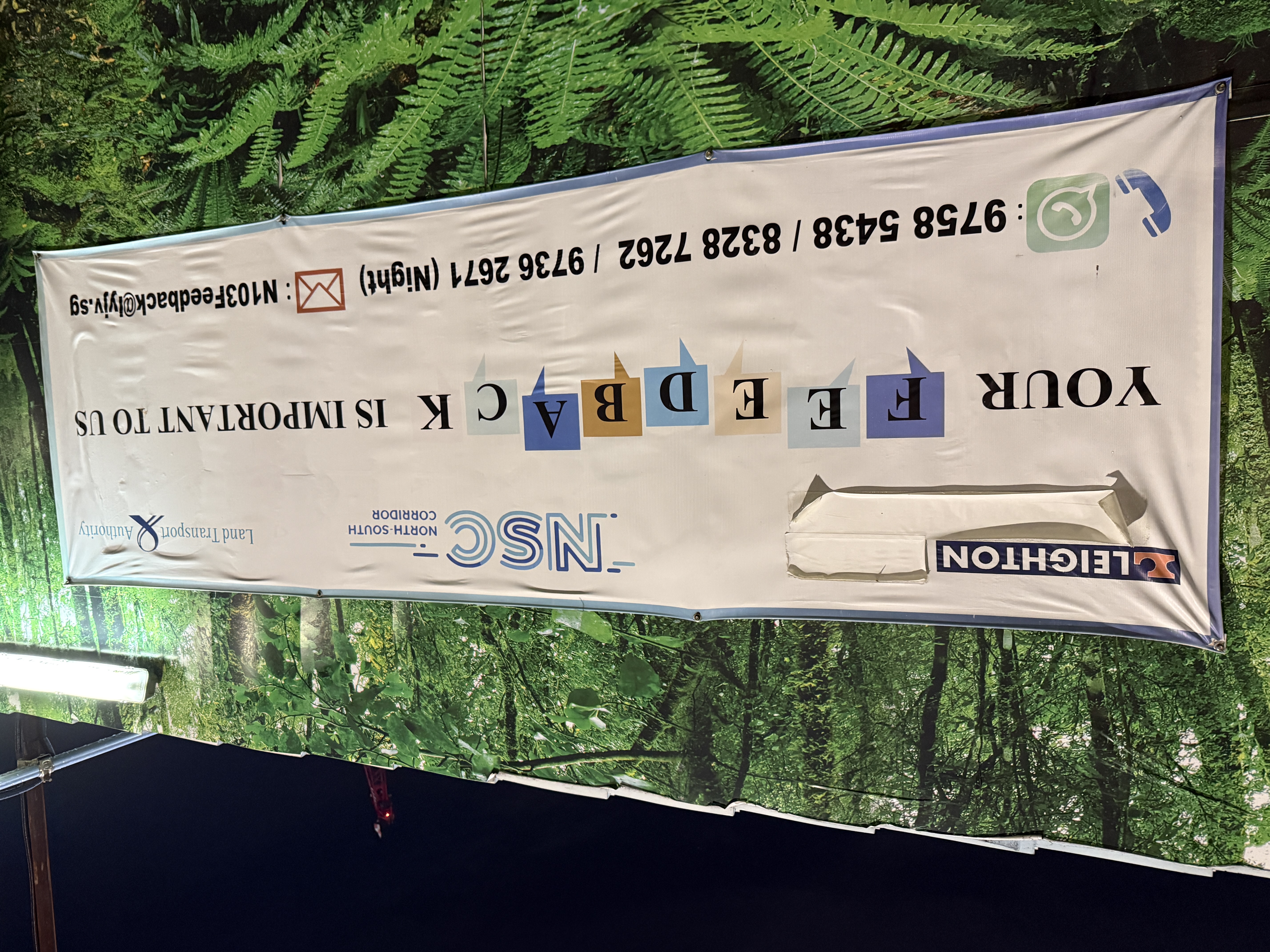 Photo via Mothership.
Construction site was cemetery over 50 years ago
A heritage enthusiast has since proposed a theory as to how the coffins got there.
Peter Pak, who runs "Rojak Librarian", a blog focusing on the history of Bukit Brown, pointed out in a post that the area where the coffins were found used to be a Christian cemetery.
Historical maps corroborated the theory, Pak posited.
Maps from 1913 and 1932 showed a "Christian cemetery" in the area enclosed by Kampong Java Road, Bukit Timah Road, and the former New Cemetery Road, which is now part of the Central Expressway.
Part of this cemetery spilled over to the other side of New Cemetery Road.
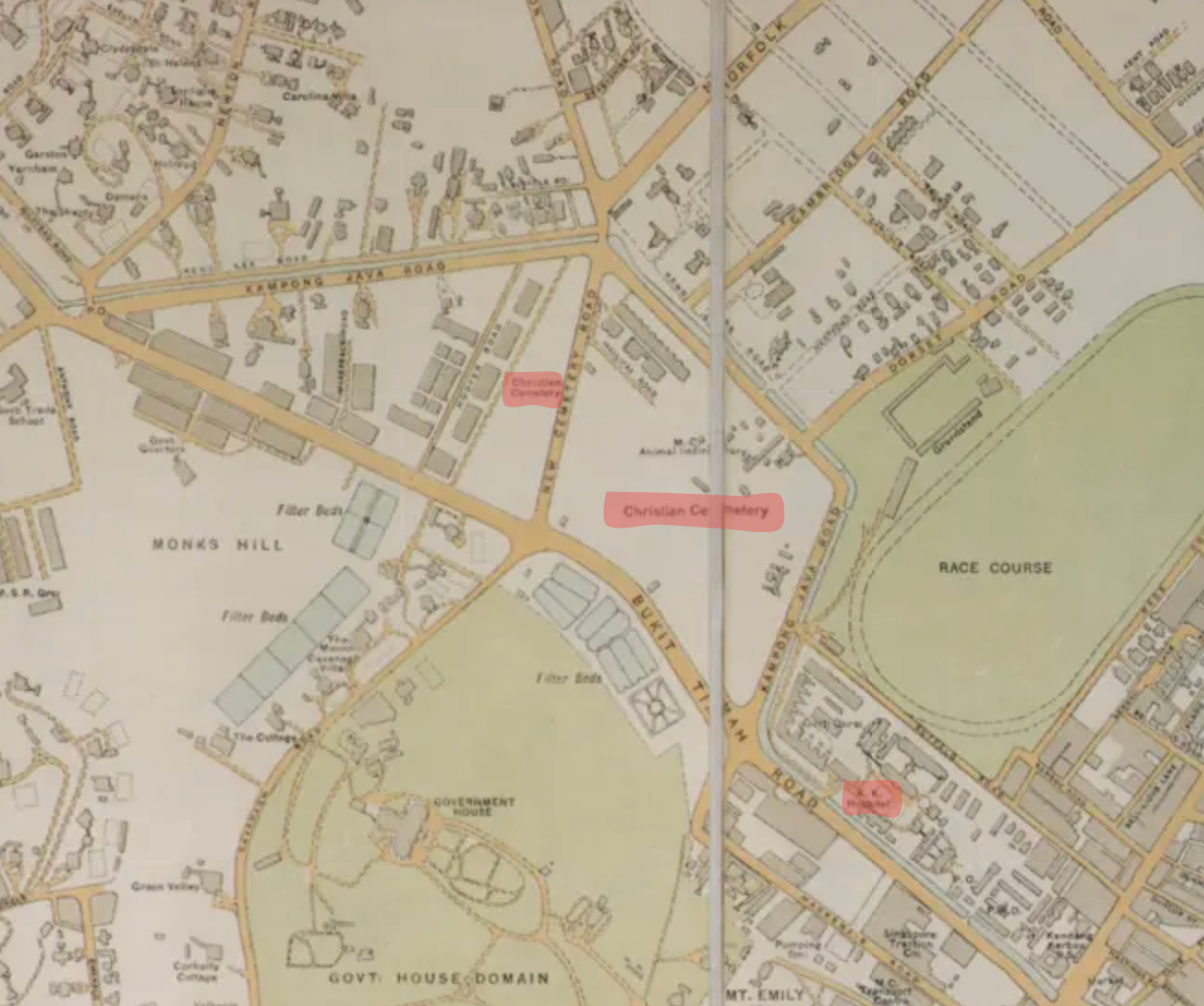 Screenshot via NUS Libraries.
Cemetery opened in 1865
In the introduction to a 2011 book, "Spaces of the Dead: A Case from the Living", Kevin Tan, adjunct professor of law at National University of Singapore, briefly detailed the history of this Christian cemetery at Bukit Timah Road.
Prior to Bukit Timah, Singapore's Christian cemetery was found on Fort Canning, Tan, the book's editor, wrote.
The Fort Canning cemetery first opened in 1859.
Over the years, as the Christian community in Singapore grew, so did the demand for burial space.
Fort Canning cemetery got to capacity, and a new cemetery site for Christians was needed.
"The municipal counsellors purchased the land for the Bukit Timah cemetery at a then-exorbitant sum of $10,000," Tan wrote.
“The cemetery was located in the land between Bukit Timah Road, Kampung Java Road, Halifax Road and Hooper Road," he described.
This was the Bukit Timah cemetery, which Pak referred to.
It opened in 1865, and was the final resting place for notable figures such as Robert Carr Woods, the first editor of The Straits Times, who was buried there after he passed in 1875.
It was split into two sections — one for Catholics, and another for protestants.
 Aerial view of Bukit Timah cemetery in 1946. Courtesy of Peter Pak / Rojak Librarian.
Closed in 1909
However, Bukit Timah cemetery was flood-prone, which motivated authorities to secure another site for burials.
This site would be found at Bidadari estate.
In 1903, land clearing works began in Bidadari, and the first burial there took place in 1907.
"Burials at Bukit Timah cemetery ceased once Bidadari was opened," Tan wrote in "Spaces of the Dead".
The cemetery officially closed for burials on Dec. 31, 1909, and only interments for reserved lots were permitted thereafter.
 Screenshot via NewspaperSG.
Exhumation in 1970
 Exhumation at Bukit Timah cemetery. Courtesy of Peter Pak / Rojak Librarian.
The Public Works Department took over Bukit Timah cemetery but it fell into disrepair after two World Wars.
"By 1956, the whole cemetery wall had been demolished and the whole site was overgrown with trees and shrubs. Furthermore, the eastern portion of the cemetery was often flooded," Tan wrote in 2011.
Despite this, burials continued to take place at the cemetery, more than 50 years after it closed in 1909.
According to the National Archives of Singapore, the latest entry in the cemetery's burial index was recorded on Nov. 29, 1961.
In May 1970, it was announced that the 10.5-hectare cemetery will be exhumed.
In 1971, exhumation commenced.
Two years later in 1973, the area would be turned into the idyllic Kampong Java Park, complete with first-of-its-kind nighttime illumination.
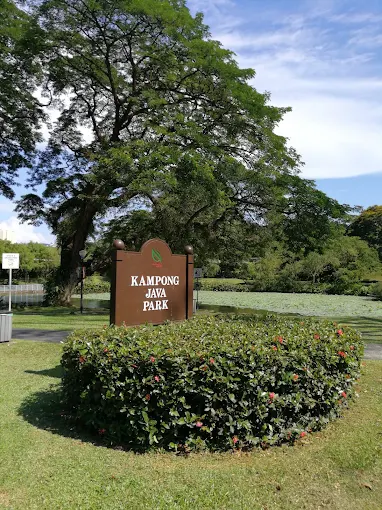 Kampong Java Park, around 2017. Image via Google Maps.
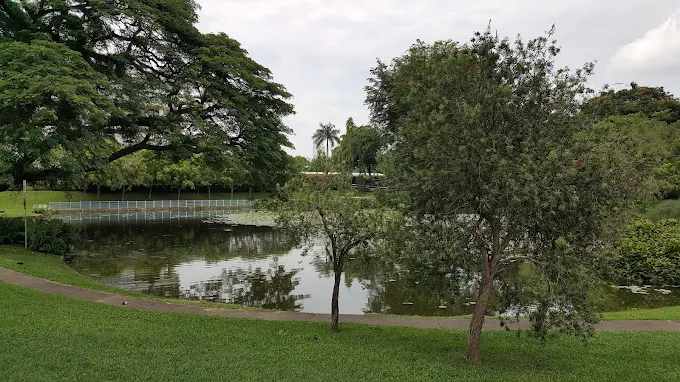 Kampong Java Park, around 2017. Image via Google Maps.
KKH relocated from its original site at Hampshire Road to its current site along Kampong Java Road in 1997.
Kampong Java Park would go on to serve as a hang out spot for the public until 2018, when it closed to make way for the development of the North-South Corridor and became the construction site of today.
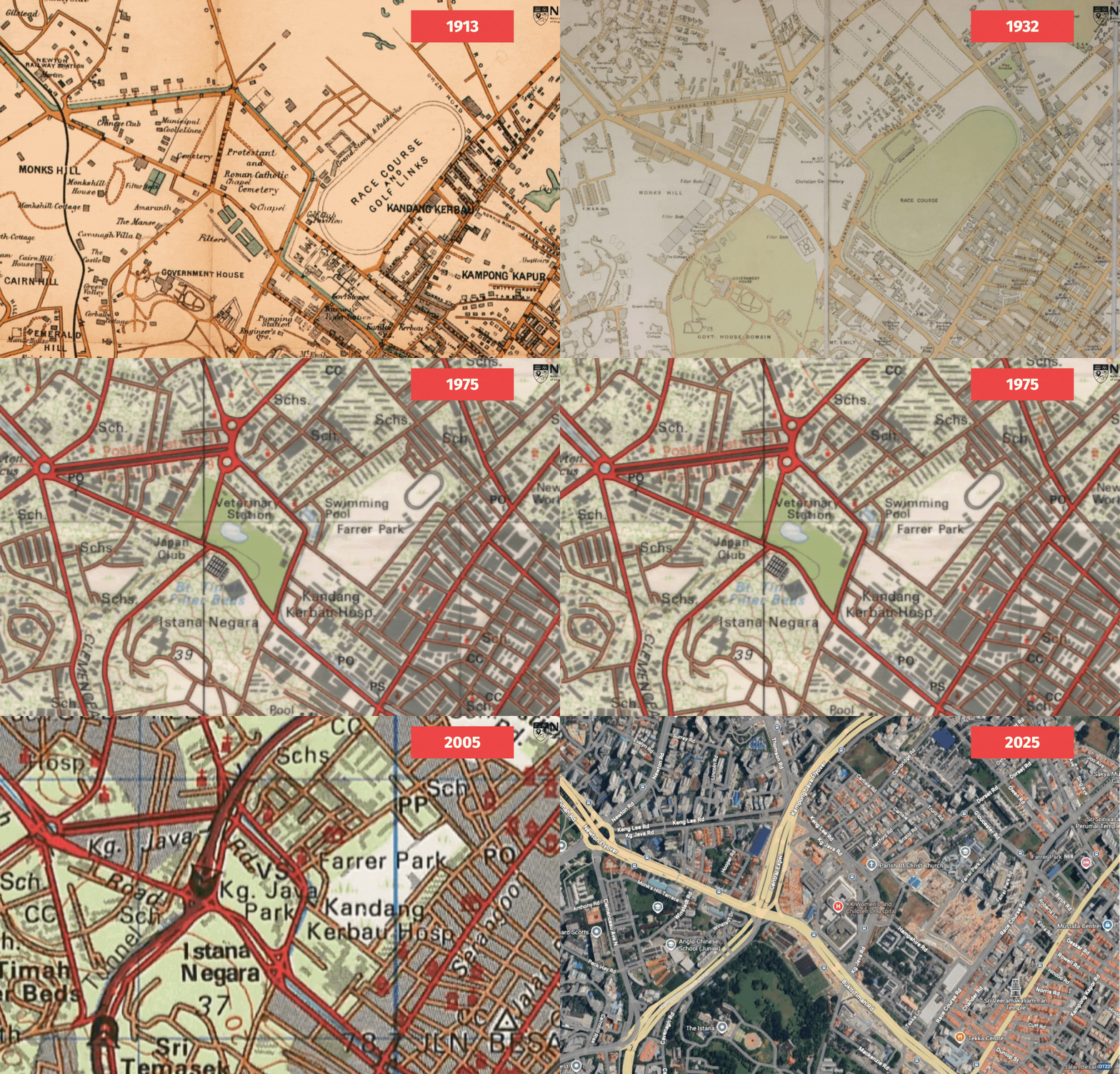 Gif via NUS Libraries.
Five unmarked burials
Researching into the unidentified coffins, Raymond and Charles Goh, co-founders of Asia Paranormal Investigators and tomb researchers, wrote on their blog about five burials with no headstones at Bukit Timah cemetery.
On Apr. 15, 1865, the same year Bukit Timah cemetery opened, an iron screw steamer, named the Johore, blew up off Dalhousie Pier.
The pier was located near the mouth of Singapore River.
 Image via Academia.edu.
Among the dead were five Europeans, the Gohs wrote.
Three of the five Europeans were buried at Bukit Timah cemetery at 3pm on Apr. 16, 1865.
They were:
- Captain Cleghorn, Master of the ship "Henrietta"
- John Young, Gunner of the steamer "Johore"
- Henry Sandhurst, Boilermaker of the New Harbour Dock Company
The following day, two more were laid to rest:
- John Miller, Engineer Officer of the steamer "Johore"
- Hugh Bain, Engineer of the New Harbour Dock Company
The five were buried without headstones but are recorded as being "situated at the corner of the first plot of ground on the right of the centre path after passing the path that turns to the right leading to the Chapel", the Gohs wrote.
"Based on [the LTA notice], the location of these [unidentified] coffins plotted on the cemetery map is as follows indicated by the triangle," the Gohs wrote.
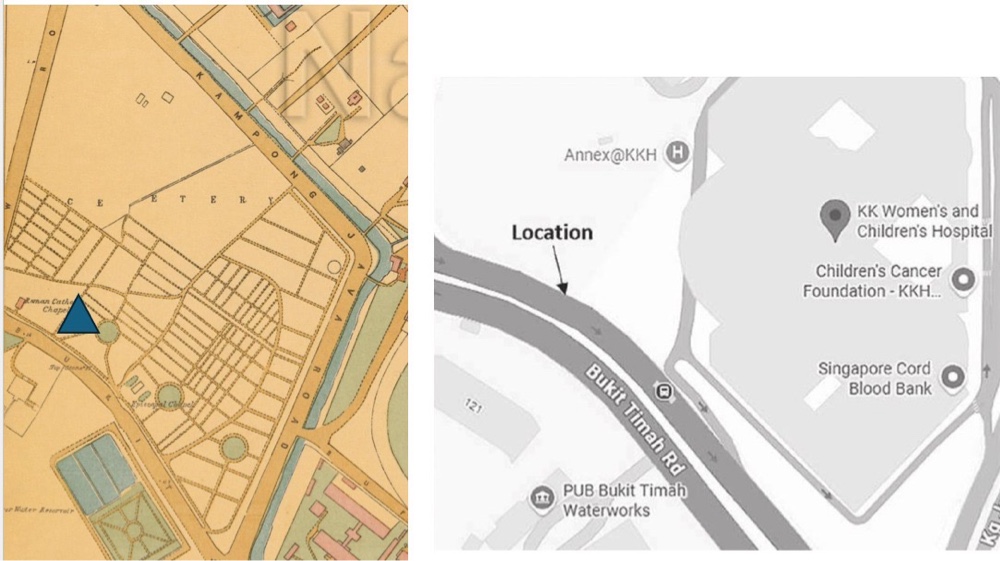 Image courtesy of Raymond and Charles Goh.
The Gohs wondered if the four unidentified coffins are related to the aforementioned five burials, but noted that there was a detail that did not line up, based on this account of events.
The burial service for the five deceased was administered by one Reverend C J Waterhouse MA, who was a Protestant minister.
Going by this, the five who died from the 1865 steamer explosion would have been buried in the Protestant section.
However, the four unidentified coffins were found in the Roman Catholic section.
The Gohs also wondered if there is the possibility that other coffins were left behind during the exhumation in the 1970s.
Years between burial and exhumation
Speaking to Mothership, Tan said the discovery of the unmarked coffins at the construction site behind KKH was an "interesting but not altogether surprising find".
"Because exhumation was undertaken so many years after [Bukit Timah cemetery] was closed for burials, the precise locations of all the bodies buried could not be ascertained with great accuracy back in the late 1960s and early 1970s," Tan explained.
If the coffins did indeed belong to those interred at the former Christian cemetery, finding the next-of-kin might not be an easy feat.
"To make matters worse, many of the descendants of those buried there — mostly Christians — were descendants of expatriates who might have returned to England or other parts of the British empire from which they came," Tan said.
Pak told Mothership that the discovery of the the coffins was a poignant reminder of Singapore's "deep and rich heritage", which prompts reflection on the "untold stories and historical layers beneath the modern city".
He said:
"They underscore the continuous narrative of a society built by generations, offering a tangible connection to the early pioneers and the historical foundations of Singapore. This connection not only adds depth to the national story but also emphasises the importance of archaeological preservation and documentation in honoring the diverse lives that contributed to the country's development."
In a Facebook post, Pak expressed hope that a church organisation will claim the coffins.
Next-of-kin or descendants are requested to contact LTA to make a claim or provide relevant information regarding the remains, LTA said in its statement.
They may reach LTA at +6594352425 or via email at [email protected].
Top image via LTA, Mothership