News

M'sia tourists caught vandalising Kyoto's famous bamboo forest, say they 'didn't know'
Not cool.
November 12, 2025, 06:28 PM


A group of Malaysian tourists were caught carving their names into one of the famous bamboo stalks at Kyoto’s Arashiyama Bamboo Forest.
When confronted by a reporter, they claimed they didn't know that they were not supposed to.
Footage of the act was later broadcast on YouTube and circulated on social media, prompting backlash.
The act of vandalism
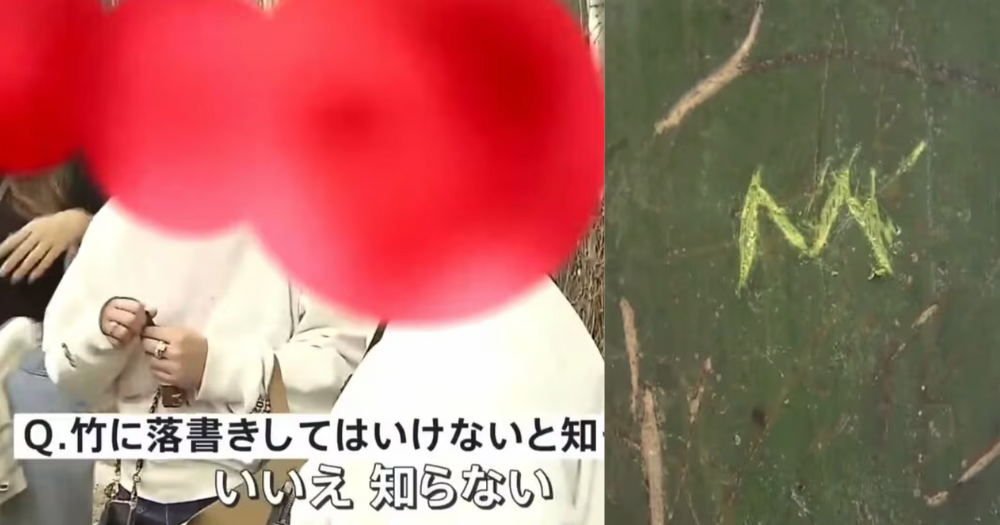
In the broadcast, one of the tourists could be seen scratching the letter “M” and other markings into a bamboo stalk using a rock.
 Screenshot via tbsnewsdig/YouTube
This was on a TV programme called “Direct confrontation with ‘nuisance tourists'".
Aired by a Japanese news crew, it featured reporters who questioned tourists about their actions at the iconic Arashiyama Bamboo Forest, one of Kyoto’s most-visited attractions.

The Japanese reporter, who confronted the tourists in English, asked:
“Do you know that you shouldn’t hurt the bamboo?”
The group of women appeared ignorant, saying that they didn’t know.
The voiceover from the programme then proceeded to say:
“The women, who said they were from Malaysia, showed no remorse.”
The segment on Arashiyama Bamboo Forest ended with Ishikawa Keisuke, chairman of the Arashiyama Shopping Street Association and owner of a dedicated bamboo goods store, lamenting the state of the forest.
“It’s sad that the graffiti ruins the beautiful scenery. It is also sad that we have to spend money to fix it. We really want them to stop.”

Social media reaction
The tourists were swiftly condemned on social media, with some pointing out how such actions cause permanent damage to the bamboo.


Japanese commenters also called for harsher measures against such behaviour.
More than a few brought up Singapore’s fines as an example.


Bamboo forest graffiti problem
Vandalism has long been a problem at the protected UNESCO world heritage site.
A recent inspection, as reported by Tokyo Weekender, found that at least 350 bamboo stalks have been defaced with carvings such as initials, dates, hearts and messages that have been etched with knives or keys.
The damage is not merely cosmetic.
Deep etchings cause permanent damage, and can kill the plants and cause bamboo to fall over, according to Asahi Shimbun.
 Image via Ryo_Saeba_3/X
Such damage is associated with what locals call “meiwaku tourism” (nuisance tourism).
In response, the city of Kyoto is considering cutting down the most severely damaged bamboo stalks for safety reasons.
Volunteers have also covered the graffiti with green masking tape to conceal the damage and prevent copycat vandalists.
Top images via tbsnewsdig/YouTube