



News

Fewer youths in full-time employment, more S'poreans travelling overseas: Singstat
Lots of numbers.
November 12, 2025, 05:49 PM


The proportion of youths in full-time employment has fallen over the last few years, according to government data.
They made up 79.3 per cent of all employed youths in 2024, a drop from over 80 per cent in 2019 to 2022.
These statistics were reflected in Singapore Department of Statistics's (DOS) October 2025 newsletter.
Youth unemployment
Since 2023, the proportion of youths in full-time employment has fallen below 80 per cent.
In tandem with this, the percentage of youths in part-time employment grew to above 20 per cent.
 Photo via DOS
Youths, or individuals aged 15 to 24, have a lower full-time employment rate as compared to the general population because they may still be pursuing education, DOS said.
Some youths may also take on short-term roles before continuing with higher education, or explore different opportunities before settling into a job.
But youth unemployment remained stable at 6.8 per cent — the same as in 2023.
This is in comparison to 8.9 per cent in the U.S., 9.5 per cent in Hong Kong, and 24.3 per cent in Sweden.
Household expenditure
In terms of household expenditure, Singaporeans spent the most on housing and utilities, followed by food.
This was true across all household income groups: the lowest 20 per cent, the middle 60 per cent, and the highest 20 per cent.
The lower-income group saw a drop in expenditure on housing and utilities between 2019 and 2024, from 34.3 per cent of their expenditure to 32.6 per cent.
But the middle- and higher-income groups both spent more: from 24.7 per cent to 28.3 per cent for the middle group, and from 23 per cent to 29.9 per cent for the higher-income group.
For food, the proportion of expenditure dropped across the board, although it was still the second-highest among the different categories.
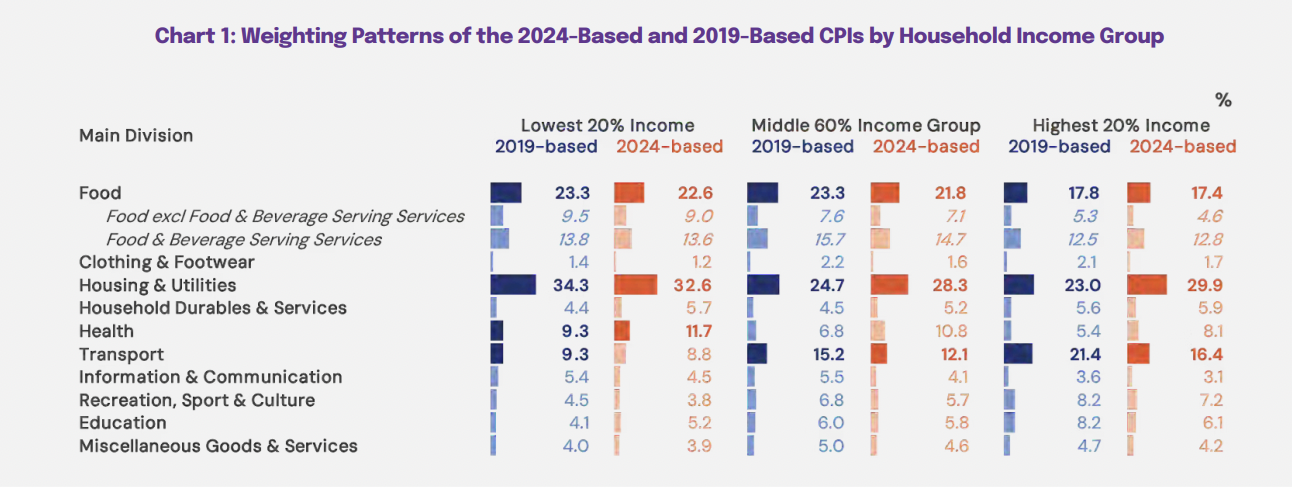 Image from DOS
The lowest 20 per cent and middle 60 per cent income groups spent more on meals at hawker centres and food courts, coffee chops and kiosks.
Meanwhile, the highest 20 per cent income group spent proportionately more on restaurants, cafes and pubs.
Travel
Another area of expenditure mentioned in the newsletter was travel.
It noted that more Singaporeans have been travelling overseas in the last decade, a sign of rising affluence and accessibility.
Between 2015 and 2025, the proportion of Singapore citizens who made at least one overseas trip increased across all age groups.
Singaporeans also made more frequent, and longer, trips.
The median number of trips taken in the year rose from three to four, while the median number of days per trip increased from two days to three.
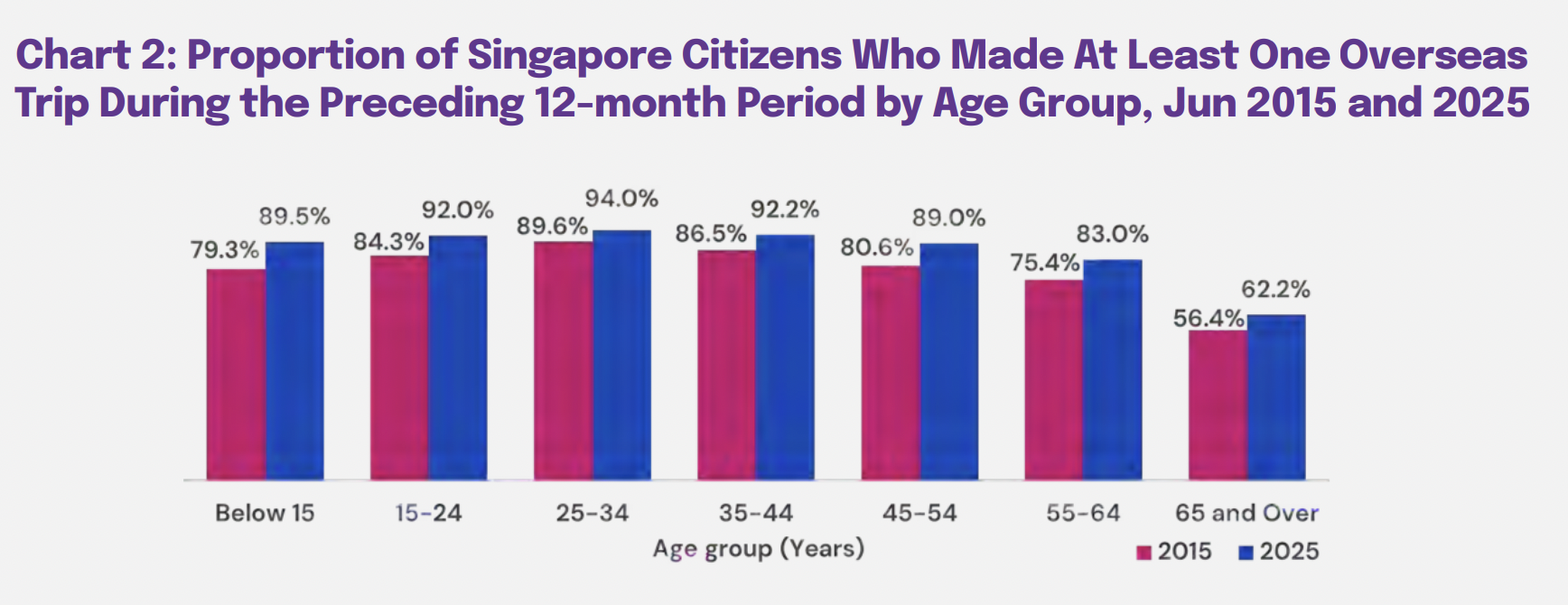 Image from DOS
The increase was also true across different dwelling types.
All saw increases, although the proportion of HDB flat dwellers who travelled overseas saw a bigger bump as compared to their private property counterparts.
Condominium and non-HDB apartment dwellers topped the list, with 92.4 per cent reporting having made at least one overnight trip in the past year.
In comparison, 87.7 per cent of landed property dwellers reported doing the same, followed by 85.4 per cent of HDB five-room and executive flat dwellers.
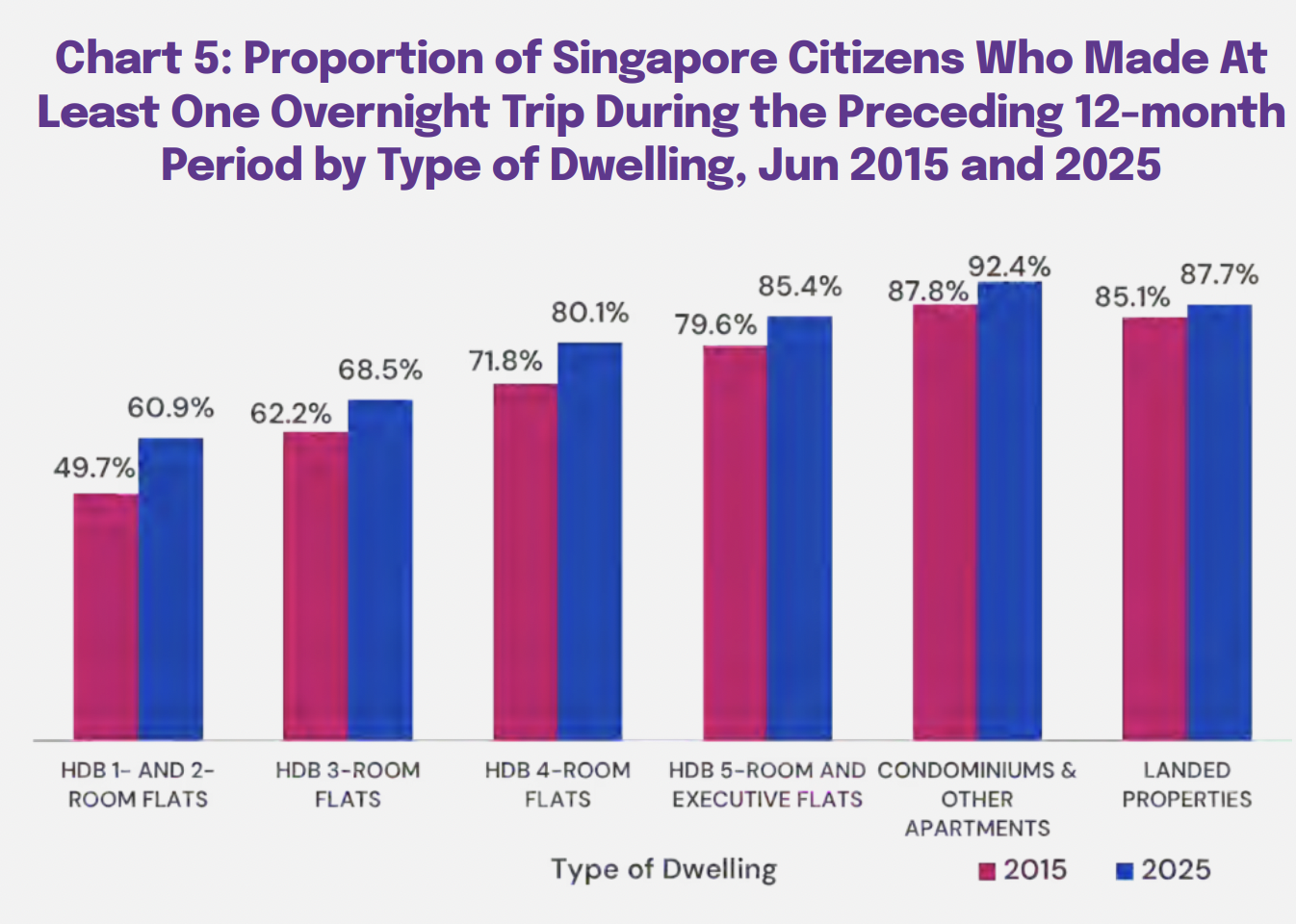 Image from DOS
Top photos via Unsplash, Canva