News

Who are PAS, the M'sia Islamist party & why did Shanmugam mention them in his parliament speech?
The Malaysian political party has been a hotly contested topic in Singapore's parliament in recent months.
October 18, 2025, 09:22 AM


In a ministerial statement in parliament on Oct. 14, Home Affairs Minister K. Shanmugam made a serious call for Singapore's politics to be kept separate from racial and religious lines.
Several attempts at inflaming racial and religious sentiments "for political gain" have been made in the past 60 years, including by foreign players attempting to influence election outcomes, he said.
One such player Shanmugam raised was Malaysia's Islamist political party PAS, whose leaders he said openly endorsed candidates in the middle of the 2025 General Elections on racial and religious basis.
"Malaysian politicians from PAS jumped in. They saw an opening and urged Singaporeans to vote along racial and religious lines. PAS National Treasurer Iskandar Abdul Samad expressed support for the WP’s Mr Faisal Manap.
PAS Selangor Youth Chief Mohamed Sukri Omar reposted a social media post stating that PAP’s Malay-Muslim MPs cannot be trusted. "
PAS later called Shanmugam's claims "a false narrative" while MHA responded that it was unacceptable for foreign entities like PAS to tell Singaporeans how to vote in the first place.
But who exactly are PAS and why is the government paying close attention on them?
Who are PAS?
PAS, or the Islamist Party of Malaysia, is a political party in Malaysia who is often seen as the main embodiment of political Islam in the country.
Some critics have even labelled it the "Malaysian Taliban", although this comparison was vigorously rejected by their vice president Ahmad Samsuri Mokhtar, who said that PAS was a "modern Islamic party".
PAS' ideology is said to be geared towards Islamic fundamentalism, as opposed to Malay nationalism, as embodied by traditional heavyweight Umno.
Despite having a major presence in parliament today, PAS' influence has historically been restricted to the state level, holding power in the northern and eastern states of Kelantan, Terengganu, Perlis and Kedah.
However, recent developments in the 2022 general election and beyond have hinted at PAS's surging strength, possibly at a national level.
PAS is a member of the Perikatan Nasional (PN) coalition, currently the largest opposition coalition in Parliament.
It also happens to have the most number of seats of any single political party in parliament at 43, more than the next largest DAP at 40.
Fundamentalist?
The party has appeared to make repeated attempts at shedding their image as a fundamentalist faction in recent years.
In 2023, their leader Abdul Hadi Awang pledged to be “fair” to all in order to draw the party closer to minority communities he said were still wary of them.
Last year, the party opened associate membership to non-Muslims, bar atheists, for the first time.
Despite these ostensible claims, the public appears to remain decidedly wary of what many continue to see as a hardline conservative agenda.
Numerous examples are cited for this.
PAS's public statements and actions
In Malaysia's last election cycle in 2022, the party came under fire for offensive remarks that targeted opposition and non-Muslim communities.
Hadi drew flak for saying that non-Muslims would take a secondary role in the government if his party took power, while a youth leader was forced to apologise for saying that opposition voters would "go to hell".
The latter comment echoed an earlier claim by Hadi in 2019 that hell awaits the country if non-Muslims were to lead, as he warned the importance of religion in keeping the law.
Other petty incidents have also affected the party's reputation.
The state of Kelantan, governed by PAS, once fined a non-Muslim woman for wearing shorts in her own boutique during a check by the local government.
In Terengganu, the state's first cinema in 22 years made headlines for having CCTVs to monitor audience behaviour.
Later in December this year, Perlis will have their first cinema in 20 years, but local laws state that the lights must be kept on and men and women will have to sit apart.
The party's leaders are also known to be vocal about the country's stance on alcohol.
Most recently, two of their lawmakers proposed that national carrier Malaysia Airlines serve traditional Malaysian beverages such as bandung and chendol instead of alcoholic drinks to passengers on board.
Gaining influence
Despite their reputation, PAS has appeared to gain influence in recent years, mostly online and on social media.
According to Asian Studies professor James Chin, the party's mastery of TikTok, fastest among its competitors, contributed significantly to this rise, especially among younger voters.
PAS may even become a threat to incumbent Prime Minister Anwar Ibrahim's party PKR and the ruling coalition Pakatan Harapan (PH) in the next general election, Chin warned.
Its alliance with former Prime Minister Muhyiddin Yassin's party of Bersatu in forming the new PN coalition also seemed to have given it a fresh appeal, by positioning itself as a direct alternative to Umno and the BN.
PAS on Singapore
However, it is PAS's numerous mentions of Singapore and Singaporean figures that may be most relevant to the recent free and frank exchange of views.
In Nov. 2023, PAS member of parliament Siti Mastura Muhammad accused Malaysia's Democratic Action Party's (DAP) bigwig Lim Guan Eng of being related to both former Singaporean Prime Minister Lee Kuan Yew and Communist guerrilla leader Chin Peng.
The DAP was founded shortly after Singapore's independence by Malaysia-based members of Singapore's People's Action Party (PAP).
Mastura was blasted for playing a "dirty political game" by Lim, who denied being related to either man.
In Dec. 2023, Secretary-General Takiyuddin Hassan slammed DAP's Lim Kit Siang for his comment that one day he would like to see a non-Malay as the Prime Minister of Malaysia.
Lee Kuan Yew's name was raised in the kerfuffle, with Takiyuddin saying that Lim had a "striking similarity" to Lee's "Malaysian Malaysia" ideal of equality for all Malaysian citizens regardless of race.
GE2025
In the most recent saga, Singapore's government doubled down on its zero tolerance for identity politics after it was found that three foreigners, including PAS' National Treasurer Iskandar Abdul Samad and Selangor Youth Chief Mohamed Sukri Omar had attempted to exert influence through Facebook posts.
Iskandar had expressed his support for WP's candidate Faisal Manap during GE2025, according to MHA, while Sukri had reposted an inflammatory post by another foreigner, Australian citizen Zulfikar bin Mohamad Shariff.
Zulfikar, who renounced his Singapore citizenship in 2020, accused several Malay-Muslim Members of Parliament (MPs) of failing to represent the interests of the Muslim community.
He also claimed that the local Muslim community did not need another Malay MP who did not represent their views.
Zulfikar was found to have previously publicly promoted the views of terrorist group ISIS and radicalised at least two other Singaporeans.
He was vocally supportive of the rejection of a secular state in favour of an Islamic state.
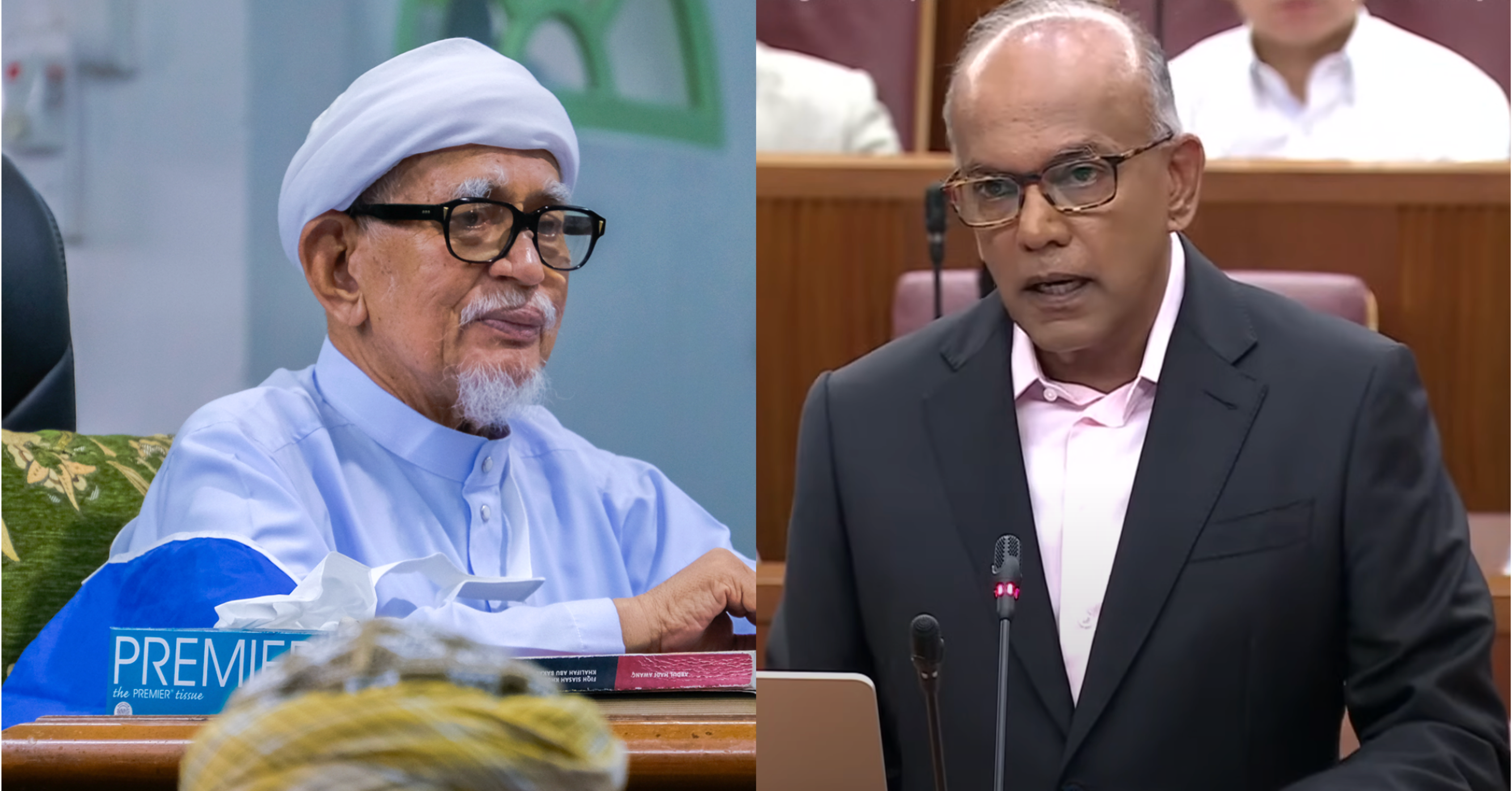
Top images via Abdul Hadi Awang/FB & Gov.sg/YouTube