News

Daily calls to S'pore ScamShield helpline increase from 30 to 700 in a year
To accommodate additional manpower, the 1799 ScamShield Helpline moved to its new Certis headquarters in Bedok South.
September 15, 2025, 07:11 PM
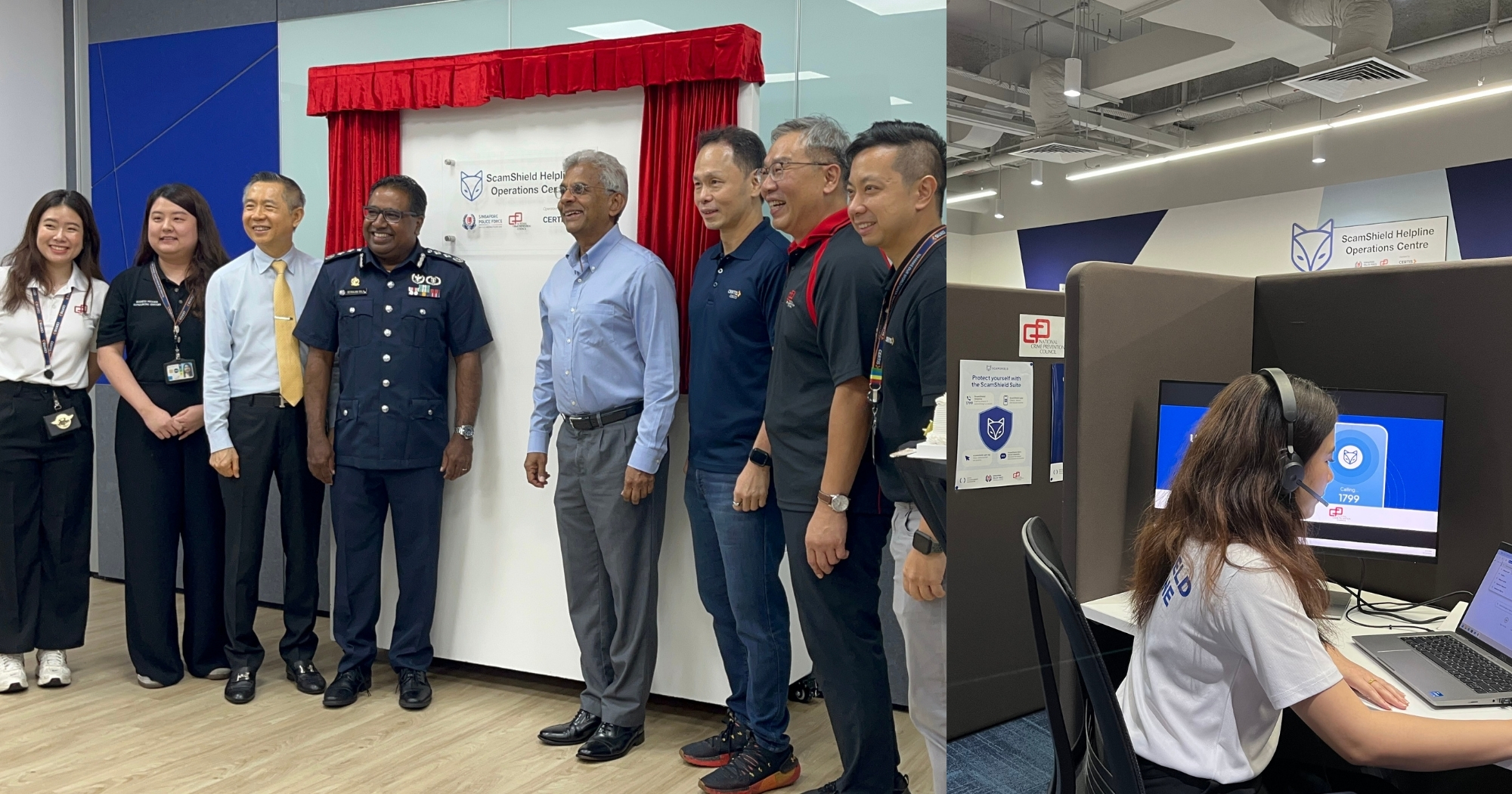


The 1799 ScamShield Helpline celebrated its first anniversary at its new Certis premises on Sep. 15.
It previously operated at the Police Cantonment Complex. This move is part of its efforts to accommodate the additional manpower needed to operate the helpline.
1799
Fronted by the National Crime Prevention Council (NCPC), the ScamShield Helpline currently receives around 500 to 700 calls per day, up from 30 calls per day previously.
Its operating hours have also been extended to 24 hours a day, an increase from 9am to 5pm on weekdays.
This is part of the NCPC's Anti-Scam Helpline major rebranding exercise in September 2024.
As part of efforts to tackle scams, the 1799 ScamShield Helpline was launched in September 2024.
Since its launch, the helpline has handled over 128,000 calls and online chats.
The helpline allows members of the public to identify and prevent scams by calling 1799.
New ScamShield Helpline Operations Centre at Certis
NCPC Chairman Gerald Singham told the media on Sep. 15: "Scam trends tend to change with time."
He added that about two years ago, love scams were the number one scam.
However, the number of government official impersonation scams has increased, with reported cases nearly tripling.
He encouraged members of the public to call 1799 whenever they are unsure if something is a scam.
Timely intervention
ScamShield Helpline agent Ashley Teh has spoken to many members of the public calling in to verify if something is a scam.
She told the media at the new Certis premises about cases where ScamShield Helpline agents prevented scams.
Called 1799 while driving
In one such case, a potential victim, Y, called the ScamShield Helpline in July 2025.
A supposed Maybank officer claimed there was a suspicious transaction on a credit card under her name, even though she did not own one.
The call was then transferred to someone posing as a police officer.
The fake police officer accused her of being involved in money laundering. Y was also threatened with an arrest warrant unless she cooperated.
Under immense pressure, Y called 1799 in a highly stressed and emotional state. At that time, Y was driving to meet the scammer and hand over the S$38,000 she had withdrawn.
The ScamShield Helpline agent tried to calm Y down. Throughout the call, Y was asking the agent if it was really a scam and if she would get in trouble for not handing over the money, said Teh.
The agent patiently listened and suggested that Y take a detour and drive to the police station instead to make a report.
Y did not lose any money to this scam.
Almost lost S$40,000
In another case, a UnionPay officer told X that his personal details were used to purchase a S$1 million insurance plan in Malaysia.
After X received the suspicious call, it was transferred to someone posing as a Monetary Authority of Singapore (MAS) officer.
The MAS officer then instructed him via WhatsApp to withdraw S$40,000 and hand it over to an ‘undercover officer’ for investigations.
X doubted the authenticity of the calls and called 1799 in May 2025.
By then, he had already withdrawn S$40,000. He repeatedly said during the call that the ‘undercover officer’ was waiting downstairs to collect the money.
The ScamShield Helpline agent calmly pointed out the key scam signs and advised X to file a police report immediately.
X was convinced and did not suffer any financial losses.
Insurance services scam
X was among the members of the public who nearly fell for insurance services scams.
It was among the top five scam types in the first half of 2025, according to the Singapore Police Force’s (SPF) Mid-Year Scam and Cybercrime Brief 2025.
 Photo via SPF.
This is a new scam type that emerged in 2025.
Most victims were aged 65 and above. This age group made up 27.6 per cent of victims for this scam type.
Phone calls and WhatsApp were the most common channels used by insurance services scammers to contact potential victims.
 Photo via SPF.
A total of S$21.3 million was lost to 791 insurance services scam cases reported in the first half of 2025.
Impersonating insurance company staff part of modus operandi
For this scam type, scammers impersonate staff from insurance companies.
They then claim that victims would have to pay for their supposed insurance packages or expiring trial subscriptions, unless they are cancelled.
To proceed with the cancellation, victims are asked to verify their identity by sharing personal details and transferring money.
However, victims are given false promises of refunds after verification.
The report added that the Police have also observed a new money transfer method involving fund transfers to credit cards, in both government official impersonation scams and insurance services scams.
The report also noted that since May 2025, there has been a pattern of scammers instructing victims to make fund transfers from their bank accounts to credit cards provided by the scammers.
These transfers were believed to be done to increase credit limits, enabling large purchases of jewellery and precious metals, particularly gold bars.
Government officials impersonation scam
Y is among many potential victims of government officials' impersonation scam cases.
The number of reported cases almost tripled, with an increase of 199.2 per cent from 589 cases in the first half of 2024 to 1,762 cases in the first half of 2025, according to SPF's report.
In the report, SPF noted that government official impersonation scams are among the key scam types that are of particular concern in the first half of 2025.
The report added that government official impersonation scams recorded the second-highest loss among all scam types in the first half of 2025.
The amount lost to this scam type increased by 88.3 per cent from S$67.2 million in the first half of 2024 to S$126.5 million in the first half of 2025.
Precautionary measures to take
Members of the public who are dealing with scams or suspected scams can take the following precautionary measures:
- ADD
- Add the ScamShield App to block calls and filter SMSes
- Set transaction limits that are adequate for daily expenses
- Lower transaction notification thresholds
- Alert the bank immediately of any suspicious activity in your bank account
- Activate the Money Lock feature of your bank to digitally secure your money
- CHECK – Check against the 24/7 ScamShield Helpline at 1799 or other official sources.
- TELL – Tell your bank immediately if you suspect that you have fallen victim to a scam to block any fraudulent transactions, and then make a police report. Report any scams to the authorities, family, and friends if or when you encounter scams.
If unsure about any request involving your money or bank account, MAS encourages the public to call the 24/7 ScamShield Helpline at 1799.
Top photos via Mothership