



News

All recruits at BMTC to undergo drone training: Chan Chun Sing during 1st visit to Pulau Tekong as defence minister
He observed a number of new implementations rolled out at BMTC.
August 04, 2025, 07:04 PM
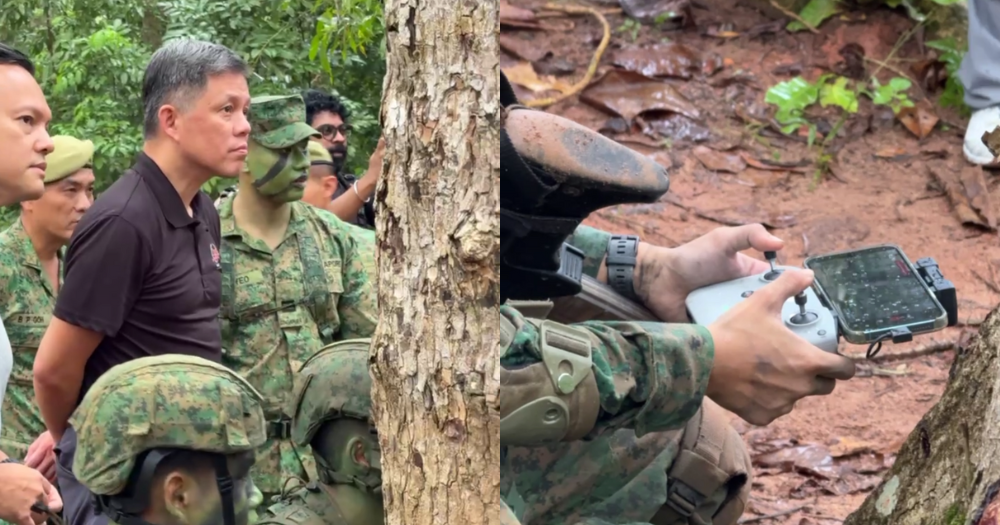

 Minister for Defence Chan Chun Sing conducted a visit to Pulau Tekong on Aug. 4, observing the role of data and technology in recruits' training at the Singapore Armed Forces' (SAF) Basic Military Training Centre (BMTC).
This marks Chan's first official visit to BMTC since taking office on May. 23. He previously stopped by a number of specialised SAF units on Singapore's mainland, including the Air Force and Navy, on May. 27.
Joining Chan at Tekong were Senior Minister of State for Defence Zaqy Mohamad, Chief of Defence Force Vice Admiral Aaron Beng, and Chief of Army Major General Cai Dexian.
The group observed a number of training demonstrations, including recruits' use of fitness wearables to measure physiological metrics during metabolic circuits, drone-flying lessons, and tactical drills in outfield training.
New technologies
Drone training is now an integral aspect of BMT, and was rolled out as a compulsory part of recruits' training from July 2025.
Recruits employ the technology during their outfield trainings, where they learn to manoeuvre a suite of commercial surveillance drones.
Speaking to the media, Chan said this is a part of soldiers' need to develop "three-dimensional spatial awareness", especially with the proliferation of unmanned technology in the urban terrain in recent years.
It is also the SAF's continued integration of technology to complement "fighting capabilities at the individual and at the unit level", he added.
Chan noted that in the past, one soldier might be operating one rifle. Going forward, that one soldier will be operating not just his own rifle and weapon system, but "a suite of technologies", from drones to robots that will augment the soldier's capabilities.
Technological advancements have also been used to enhance the wellbeing of recruits in training, specifically through the employment of heart rate trackers used during high intensity fitness trainings.
The tracker, which recruits wear on their wrists during trainings, is designed to measure their heart rate and categorise it from zones one to five levels of intensity, five being the most intense.
The soldier's zone is then projected on a screen in the multipurpose hall where trainings occur, indicating to commanders the level of exertion.
The trackers allow for a more personalised and safe training, Chan said, as they are more tailored to suit individual fitness levels, in turn optimising soldiers' performance.
"We know each and every soldier, what is their heart rate, how much effort they are exerting, whether they can go further, or they are at the risk of over straining themselves", he said.
Chan was also briefed on injury management and prevention measures employed in training at the Tekong Physiotherapy Centre.
The centre allows injured soldiers to seek rehabilitation quickly instead of the previous process of sending them back to the mainland.
The ability to address current and potential injuries faster "shortens the cycle" recruits need to recuperate and recover, Chan said.
"The will to fight"
In spite of the advancements at the BTMC, Chan emphasised that "the will to fight, the inner spirit" as well as resilience are some traits "that will never change".
"Some of the very basic, fundamental soldiering skills will not change, and that is what we must continue to emphasise on the ability to take care of themselves in a very challenging environment, their ability to work as a team, to overcome the challenges together as a unit."
Top images by Aiman Nadzri/Mothership