News

Self-radicalisation among youths a growing concern in S'pore amid high terrorism threat: ISD
ISD said some radicalised youths had made extensive preparations.
July 30, 2025, 07:05 PM


The terrorism threat in Singapore remains high, with a growing diversity of extremist ideologies, said the Internal Security Department (ISD) on Jul. 29.
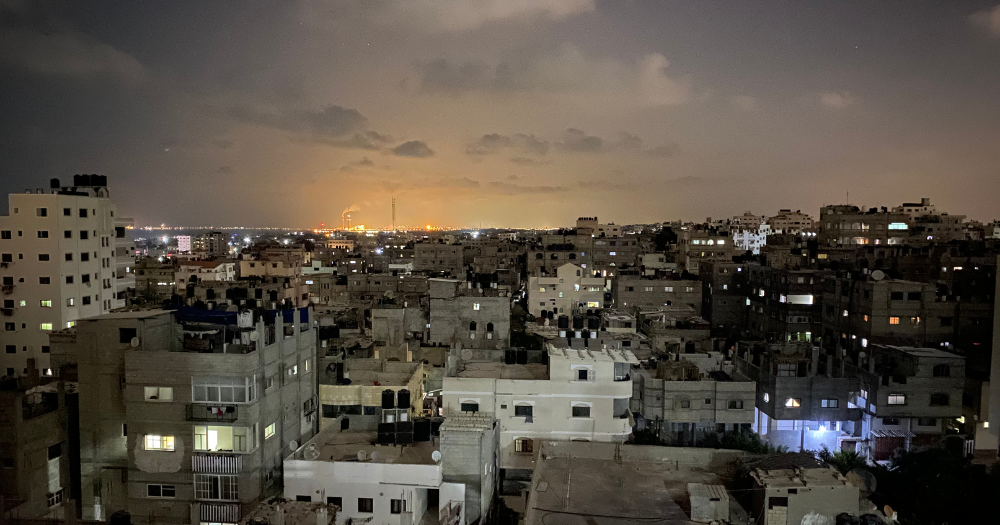
ISD added in its annual Singapore Terrorism Threat Assessment (STTA) Report that this is fuelled by "a volatile global landscape arising from developments such as the ongoing Israeli-Palestinian conflict and continued traction of radical narratives."
By exploiting these geopolitical conflicts and using engaging content like memes, terrorist organisations promote their radical narratives and facilitate self-radicalisation.
Take advantage of conflicts to spread unrest
Home Affairs minister K Shanmugam emphasised this during his opening address at the launch of SGSecure Social Experiments web series on Jul. 30.
He said: "You have seen how terrorist groups are taking advantage of every situation – the Ukraine conflict, the conflict in Myanmar, the conflict in Gaza – and they use it to radicalise, recruit, incite violence.
What’s happening in the Middle East: Israel’s conflicts with Iran, Hezbollah, and of course, what’s happening in Palestine – which is quite grievous and has been described as genocidal – have heightened risk of terror attacks elsewhere."
Self-radicalised youths concerning
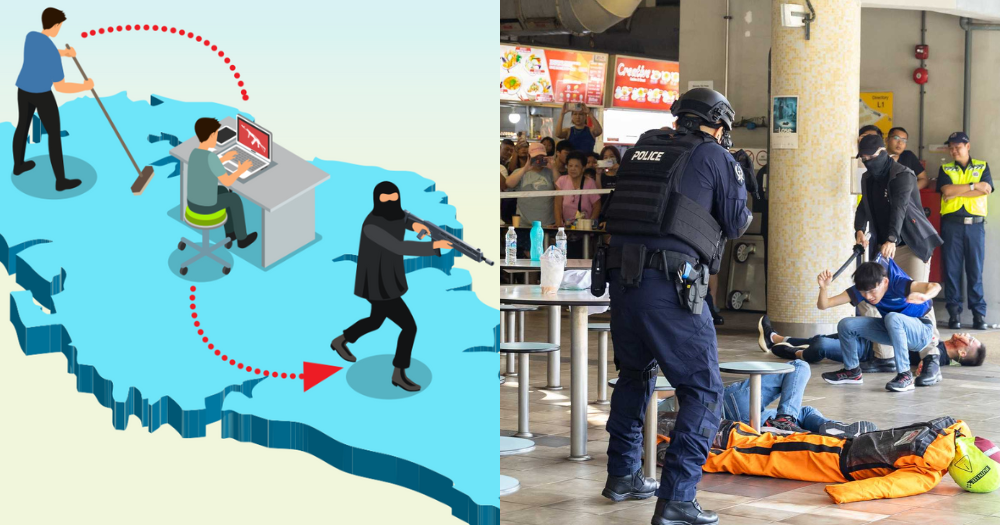
ISD's report noted that self-radicalisation continues to be the primary driver of the domestic terrorism threat in Singapore.
This is due to geopolitical conflicts, external developments and the easy accessibility of various extremist ideologies online.
Among the 60 self-radicalised individuals, 48 Singaporeans and 12 foreigners, issued with orders under the Internal Security Act (ISA) since 2015 until June 2025, 17 were youths aged 20 or younger.
ISD has dealt with eight self-radicalised Singaporeans under the ISA from July 2024 to June 2025. This comprises six males and two females between the ages of 15 and 56.
Half of their radicalisation was triggered or accelerated by the re-escalation of the Israeli-Palestinian conflict in October 2023.
Another two were indoctrinated by pro-ISIS extremist ideologies and the remaining two were radicalised by violent far-right extremist (FRE) ideologies.
Violent plans
In recent ISA cases, four youths detained from September 2024 to March 2025 had searched for ways to obtain weapons as well as how to join extremist groups.
The report said Nick Lee Xing Qiu who was detained in December 2024 role-played as Tarrant in a violent online simulation game and downloaded video game modifications to recreate the Christchurch attacks on several occasions.
The 18-year-old even considered using Molotov cocktails for his attacks and enquired online on how to make them.
Muhammad Indra Aqmal Effendy wanted to join Hamas and tried to find possible travel routes to Gaza.
The 21-year-old who was detained in November 2024, watched videos on YouTube to familiarise himself with close quarter battle.
A 17-year-old FRE supporter who was detained in March 2025 had conducted extensive research online on firearms and considered 3D printing firearms and ammunition.
He was also in contact with several individuals online, from whom he had sought advice and/or assistance to procure firearms for his attacks.
Accelerating radicalisation
The report added that Singaporeans continue to be vulnerable to online radicalisation by a variety of extremist ideologies.
This is because online platforms act as a catalyst for self-radicalisation, accelerating the time taken between an individual's first encounter with terrorist and radical elements to their subscription to violent extremist ideologies.
In many recent ISA cases, it only took a few months for individuals to become self-radicalised online.
Over the past decade, the time taken for self-radicalisation for ISA cases has halved from an average of 24 months before 2015 to an average of 12 months between 2021 and 2025.
A 15-year-old pro-ISIS female youth who was issued with a RO in February 2025 took only weeks to become self-radicalised.
Early intervention helps
ISD said the public can help keep Singapore safe by remaining vigilant and reporting any information or suspicion on terrorism or signs of radicalisation early to ISD at 1800-2626-473.
The agency added that early intervention will benefit the suspected radicalised individual and keep society safe.
In measuring Singaporeans' alertness to anti-terrorism, Senior Minister of State for Home Affairs Sim Ann said at the launch of SGSecure Social Experiments web series on Jul. 30 that during two social experiments in June, only 5 per cent of passers-by who noticed suspicious items either intended to inform the authorities or took actual action to inform the authorities.
She added that there is still some way to go in raising the public's alertness and awareness as well as their readiness to combat terrorism.
Top photo via Singapore Terrorism Threat Assessment Report 2025