News

Chan Chun Sing: If S'pore have to choose sides, it will choose 'the side of principles'
Singapore believes that taking sides, regardless of issues and context, “breeds irrelevance”, he said. And if one is irrelevant, it will almost certainly require taking sides.
June 01, 2025, 01:35 PM


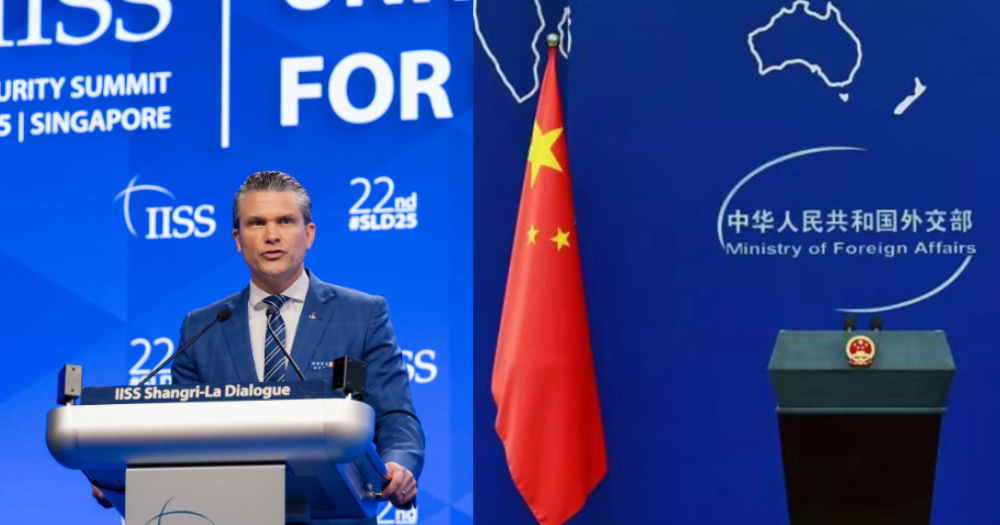
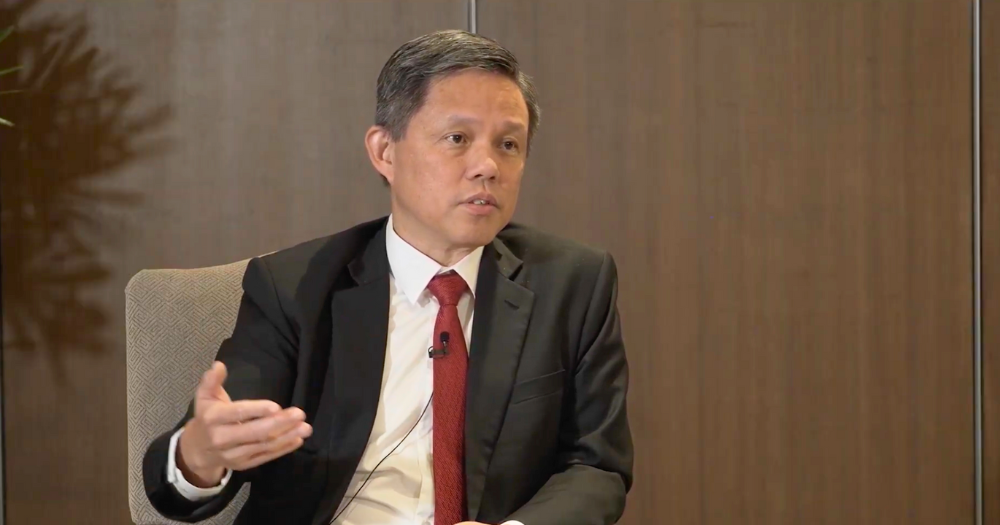
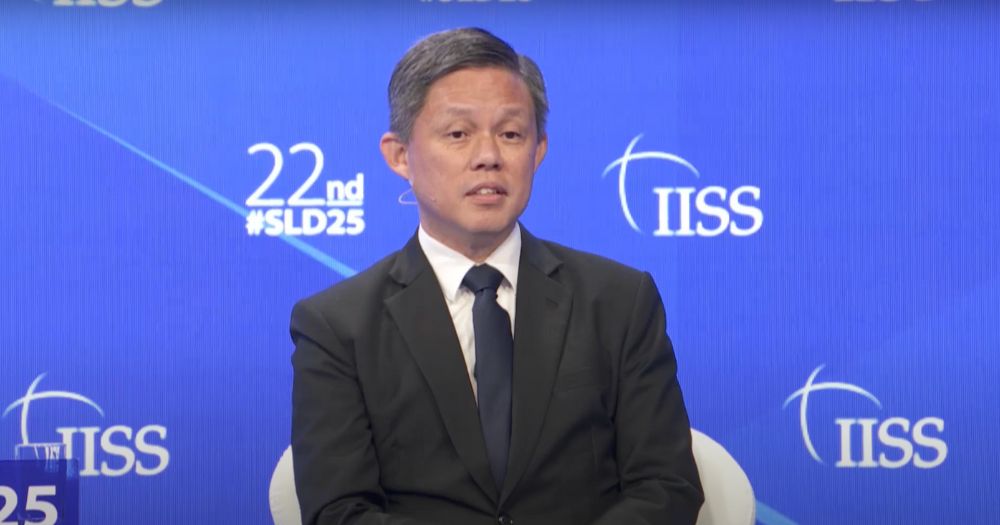
Minister for Defence Chan Chun Sing spoke during a panel session on the final day of the Shangri-La Dialogue 2025 on Jun. 1.
He observed that there is a growing recognition that regional security is deeply interconnected, with cross-border challenges such as supply chain vulnerabilities, disinformation, and cyberinfrastructure threats affecting multiple nations.
Chan also emphasised the vital role of international laws and norms in preventing conflict and maintaining global stability.
He shared these reflections as part of his observations from the past three days of discussions at the summit.
Going alone is not the answer to insecurity
Chan outlined the importance of working with other nations to combat insecurity.
He said that while prioritising one's security is not wrong, this quest for security must be pursued alongside a "firm commitment to international laws and norms, which set the rules of what is acceptable state behaviour".
"My security first should not become my security only. Otherwise, we all fall victim of the prisoner's dilemma, where the pursuit of self-interest leads to less ideal outcomes, both individually and collectively," Chan said.
Chan said this applies not only to the military domain but to all forms of security, adding that economic insecurities mirror military insecurities.
He explained that economic insecurity, which can include widening domestic inequalities, inability to secure one's economic lifelines or to achieve economic growth through fair economic competition, can all combine to heighten the risk of military conflict.
Saying that "competition and cooperation" are not mutually exclusive, he explained that greater competition means one would need more "guardrails to ensure that competition does not descend into conflict".
These guardrails include a commitment to resolve disputes peacefully and in accordance with international law, and channels of communications, so that one remains open to de-escalation and confidence-building measures to reduce the risk of miscalculations.
International cooperation starts with domestic confidence
Instead, he emphasised that "domestic cohesion, policy coherence, and leadership continuity" are key to building national credibility — making it easier for a country to work with others and be seen as a reliable partner in negotiations.
A stable government with strong public support will have the confidence to sustain strategic partnerships, address shared security challenges, and reach mutually beneficial agreements through peaceful means.
Such a government can also take an active, constructive role in shaping and upholding the global rules-based order.
The opposite, he noted, also holds true.
Thus, domestic and external security must be mutually reinforcing — one cannot exist without the other.
"Political and military leaders must arrest the instinct or temptation to go at it alone when they feel insecure, only then can we avoid conflict and keep the peace," he said.
All states have agency and responsibilities
For his last point, Chan noted that in the current global context of fragmenting security and economic order, it can be tempting for small states, including many in Southeast Asia, to question whether they have any real agency or whether they must inevitably pick a side.
“The strategic context for us in the region is as such: It is said that China's presence is a geostrategic reality. The U.S. engagement of Southeast Asia is a geostrategic policy. And if so, Southeast Asia's engagement of the U.S., China, and others must be our geostrategic necessity,” Chan said.
Singapore believes that taking sides, regardless of issues and context, "breeds irrelevance", he said.
Chan stated that if Singapore must choose sides, it will choose “the side of principles”.
These are principles that uphold a more integrated global economic and security order underpinned by international law, sovereignty and sovereign equality.
“Where we do not descend into the law of the jungle, where the mighty do what they wish and the weak suffer what they must,” he said.
"Where states big and small have a fair chance to compete and can improve the lives of our people through trade and not war."
As such, Singapore is committed to working with like-minded partners and with a web of bilateral, plurilateral and multilateral networks for the "common good", Chan said.
He said that any "functioning global rules-based economic and security order" must be able to address current and future challenges.
"Openness and inclusivity are important because all stakeholders must feel that they have a voice in shaping the rules," he said.
Power comes with responsibility
Chan also addressed "all the powers of the world", saying that with greater power comes greater responsibility.
"All great powers can choose to demonstrate the power of its example, or it can choose to demonstrate the example of its power," he said.
As such, everyone has a choice to make, he concluded.
Top photo from The International Institute for Strategic Studies/YouTube