



News

S'pore needs to be 'alert, realistic & careful in dangerous times': Vivian Balakrishnan
Vivian, while expressing some point of difference with opposition parliamentarians, nonetheless thanked them for stopping politics "at the water's edge".
March 03, 2025, 10:36 PM


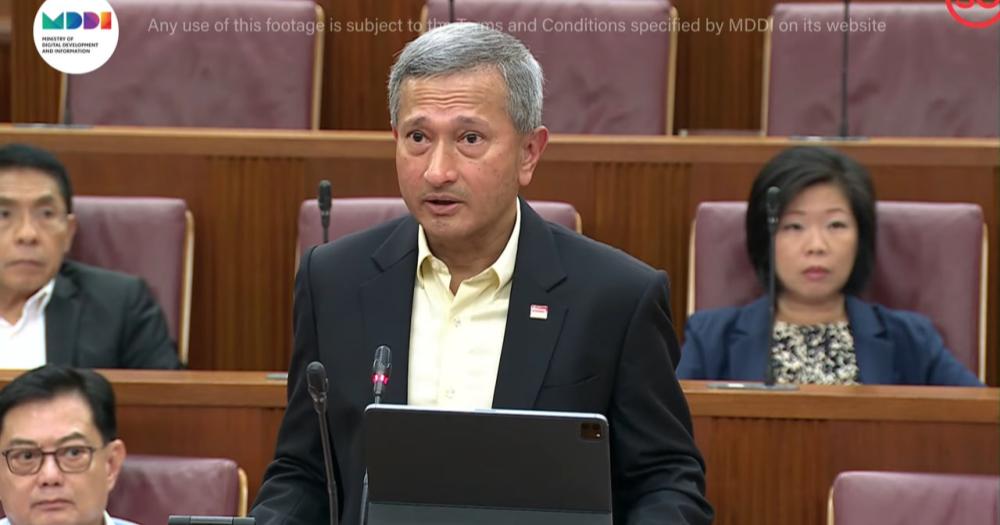
Foreign Minister Vivian Balakrishnan spoke at length about a new world order taking shape amid profound unpredictability, instability and volatility at the 2025 Committee of Supply debate about Singapore's foreign policy on Monday (Mar. 3).
Vivian spoke candidly about the deterioration of the global world order that Singapore had found conducive to its growth and development over the years.
He said that Singapore's foreign policy must always be a balance between realism and idealism, and urged Singaporeans to be "alert, realistic and careful in dangerous times".
However, he also warned that caution is not the same as fatalism, and that Singaporeans must remain united in the face of external challenges.
Weathermen
In 2025, Singapore will be celebrating the 60th anniversary of independence, which was built into social and economic success through the hard work and discipline of successive generations.
But it had also taken advantage of a conducive world order after the end of WWII, which had built global supply chains, promoted free trade, and created multilateral organisations that contributed to the development and protection of international law.
Now, that world order is eroding, perhaps even coming to an end, as countries turn away from globalism and become more protectionist.
"This is not merely a sudden temporary change in diplomatic weather. A new world order is taking shape among profound unpredictability, instability, and volatility."
Trade, war, and the global commons
This would have several impacts on Singapore, Vivian said, setting out three sets of implications.
Tariffs and trade
Firstly, the change would have a major impact on trade and growth.
The U.S. had once advocated for trade globally but was now progressively shifting to a more nationalist approach, ostensibly in response to "unfair trade measures."
Tariffs, for example, are now being used by the U.S. and other countries to address non-trade related policy objectives.
Affected countries were in turn threatening retaliatory measures, and Vivian warned that tit-for-tat tariffs by other countries could easily escalate into a global trade war.
While Singapore was not currently directly targeted, it could still be affected.
Tariffs would have a major impact on the volume and patterns of world trade, as well as disrupting supply chains and causing more volatile prices, all of which would affect Singapore.
Erosion of sovereignty
The second set of implications was the erosion of international law, the UN charter, the principles of sovereign quality, political independence, and territorial integrity.
Vivian gave examples such as the Russia-Ukraine war, the conflict in Gaza, and, to a lesser extent, the tensions in the South China Sea and Taiwan Strait.
The rules-based international order that had prevailed since the end of the Second World War might denigrate into the "law of the jungle", where might makes right.
Vivian warned that the world might return to a time when big powers divided it into zones of influence, and that would result in the loss of autonomy and choice for small states.
The global commons
Third, the world's ability to respond collectively to global threats and safeguard the global commons had been impaired.
The collective commitment to international institutions such as the World Health Organization (WHO) and the UN Framework Convention on Climate Change was waning, and Vivian asked how the world would face another pandemic with a severely weakened WHO.
The water's edge and the budget
Vivian said he did not mean to engender a sense of pessimism but to issue a call to be "alert, realistic, and careful in dangerous times."
Vivian said that Singapore was in a strong position and that its core strengths were rooted in three key pillars: its economic strength, its ability to stand on its own two feet to defend itself, and its domestic cohesion.
If the biggest criticism of the budget was that of "budget marksmanship," referencing a Workers' Party criticism and having more reserves than anticipated, it was "a reason for celebration."
Considering the circumstances, this was an enormous advantage, especially when other countries who sought international assistance ultimately found that they had almost no say.
Singapore had a big advantage by not having to beg for aid, nor requiring assistance or loans that would subject it to external pressure.
Vivian referenced Defence Minister's Ng Eng Hen's speech earlier in the day, saying "we do not depend on any external country to defend Singapore, we have the capability and the will to defend ourselves."
"The fact that everybody knows that we are good for our money, and we put our blood where we stand on is the core of deterrence and respect."
Unity at home
But this still requires domestic unity.
Vivian underscored that whatever the disagreements over the budget, Vivian still thanked the opposition that, so far, parliament had worked on the basis that politics stopped at the water's edge.
"Our diplomacy works because we have painstakingly forged and maintained domestic consensus on our core long-term interests and foreign policy priorities," Vivian said.
But being a diverse country meant that Singaporeans would develop different views on development across the world. Space had to be provided for these views to be expressed without causing division.
Vivian gave the example of the "disaster in Gaza", a "deeply emotional issue."
In the wake of the Oct. 7, 2023 attack by Hamas, Singapore reaffirmed Israel's right of self-defence because if ever attacked in a similar way, Singapore would also seek to fully exercise its right of self-defence.
However, the right of self-defence had to be consistent with international and humanitarian law, and Singapore was direct when telling Israel that they had gone too far.
In the cases of Gaza and Ukraine, Singapore's positions were not to take sides but to protect its national interests.
He warned that a potential Asian conflict would face even more emotional resonance and economic impact, and "grey zone tactics" to divide and polarise Singaporeans had to be expected.
Singaporeans had to be prepared, stay united and, close ranks on issues of national interest despite different views.
Relations with the world
Vivian responded to questions about how Singapore engaged with the world and other partners in a rapidly changing landscape, saying that longstanding principles must anchor Singapore's foreign policy.
Singapore must maintain omnidirectional, balanced, and constructive engagement with all partners.
The U.S. remains Singapore's largest foreign investor, and Singapore is the U.S.'s only Major Security Cooperation partner.
Meanwhile, Singapore is China's largest foreign investor, and China is Singapore's largest trading partner in goods.
Singapore maintains relevance and credibility with both major powers by being consistent, transparent, and constructive.
Meanwhile, interdependence, mutual respect, and healthy relations with Asean are crucial to Singapore's stability and growth.
Singapore is pursuing mutually beneficial projects with Malaysia, both bilaterally and within the region.
With Indonesia, Prime Minister Lawrence Wong was the first foreign leader to visit Jakarta after President Prabowo Subianto took office, and both countries continued to make good progress in relations.
Singapore continued to make common cause with partners beyond the immediate region.
Singapore is working towards upgrading relations with several countries, such as South Korea, which would be a strategic partnership later in the year, as well as previously having upgraded relations with the United Kingdom and Germany to a strategic partnership, but to name a few.
Multilateralism and the future
Vivian said that Singapore had to continue to advocate for adherence to international law, the United Nations charter, and the rules-based multilateral system.
Singapore is and will remain an ardent supporter of multilateralism, and its commitment is shown in the Forum of Small States.
International law remains important for Singapore to trade and be connected with the world, and Vivian gave the example of the adoption of the Biodiversity Beyond National Jurisdiction agreement, which was settled in June 2023 by Singapore's ambassador Rena Lee.
Vivian said that Singapore would also nominate Lee for the International Court of Justice elections and that he hoped the house would support the nomination.
Vivian concluded his speech by imploring all Singaporeans, both inside parliament and without, to forge an unbreakable unity in the midst of great tumult and volatility.
"And if we can do so, then we can face the future with confidence, and Singapore will emerge stronger."
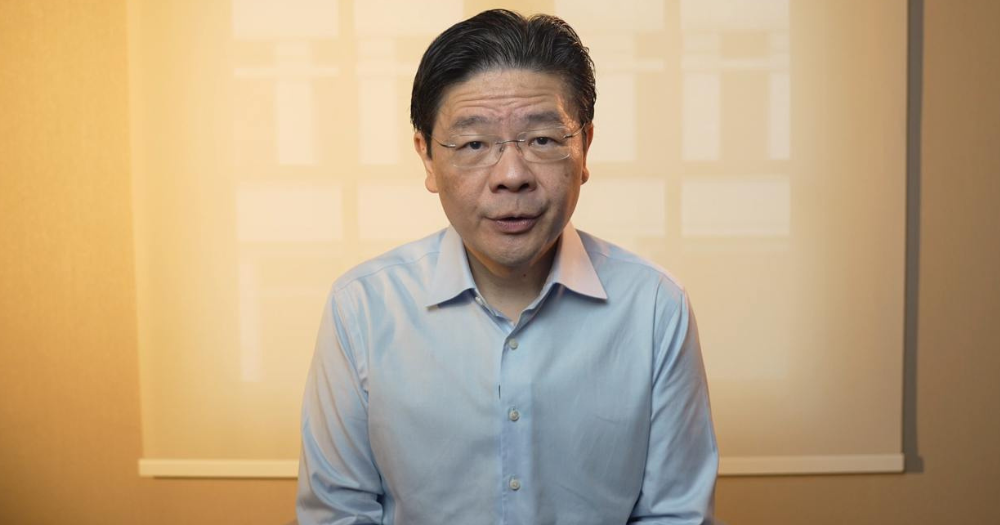
Top image via MDDI/YouTube