Environment

In 2024, S'pore experienced 18-day dry spell, intense Sumatra squall & heavy rain leading to flash floods
An eventful year.
March 23, 2025, 10:24 AM


2024 was a rather eventful year when it came to weather phenomenon.
An annual climate assessment of the previous year by the Meteorological Service Singapore showed that there were three notable weather events, all of which happened in the second half of 2024.
The report, which was released on Mar. 23, covers Singapore's main climactic features and notable weather records of the year.
It also highlighted that 2024 was Singapore's warmest year on record, tied with 2019 and 2016.
Dry spell
To jolt your memory, a dry spell occurred here in the second half of July 2024.
Singapore and the surrounding region experienced some rather dry weather, partly due to the formation of at least three tropical cyclones in the northern part of the South China Sea.
With stronger winds and the movement of drier air into the region, Singapore experienced a dry spell that lasted 18 days from Jul. 13 to Jul. 30, 2024.
There was little rainfall during the period as well, and daily maximum temperatures ranged between 32.8°C and 35.2°C.
This was Singapore's first dry spell since 2019, with the last recorded dry spell from July to August 2019 lasting 17 days.
Sumatra squall
You're unlikely to forget the very rainy and blustery evening on Sep. 17.
This was when an intense and fast-moving Sumatra squall line developed over the Strait of Malacca and swept across the whole of Singapore from 7pm to 8:30pm.
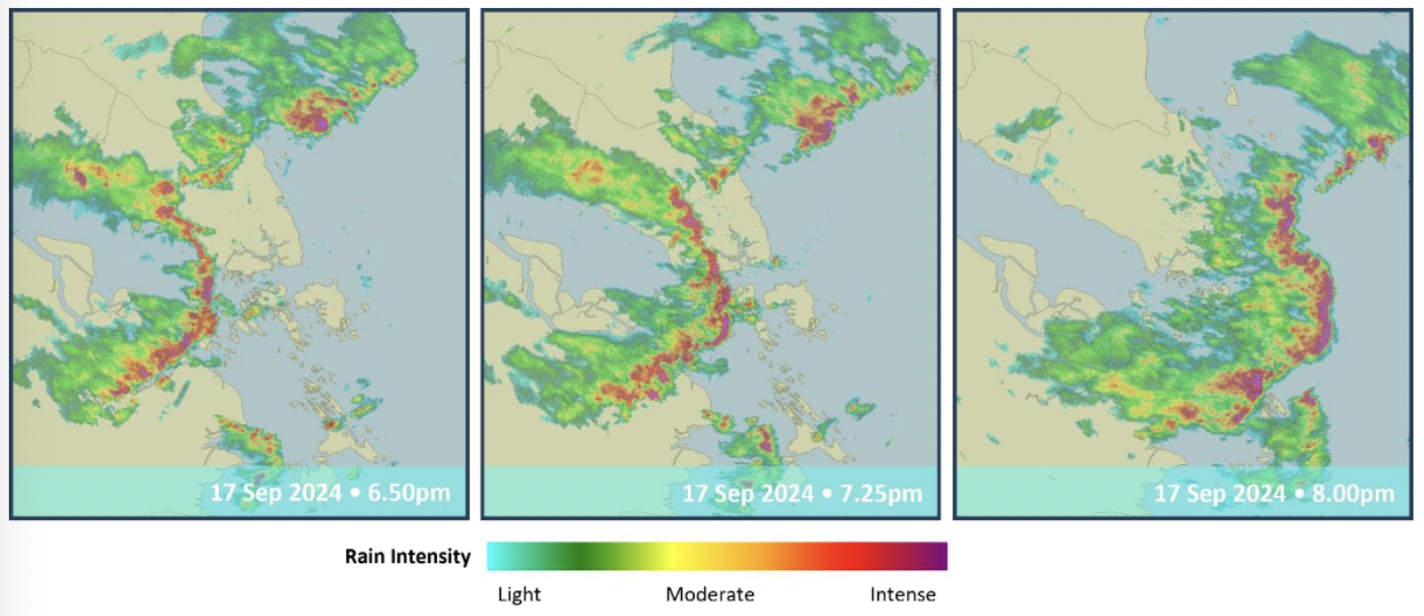 The squall line moving across Singapore, starting from 6:50pm to 8pm. Screenshot from MSS
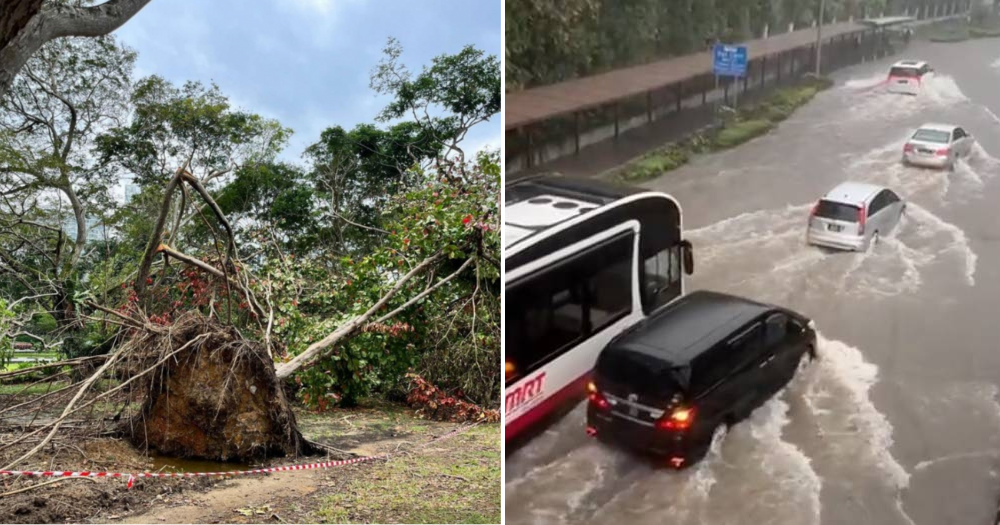
The storm brought heavy rains, strong winds that sent clothes flying, and even felled trees.
The strongest wind gust of 83.2km/h was recorded at East Coast Parkway at 7:33pm.
Temperatures also dropped rapidly.
The steepest temperature drop over a five-minute period was observed — at Ang Mo Kio, the mercury decreased by 7.1°C, from 30.9°C at 7:24pm to 23.8°C at 7:29pm.
Although it felt like Singapore was lashed with an insane amount of rain, the squall was so fast-moving that Singapore’s islandwide average rainfall from the event was only about 10.3mm.
Flash floods
Not forgetting the inter-monsoon period towards the end of 2024, where Singapore experienced more heavy rain in October.
On Oct. 14, regional convergence of winds caused widespread thunderstorms over the island.
Over 100mm of rainfall was recorded at many areas in the southern, western and central parts of Singapore, such as Jurong, Clementi, Queenstown, and Bukit Timah.
The heavy rain led to flash floods.
According to PUB, 134.8mm of rainfall was recorded in western Singapore from 8:15am to 1:50pm, which is among the highest recorded in over 40 years.
Top photo from Malcolm Tan via MSS and James Fong