News

S'pore woman loses S$1.2 million over month-long scam to fake Anti-Scam Centre officials
The scammers said she was suspected of money laundering, and asked her to "prove her innocence".
March 19, 2025, 11:24 AM
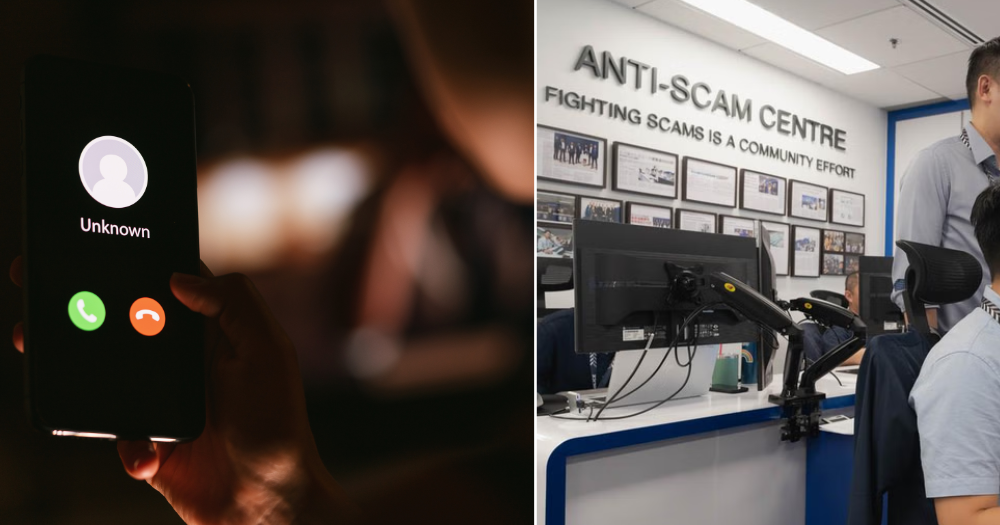


A woman in Singapore working in finance lost S$1.2 million to scammers masquerading as officials from the Singapore Police Force's Anti-Scam Centre (ASC).
In an elaborate scam lasting more than a month, the victim in her 50s was led to believe that she was suspected of money laundering by the authorities and that she had to "prove her innocence".
Under the guise of assisting in police investigations, she opened a new bank account to transfer S$180,000 to the scammers, and passed them the remainder in cash via physical meetups.
It was money she had been saving to pay off a new house.
Accused of involvement in money laundering
Speaking to the media on Mar. 14, the victim, "Jane", said she first came in contact with the scammers on Dec. 11, 2024, reported The Straits Times and CNA.
Jane was having breakfast that morning when she got a call from a woman claiming to be from the ASC.
The woman, "Jenny Koo", told Jane her NRIC had been used to register a SIM card that sent out spam messages.
When Jane asked for the address the SIM card was registered under, she realised it was not hers.
Jenny then advised Jane to lodge a police report, and redirected the call to the "police investigation team".
A second scammer, "Inspector Yang", picked up the call.
Yang told Jane that based on "checks", a UOB branch manager named "Serena Chilyn" had used Jane's identity to open an account used for money laundering and taken 10 per cent in commissions.
Asked to 'prove innocence'
Yang said Jane would have to prove her innocence by updating him on her movements four times a day over WhatsApp, and also provide bank statements.
Jane felt the call was legitimate as Yang seemed to be conversing with another party through a walkie-talkie, CNA reported.
However, she was still suspicious of Yang's claims.
When she challenged Yang to prove his identity, he showed her a fake police pass.
As Jane was an existing UOB customer, she also asked Yang why UOB did not send her any notification about the new "account" opened using her details.
Yang replied that Serena, as a branch manager, was able to "hide" the account.
Jane said she had her doubts initially.
But after talking with Yang over the next few days, she was slowly convinced he was investigating her case.
Jane was also warned not to share information with third parties.
Jane, who was dealing with the death of her father at the time, while feeling overworked and unwell, complied, according to ST.
She said she was "not in the state of mind to decide anything" and was also worried she might get detained.
Transferred money to assist "police"
Next, Yang redirected Jane to his "senior officer" to apply for what he called a "priority financial inspection".
Upon Yang's instructions, Jane withdrew S$500,000 of her savings and opened a new account at a Chinese bank to deposit it.
The "senior officer", who called himself "Inspector Chong", told Jane they needed her help to trap fraudsters like Serena.
Under the impression that she was helping the police, Jane made nine bank transfers from the Chinese bank account to the scammers between Dec. 18 and 19, each under S$20,000.
She had been told that these were just "dummy" payments to draw Serena out, and her money would be intact.
Jane transferred a total of S$180,000 to the scammers this way, which alerted the real ASC.
Lost S$1.2 million in a month
But Chong had pre-empted this, and already warned Jane that the ASC would call her.
He instructed her to tell them that she knew what they were doing, and assured her that she didn't have to tell them the truth as she was already assisting the "police".
It was when ASC called Jane, and repeated what Chong said they would, that Jane was finally convinced the scammers were telling the truth.
"I don't know why they said exactly what he said. (It) made me believe what he said," said Jane, as quoted by CNA.
After the Chinese bank suspended Jane's account for the suspicious transfers, the scammers asked her to close the account, withdraw the remaining S$320,000 cash and hand it over in person.
At the first meetup at a public space in central Singapore, Chong stayed on the line with her, ST reported.
Following Chong's instructions, Jane passed the cash to a Chinese man with a local accent, who looked to be in his 30s.
Three more meetups were arranged for Jane to hand over even more cash to the scammers for "investigation" purposes.
She ended up losing S$1.2 million to the scammers in just over a month.
The scammers stopped replying Jane altogether from Jan. 24.
After 10 days of no replies from them, Jane realised she might have been scammed.
As she was recovering from her illness, Jane lodged a police report two days after that, on Feb. 6.
How to avoid scams
Scam victims lost over S$1.1 billion in 2024, with 1,504 reported cases of government official impersonation scams.
In at least two cases, S$73,000 was lost to robocalls claiming to be from the police's Anti-Scam Centre.
SPF previously said that the police would never ask an individual to transfer money into a bank account under their name or another person's name to assist in investigations.
MAS also said banks will not transfer calls to any party outside the bank, such as the police or government officials.
Members of the public are also advised to adopt precautionary measures to safeguard against scams, such as using the ScamShield app and website, and enabling two-factor authentication (2FA) or Multifactor Authentication for online accounts.
They are also advised to tell the authorities, family, and friends when they encounter scams.
Those with information relating to scams, or who are in doubt, can call the police hotline at 1800-255-0000, or submit a report online.
More information on scams can be found on the ScamShield website or via the ScamShield Helpline, 1799.
Top image from Canva