News

War in Taiwan Strait would be 'catastrophic', no reason for war under status quo: Ng Eng Hen
Ng said that Singapore's relations with the United States were "very good", and that he and Defence Secretary Pete Hegseth "were on the same page".
February 26, 2025, 03:41 PM


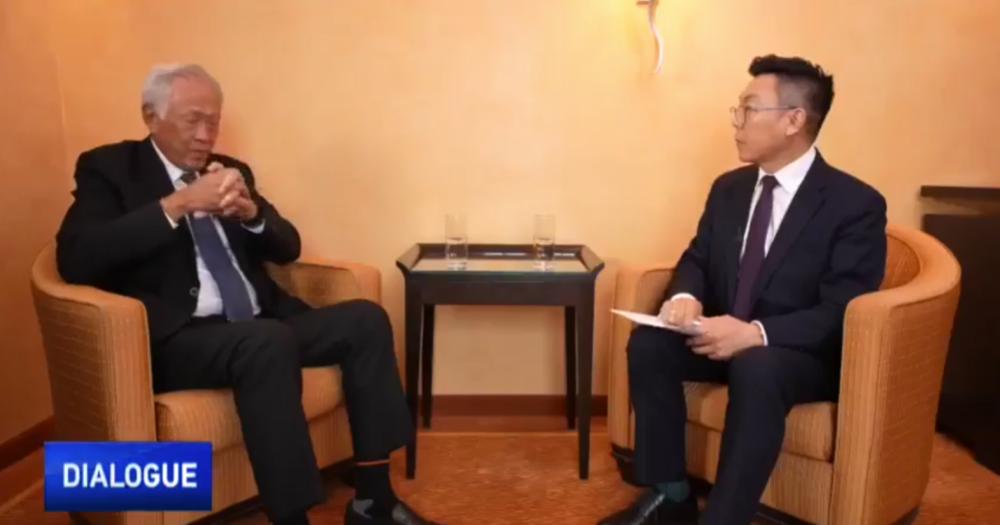
Singapore's Defence Minister Ng Eng Hen spoke to Chinese broadcaster CGTN while attending this year's Munich security conference (Feb 14 -16).
In a 15-minute interview, which was subsequently published a few days after the conference, Ng covered the Ukrainian peace process, concerns about the changing world, as well as the ongoing situation in Taiwan.
No cause for war in Taiwan
The interviewer asked about the tendency of the previous U.S. administration under Joe Biden for being strategically vague regarding Taiwan, where some might have favoured more clarity.
Ng was also asked what the future of the U.S.'s Taiwan policy would be under Trump.
Ng downplayed the potential for conflict in Taiwan, and instead mentioned comments made the year before by China's foreign minister Wang Yi.
Wang had said in 2024 that there were only three conditions that would cause conflict over Taiwan.
The first is if Taiwan declared independence, the second is if another country should act for Taiwan to gain its independence, and finally if all peaceful means had been exhausted.
Ng said the answer was "crystal clear" and that the status quo was best for all involved.
Under status quo conditions, China had no cause to go to war, and thus, war over Taiwan would be averted.
But he also warned that any such war would be "catastrophic".
Dynamics between U.S. & China
Ng said that it was interesting to note that the goal of the U.S. Secretary of Defense Pete Hegseth was to avoid war with China and this is "quite positive".
Ng noted that Hegseth wanted to focus on Asia, and appreciated the fact that U.S.' starting basis is to avoid war with China, and he welcomed it.
He said that while more details are needed from the U.S., Ng viewed a desire to talk about hot button issues as "positive moves".
Ng also noted that the relations between Singapore and U.S. are "very good".
Ng had also spoken to Hegseth and they are "on the same page" in terms of continuing what Hegseth's predecessors have done.
Ukrainian assurance
Ng shared his takeaways from discussions with European leaders regarding the war in Ukraine.
Ng said the war was taking place in Europe's backyard, that after three years of war, "everyone would welcome peace," and that any peace proposal "is worth looking at."
But European leaders also insisted that Ukraine had to be part of the peace process, and that is sovereignty and there should be a process such that "you won't see an invasion again a few years later".
While membership of NATO, which was mooted under the Biden Administration and rejected by the Trump Administration, may be a "bridge too far" for some, another security guarantee should be scoped.
Europe and other countries would have to "step up", and Russia would have to offer assurances that would be acceptable to Ukraine.
While peace would be welcomed, there were limits in that area.
"European nations also know that without the assurance to Ukraine, they would have sent a wrong signal of rewarding aggression to Russia," Ng said.
Multipolarity
Ng was also asked about the conference's theme of multipolarity, with the interviewer stating that the conference participants had spoken of it as if it were a "fact".
Ng agreed, saying that it was "indeed a fact", and gave the example of China's growth in the spheres of global trade and military capacity.
China, compared to when it first acceded to the World Trade Organization, had become a large share of global trade.
China's military capability had similarly made great strides.
Ng said that the question was not if the three large countries, the U.S., China, and Russia, come to an "accommodation".
The rest of the world in addition to those three, Ng said, would want some kind of assurance, "along the same lines that Ukraine needs assurances".
If
"Other countries would like an international system where might is not right, where there were rules that all countries must comply with."
Using the interviewer's leader's words to illustrate his point, Ng said what he said was consistent with China's President Xi Jinping's "global vision".
"If," he said, that's the basis of the assurances, it would be accepted by many countries.
The SEAside
The interviewer noted the ongoing South China Sea (SCS) issue as a related one to that of Taiwan, asking if China and Asean countries were capable of managing disputes in the SCS without affection efforts for cooperation.
Ng said it was possible, but not before noting that China had conflicting goals in the area.
The first goal was to establish a forward defence line, in order to combat what China perceived as attempts to contain it by the U.S.
This, Ng said, was an understandable goal, even if some still found it unacceptable.
But the pursuit of that goal where those attempts involved disputed areas of the SCS where four Asean member nations claimed as their Exclusive Economic Zones and went against the United Nations Convention on the Law of the Sea (UNCLOS).
While Ng thought it may be possible for those disputes to be resolved, it was ultimately up to China and the four Asean states.
He also warned that China's pursuit of its forward defence line in the South China Sea had affected how countries such as the Philippines and Vietnam perceived it, as well as around the globe.
But that was for "China to sort out".
Top image via CGTN/YouTube