News

S'pore woman & domestic worker help rescue 3 baby civets trapped in drain at Sin Ming
The mother was initially seen nearby looking distressed.
February 27, 2025, 03:23 PM
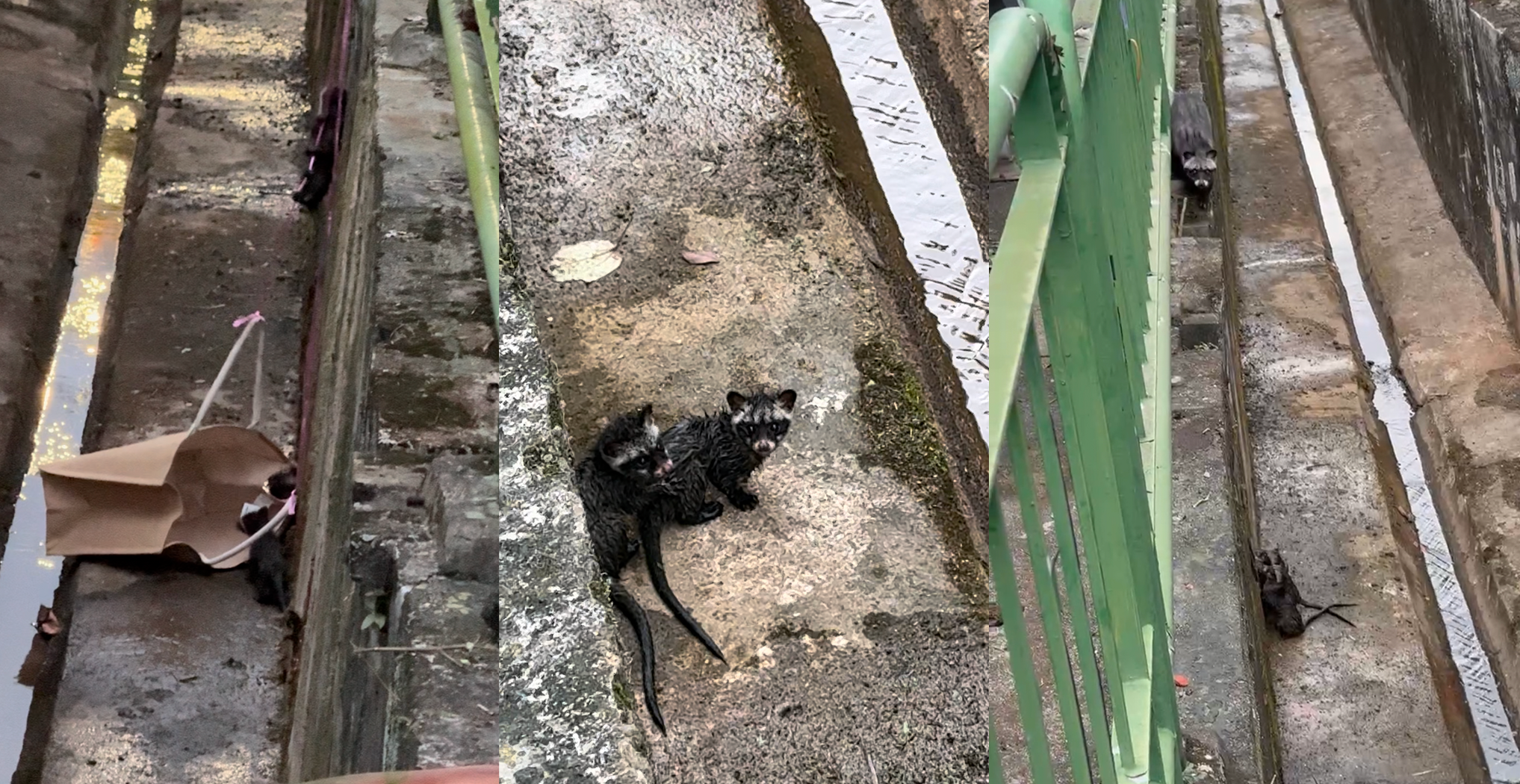


While on her way home on Feb. 25, a woman was passing by a canal near Bright Hill MRT station when she heard some high-pitched squeaking sounds coming from inside.
The woman, who gave her name as Maddy, saw a foreign domestic worker peering at what appeared to be a bundle of black fur inside the drain.
Thinking that there were kittens stuck in the drain, she went to take a closer look — and saw instead three juvenile civets.
They had been stuck there almost the entire day, according to the helper.
"[The helper] mentioned that if it rains eventually, they would likely die," Maddy recalled.
She added that the baby civets were "visibly distressed, calling out and looking around frantically".
They also had wet fur and looked "very pitiful", Maddy said.
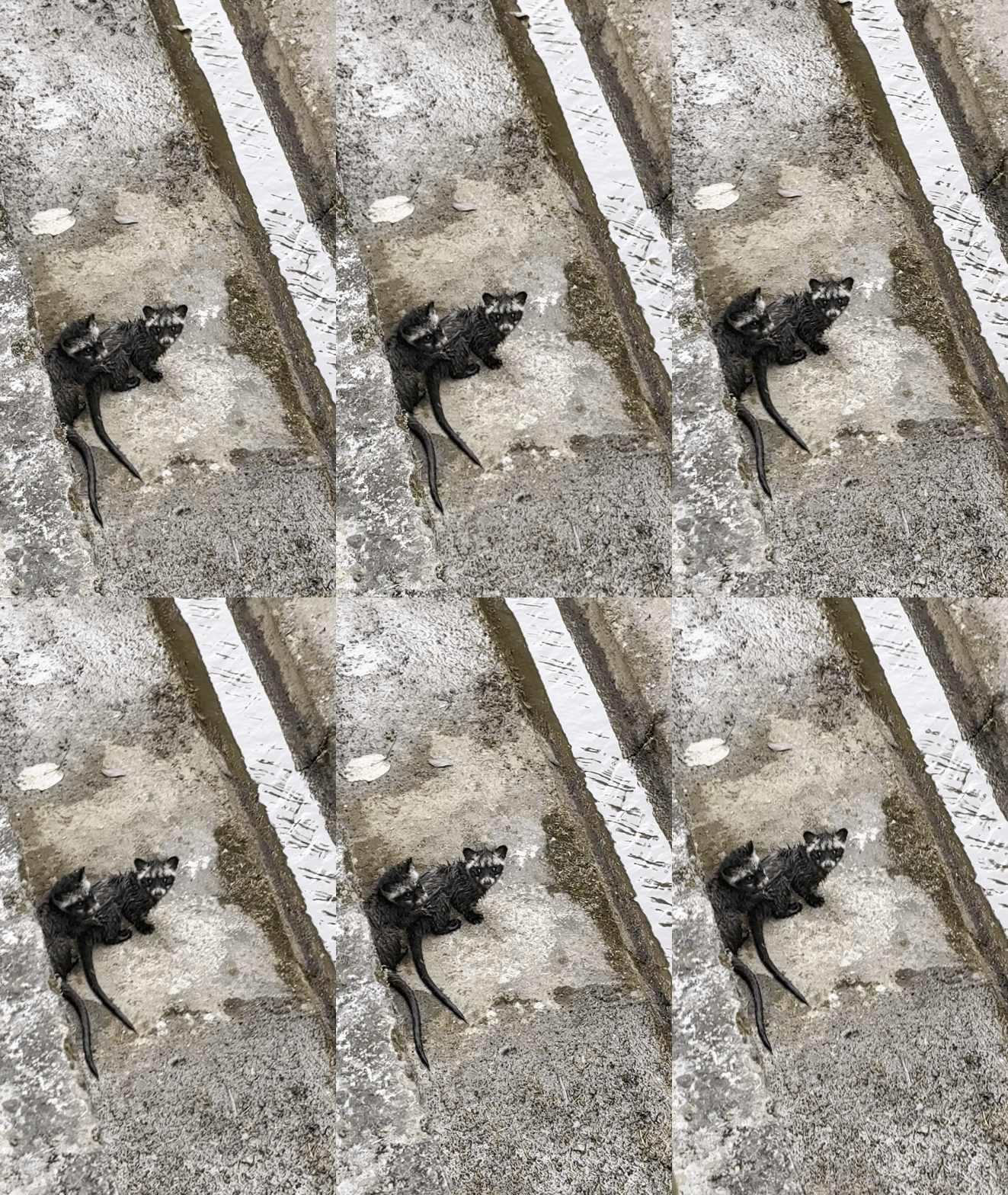 Gif from @meowdebirb/Instagram
A heartbreaking sight
After a while, a larger civet — which the two women assumed to be the babies' mother — appeared from a nearby pipe.
She also looked "very distressed" and kept pacing around.
While the mother was able to jump high enough to reach the pipe leading out of the drain, her babies were too small to follow suit.
She tried carrying the babies by the scruff of their necks, but couldn't jump high enough while holding on to them, Maddy said.
"They were all quite scared but kept looking at me as though asking for help...they started inching closer to me, continuing to cry out for help while giving me helpless, desperate looks," she told Mothership.
"It was very heartbreaking to watch."
 Gif by @meowdebirb/Instagram
Rescue effort
Maddy's initial reaction was to enter the drain to rescue the stranded baby civets.
But she could not find a way to climb down.
In hopes of getting help, she contacted the Animal Concerns Research and Education Society (Acres).
However, she was informed that they were handling other cases at the moment, and suggested she let down a rope, bed sheet, or towel to allow the babies to climb up from the drain.
"I quickly called my partner to help bring a long towel and a big bag down to try what Acres suggested," she said.
"For the next 20 mins we tried the towel method, but the civets were scared of the towel and kept moving away from it. They barely even tried climbing it."
As it was getting dark, Maddy felt increasingly anxious.
She went to the house where she'd earlier met the helper and asked for some rope or string.
She and her partner then tied the raffia string to the big bag, and dangled it into the drain, hoping the civets would enter the bag or try to climb the string.
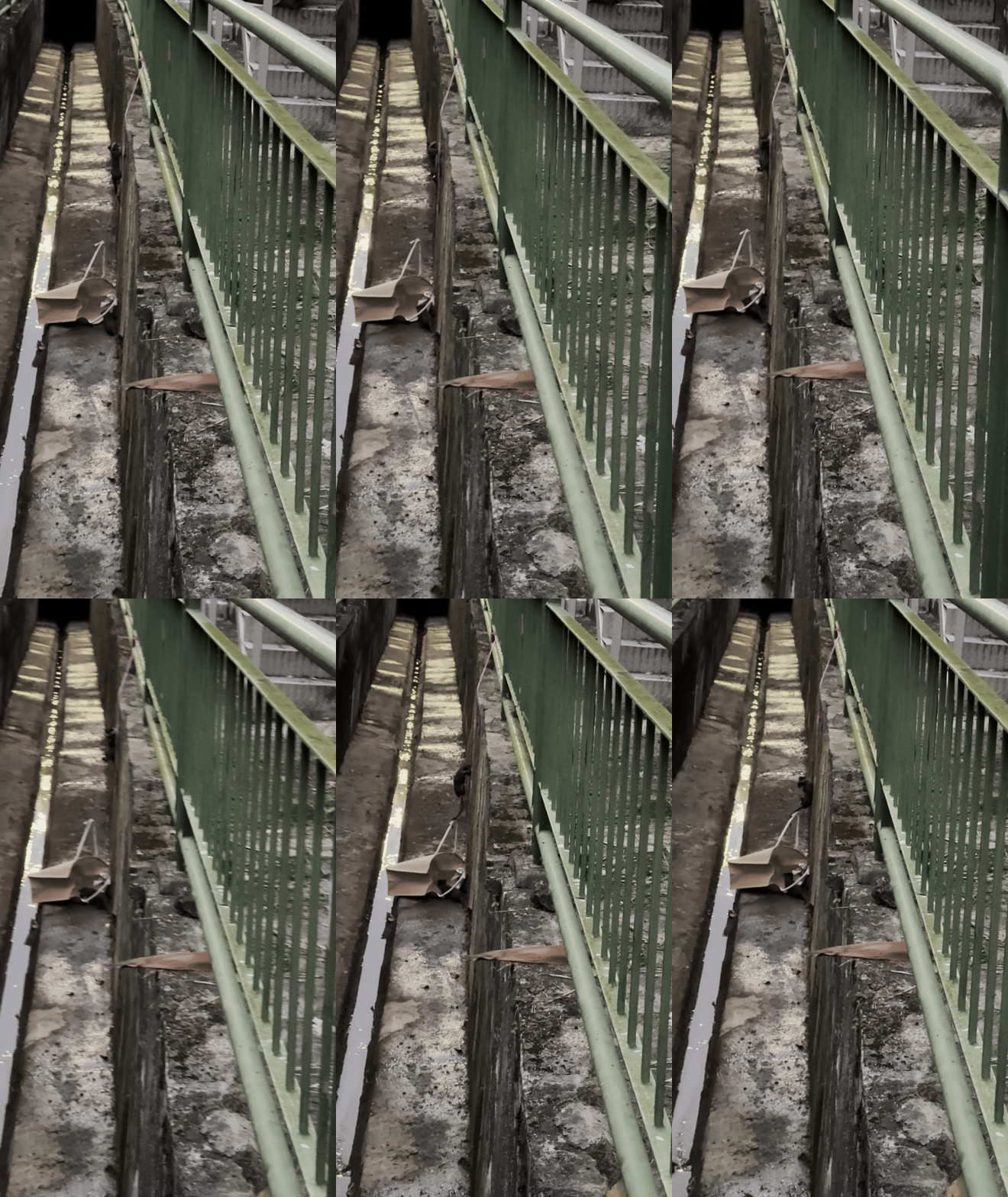 Gif from @meowdebirb/Instagram
One failed to climb the rope and another got frightened and ran away, but the third civet crept into the bag, and they were able to pull it to safety.
The baby civet then quickly ran away.
 Gif from @meowdebirb/Instagram
Second try
The other two civets however, were too afraid to enter the bag.
Fortunately, the helper appeared with a large net, "like those for catching koi fishes in ponds", Maddy said.
They used the net to gently scoop the civets out of the drain, and were able to successfully bring them to safety.
"The whole thing took about an hour," Maddy said.
While the mother civet had not yet reappeared, when they returned about an hour later, all the babies were gone.
"Hopefully, their mother came back to call for them and they were reunited," she said.
About civets
Native to Singapore, civet cats can usually be found in forests, parks, and mangroves.
They are nocturnal by nature and like to stay in trees and high places, according to the National Parks Board (NParks).
The furry creatures are omnivorous and enjoy fruits and seeds, but will also eat small snakes, birds, insects, and rats.
In Indonesia, civets are trapped, traded, and fed coffee beans which, when passed out, are highly valued for their taste and known as "kopi luwak". This is typically at the expense of the welfare of these creatures.
If you encounter a baby civet, it's best to leave them alone and not attempt to pick them up, so as to allow their mother to attend to them.
Members of the public can also contact Acres at its Wildlife Rescue Hotline at 97837782, or NParks' Animal Response Centre at 1800 476 1600.
Top image from @meowdebirb/Instagram