News

President Tharman: Countries need to tackle jobs gap challenge, or face a crisis of social compact
Soft skills can also be gained through a technical education, not just an academic one.
January 23, 2025, 09:06 AM
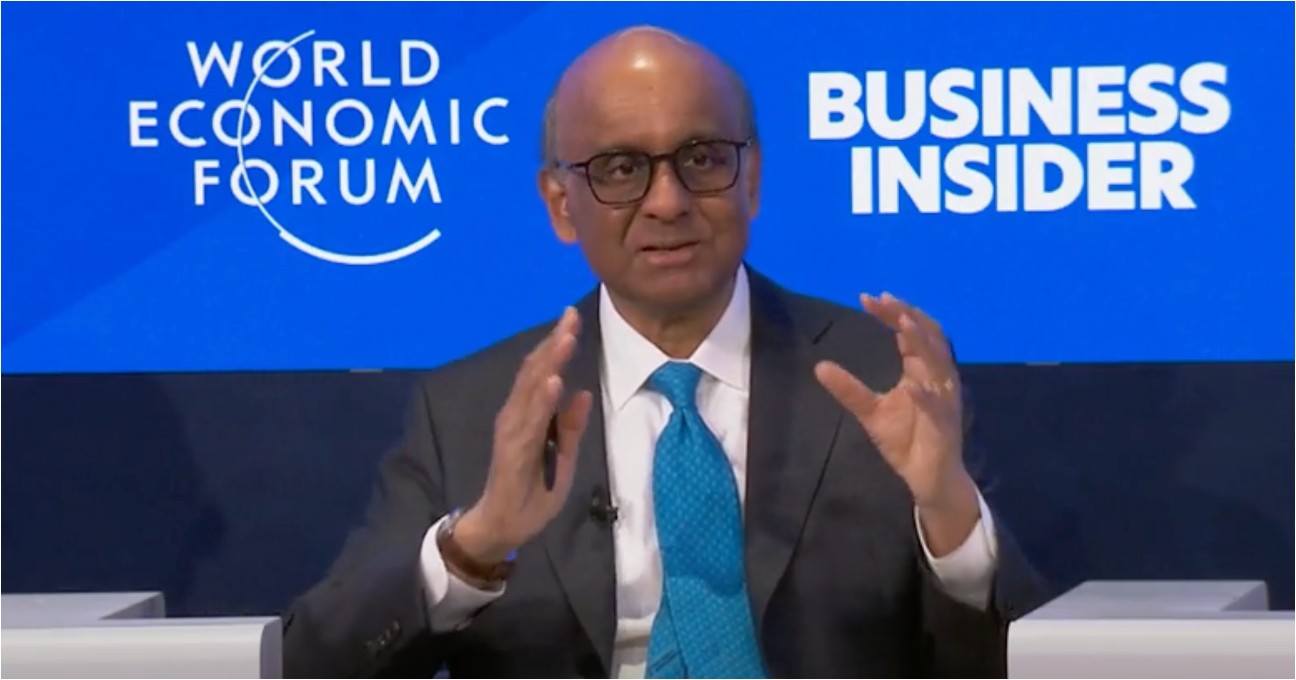


The world faces huge challenges trying to narrow the "jobs gap", but efforts must be made to help students and workers gain relevant skills.
Otherwise, this won't just lead to an economic problem, but a broader, societal crisis, said President Tharman Shanmugaratnam.
President Tharman was speaking at the World Economic Forum (WEF) in Davos, Switzerland on Jan. 22, 2025, at a panel, "Closing the Jobs Gap."
Under-employment challenge
President Tharman said that with an estimated 1.2 billion people entering the global workforce in the next 10 years, and with an estimated 400 million jobs being created, that would leave a shortfall of 800 million.
These people who do not secure jobs would find their way into the informal economy, be under-employed or remain jobless.
The consequences would not just be limited to economics, as there would also be social and political consequences that shape a new "international disorder".
"It's also not just a crisis of jobs we face, but a crisis of social compact. It's a crisis of hope, of self-belief and dignity and a crisis of solidarity," he said.
Therefore, the challenge is not just for government officials and unions, but rather a broader, societal-wide and international challenge.
President Tharman also highlighted the importance of acting early and what is done to develop human potential through life, as it shapes how well they do in their jobs.
"Whether they retain jobs, whether they are able to adjust to the churn in the job market, whether they end up feeling they've had a satisfactory career."
School education is critical
"What happens in school is critical," said President Tharman.
He made the point that the countries in the top five or 10 places in the global PISA rankings, while acknowledging the rankings are not perfect, are "dominated" by public school systems.
In contrast, other countries had private schools at the top.
This, President Tharman said, demonstrates that it is possible to provide high quality education on a broad base, and to prepare whole cohorts of students for doing well at work.
However, education is critical and doesn't stop at school.
"It requires continuous investment through life, in human potential," he said.
Problems caused by mismatch of skills
President Tharman then turned to another potential problem caused by a mismatch of skills and aspirations.
This occurs when students have invested resources in a tertiary education, enter the job market and cannot find jobs that match their skills and aspirations.
This is a major challenge, which if left unsolved, is more than an economics problem.
"We get a problem... of a whole generation feeling the system has failed them," President Tharman said.
So, what can be done?
Importance of technical education
The first involves changing what students do before they join the workforce.
In most countries, tertiary education systems have been expanded but "over-academised", with technical skills neglected.
This results in an education system tilted heavily towards one particular model of education, that previously only applied to a very narrow cohort of students when university education in general was rare.
It also created a hierarchy where academic skills are ranked above technical skills, or those acquired through experience.
"And that's at the heart of the mismatch, between what people are trained for and what the job market and employers want," President Tharman said.
The education system can be reoriented, so that graduates can leave with skills they know are relevant.
Soft skills don't just come from a traditional academic education
The second thing to keep in mind is that important soft skills and a broad education do not just come from traditional academic education.
A technical education can also impart important soft skills, such as working in a team or anticipating surprises.
"There's a whole range of soft skills that take you through life. There's a whole range of intellectual breadth as well," President Tharman said.
He added that "breadth of mind" can also be developed in the workplace and through technical education, where one has to toggle between different technologies and concepts to keep pace with the changing nature of work.
"I don't want to knock too hard the traditional model, but it shouldn't be defining the broad landscape of higher education," he added.
Education continues in the workforce
But what happens when people are already in the workforce, and no longer young graduates?
Churn is going to continue, jobs are going to be displaced, and artificial intelligence (AI) is going to be a more "powerful driver of disruption" than previous technologies.
What can be done now is to continually develop one's skills, to reduce the prospect of AI being "substitutive" and increase the chances of it being complementary to human skills.
"In other words, don't wait to see what happens 15, 20, years from now. Start acting now in skills development, which means when people are still at work, when they're still in their prime, they haven't lost their job, they haven't been dislocated. Invest now and invest continually."
Those who suffer from job disruption need help
President Tharman stressed that ways should be found where communities and individuals who have lost their jobs, can be re-trained for new employers and areas of demand.
He gave the example of coal workers, whose jobs are being displaced as alternate sources of energy are being used.
Workers in places like Germany, South Africa and South Korea were placed in jobs in other industries, or given training for skills that allowed them to work elsewhere.
"That has to be at the core of economic strategy and business strategy, and of governments working together with businesses.
Creative disruption is part of the health of any economy, but the creation often happens in a different place from the dislocation, and we've got to take care of those whose jobs have been dislocated and help them to get back in."
Informal economy
President Tharman made a final point about workers in the informal sector, typically in developing countries, with no job security and often no skills that would allow them to progress.
He referred to Singapore's efforts to give gig workers or platform workers workplace injury compensation and ensure mandatory social security contributions.
Governments can also ensure that employers feel like they have a responsibility to build up skills over time, even in the informal sector.
These efforts can help reduce the bifurcation between the formal and informal sector, help workers in the latter sector gain skills and income, and feel like they have "some control" over their lives.
Related story:
Top image from World Economic Forum.