



News


Govts are asking their citizens to stockpile food & supplies. What's going on & should you be worried?
This is it, the apocalypse?
November 07, 2026, 07:50 AM


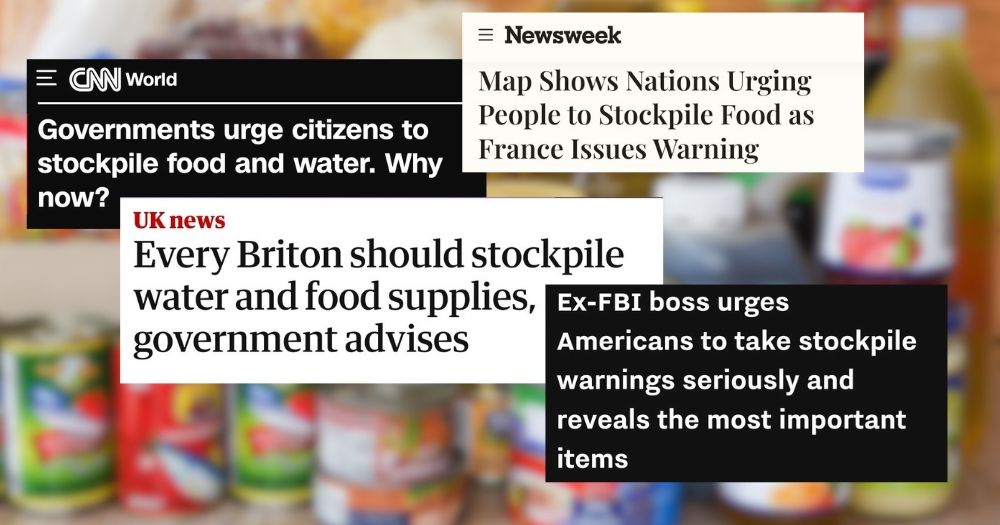
Recently, you might have come across some alarming headlines like this and this about governments urging their citizens to stockpile food.
It's uncanny and unsettling, and if it is making you anxious, you're not the only one.
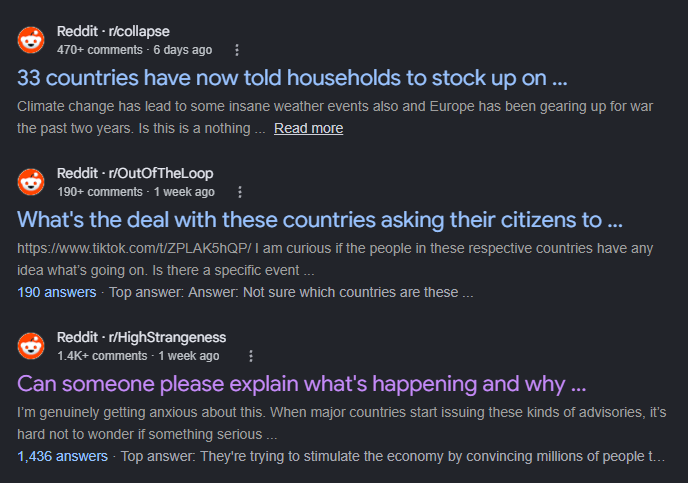
Rife speculation has prompted governments to assure their citizens.
On Oct. 29, Thailand's National Security Council denied reports that it had issued an advisory to citizens about stockpiling in response to the conflict in the Middle East. Similarly, Malaysia's deputy prime minister Ahmad Zahid Hamidi said, emphatically, that the country is "not in a state of emergency" and has enough food to tide the country though six months.
Is something major about to happen? Do we, here in Singapore, need to start stocking up as well? Are we experiencing the end times?
Before you head to the nearest Sheng Siong to start bulk-buying toilet paper, here's what's going on.
Citizens urged to stockpile—but for different reasons
Yes, citizens in a few places have been urged to stockpile food, but for completely different reasons and contexts.
The UK government launched the Be Ready campaign on Oct. 22, encouraging its citizens to have three days' worth of supplies in the event of severe weather or cyberattack.
"Are you emergency ready?" the campaign website asks.
"Being ready for 3 days helps you manage while support reaches those in need," it reads.
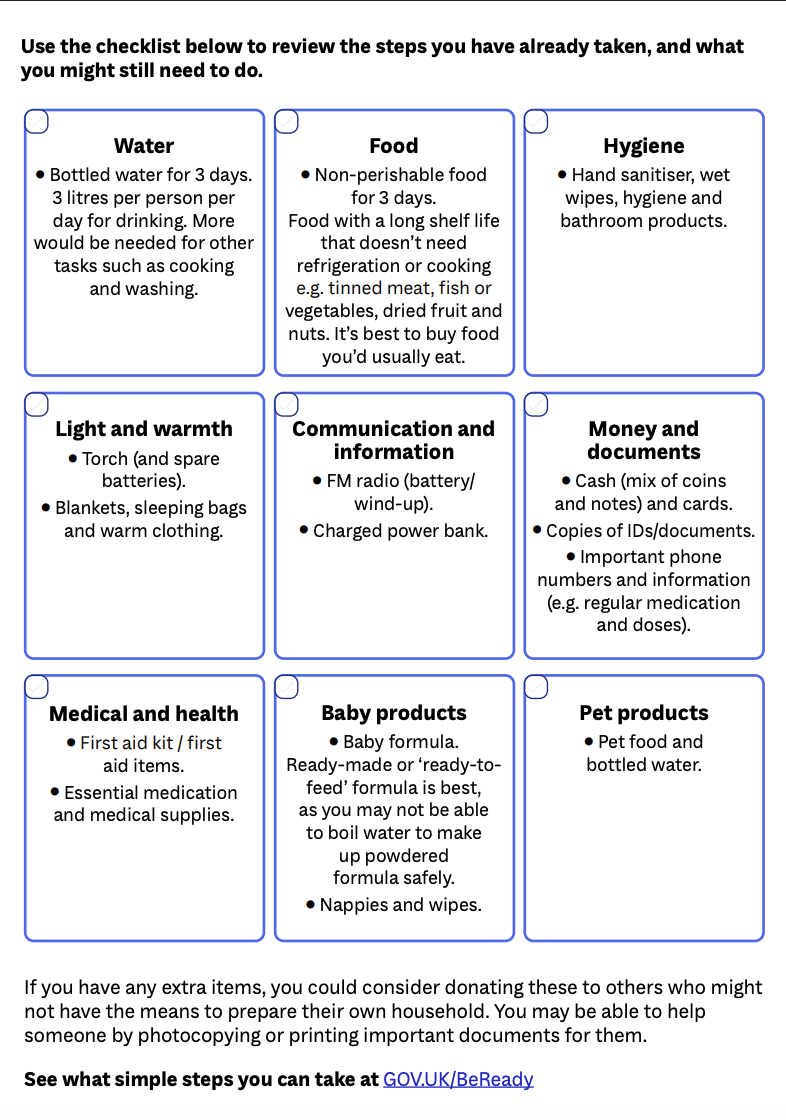 UK's "Be Ready" checklist. Screenshot via "Be Ready" website.
Speaking on the campaign, UK prime minister Andy Burnham, who apparently has stockpiles of beans, soup and Twiglets, said the move was aimed at preparing people at a time where "unexpected events seem to be becoming more and more common".
Less than a week later, officials in Normandy put out a post on social media advising residents to prepare their 72-hour emergency kits early.
Don't wait for the emergency, prepare now!" the post read on Facebook.
Officials in Normandy did not provide a reason for this notice but it came amid a period of social unrest that resulted in violent clashes and infrastructural disruptions.
Across the world, the head of Japan's newly launched National Disaster Management Agency also urged citizens on Nov. 2 to stock up on water and food supplies enough to last three days to a week.
Framed as an "emergency request", the chief, Goshi Hosono, said the country should prepare for large-scale disasters, including a potential megaquake in the Nankai Trough off the Pacific coast.
Aside from storing food, the agency also asked people to take measures such as securing their furniture to walls and familiarising themselves with the locations of evacuation shelters.
These have also prompted authorities in other jurisdictions, such as Canada and Mexico, to reiterate their own preparedness advisories.
Not new
Taken together, these advisories might give the impression that governments around the world are suddenly scrambling to respond to an imminent threat.
However, the truth is emergency planning has been intensified for years now in response to a world that that increasingly prone to conflict, extreme natural disasters, infrastructural sabotage and more.
When the European Union launched its Preparedness Union Strategy in March 2025, its Commissioner for Preparedness, Crisis Management and Equality, Hadja Lahbib, called for a more proactive and integrated response to the "fast, complex, and interconnected" threats that Europe faces today.
Nordic countries have also been priming their citizens since Russia's invasion of Ukraine in 2022, bracing them for a whole host of calamities from terrorism to the collapse of the Internet.
No single threat
Richard Clarke, a former White House counter-terrorism adviser, told CNN in an interview that there is "no specific threat" spurring the recent global push for citizens to maintain an inventory of essential supplies.
Clarke acknowledged that being prepared is "smart" and "prudent" given the possibility of threats like natural disasters and war.
In particular, Clarke pointed out the "fragile" nature of supply systems due to their dependence on the internet. These are vulnerable to attacks, more so at a time when artificial intelligence can greatly boost a rogue hacker's ability to break into and shut down networks.
The recent supermarket cyber attacks in Europe illustrate this.
In the past month, supermarkets across Europe have repeatedly been targeted by cyber attacks, with hackers remotely raising freezer temperatures and causing food to go bad.
Blood banks in France were also targeted in November. While these attacks were unsuccessful, they posed a risk to the 19,000 hospitals in France that depend on the blood products from these blood banks.
What about Singapore?
Singapore hasn't made similar announcements although the government has longstanding preparedness advisories for emergencies.
The Singapore Civil Defence Force (SCDF) recommends putting together a Ready Bag containing essentials like an N95 mask and first aid kit, which should be brought along when one needs to evacuate the house.
Food stockpiling is managed by the state, which maintains reserves of essential food items like rice, canned vegetables, and frozen proteins. These reserves are meant to act as a buffer while food supply is being restored during a widespread disruption.
Singaporeans are encouraged not to hoard food and instead exercise flexibility in switching to alternative brands or substitute foods when a specific item is unavailable.
As for inculcating a culture of preparedness, Singapore's answer to that is Total Defence. Introduced in 1984 as the country's "national defence concept" as a safeguard against military threats, Total Defence has evolved to cover non-conventional threats such as pandemic and disinformation warfare.
It isn't an abstract concept; preparing a Ready Bag and being flexible about options during a food shortage are practical examples of Psychological Defence.
TL;DR: Don't worry
So, is a major emergency on the horizon? Not really.
However, the prospect of it has increased not just in possibility, but complexity; it pays to be alert—not just to our immediate surroundings, but also to happenings in the world.
In some countries, the threat of war is more apparent. In others, natural disasters are a constant worry. As technology gets more sophisticated, cyber attacks pose a danger to most advanced societies reliant on digital infrastructure.
Facing all these, it would seem apt for governments to take a prudent approach to increase awareness and resilience among its citizenry, even though the threat is not imminent.
If you decide to start preparing for an emergency now, there is no need to rush or panic. It is just good practice.