



News


No new faces in PAP's top leadership signals party's preference for stability & continuity: Analysts
But some first-term political office-holders such as Jeffrey Siow and Jasmin Lau might get co-opted later, analysts believe.
October 25, 2026, 08:21 PM
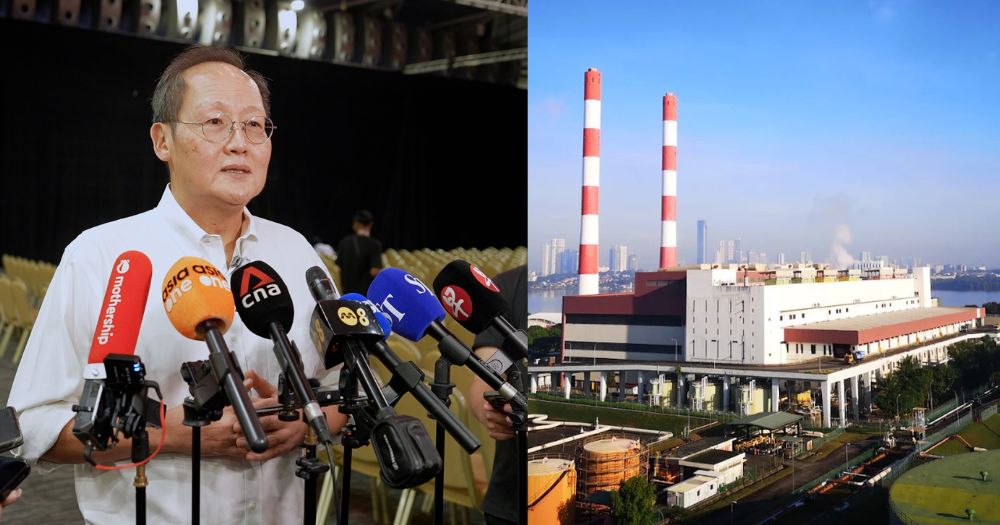
Photo by Mothership


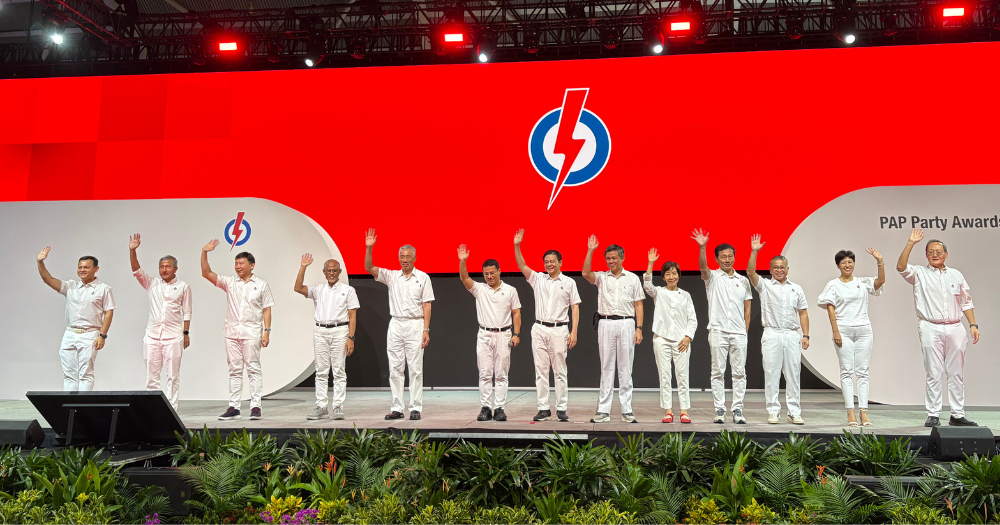
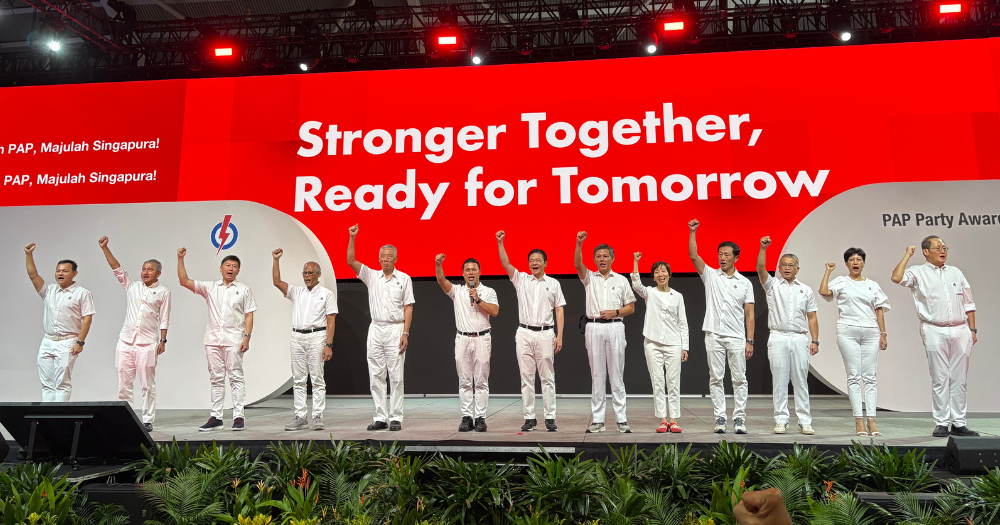
The People's Action Party (PAP)'s newly announced central executive committee (CEC) on Oct. 25 saw the previous line-up of core leaders re-elected, with all 14 members returning from the previous CEC.
The CEC is the highest decision-making body of the party, making major decisions on election candidates.
Most of the analysts Mothership spoke to found the election results slightly surprising, given how Prime Minister Lawrence Wong spoke about party renewal ahead of the biennial conference where the vote took place.
In a video on Oct. 24, PM Wong called the party conference an important occasion for such renewal, and looked forward to working with "a team that brings experience as well as fresh perspectives".
The July Cabinet reshuffle also pointed to an emerging fifth-generation (5G) leadership from the PAP bench, particularly with the promotions of Jeffrey Siow and David Neo as ministers, and Jasmin Lau as acting minister.
However, none of these three first-term political office-holders were elected or co-opted to the CEC on Oct. 25.
Before the vote in the morning, The Straits Times reported that Siow and Lau were included in a list of 19 candidates that the PAP gave the 3,000 cadres to consider.
Party sources told ST that there were seven that the party encouraged the cadres to vote for.
They were reportedly PM Wong, Lee Hsien Loong, K Shanmugam, Desmond Lee, Chan Chun Sing, Masagos Zulkifli, and Grace Fu.
All of them were elected among the top 12 vote-getters along with Chee Hong Tat, Edwin Tong, Indranee Rajah, Ong Ye Kung and Vivian Balakrishnan.
Tan See Leng and Zaqy Mohamad were directly co-opted after receiving the next-highest number of votes.
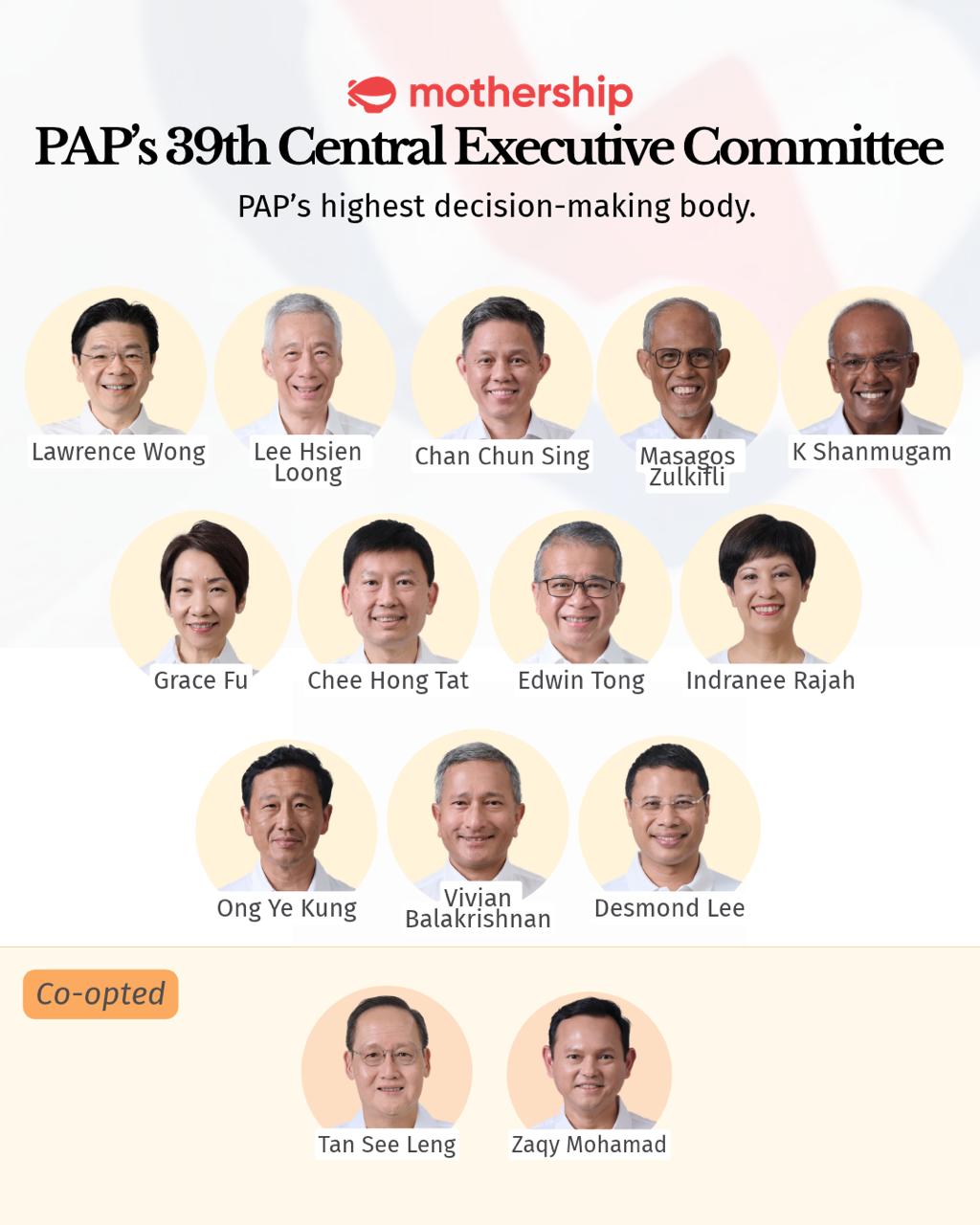 Image by Mothership
Continuity now, renewal later
What does the outcome suggest about the PAP cadres' view of the top leadership? Is the party on track for a 5G renewal?
Eugene Tan, political analyst and associate professor of Law at Singapore Management University (SMU), believes the outcome was a vote for continuity and consolidation of the party leadership.
Though somewhat surprised, having read PM Wong's Oct. 24 video as signalling "support for new blood", Tan nevertheless finds no "misalignment in terms of the intent and need for renewal".
"It’s more a matter of when rather than whether the 5G leaders will be on the CEC," he said.
"It can be said that the party cadres are of the view that the 5G leaders will gradually be elected in the CEC elections of 2028 and 2030, when renewal will have to be the overarching theme."
This view was echoed by independent analyst Felix Tan, who said that the "only real surprise is that there were no changes to the existing line-up".
Tan said that the PAP has opted for continuity rather than renewal at this juncture.
He believes that the younger leaders such as Siow and Lau were left out because PAP cadre members may not yet be ready to embrace significant change, and prefer continuity and the existing leadership structure for now.
"Given the wider regional and global uncertainties, there may simply be a greater premium placed on stability and experience at this juncture," he opined.
He saw the election outcome possibly as a "carefully calibrated balance" to maintain the status quo for now while still leaving room for some of the newer faces to be co-opted later.
Both Eugene Tan and Felix Tan find it likely that Siow and Lau would be co-opted into the CEC eventually.
Eugene Tan said it could happen at the first CEC meeting, where the committee typically co-opts another four members.
While believing that the subsequent co-option of newer faces would introduce some renewal, Felix Tan pointed out that it may be seen as "more symbolic than substantive, given that the core leadership remains largely unchanged".
A reflection of favour and power
Getting elected to the CEC signalled where a person stood as a party leader to the cadres.
Noting that Siow and Lau had joined the party just before the 2025 General Election, Eugene Tan felt it should not be surprising that their standing and popularity within the party have "yet to be firmly established at this time".
"There are limited directly elected seats on the CEC so to be among the 12 top vote-getters was a tall order from the get-go," he said.
"But given that they were on the list of recommended candidates, it does point to the previous CEC holding them in high regard."
To Walid Jumblatt Abdullah, Associate Professor at the Nanyang Technological University (NTU) School of Social Sciences, the election results are "basically status quo".
Similar to Eugene Tan, he said that Siow and Lau not getting elected shows that PAP cadres do not see them as among the most important people in the leadership at the moment.
However, this could change fast if they do a good job in their respective ministries, he added.
He highlighted that the list of recommended candidates, particularly the marked out group of seven, is a reflection of who is in more favour or has more power.
By that understanding, he noted the absences of ministerial heavyweights like Gan Kim Yong and Ong Ye Kung in the group of seven.
Walid also noted that Zaqy, who was made Acting Minister-in-charge of Muslim Affairs in July, was not included in the group of seven, where Masagos was the Malay representative.
But Walid believes Zaqy, like Siow and Lau, could move up in standing if he performs well in his new role.
On Zaqy getting directly co-opted this time, Eugene Tan said it does not take anything away from him.
"It is a recognition that he can, with party vice-chair Masagos, better represent the Malay community on the CEC."
Another notable outcome was Chee Hong Tat, who was co-opted in the 2024 CEC election, getting voted in among the top 12 for the first time.
Eugene Tan found this unsurprising. "Chee is slated for bigger roles in government and his party certainly rates him highly as well," he said.
Felix Tan expressed caution about interpreting the elections as a popularity contest, but shared the other analysts' views that those who have taken on greater roles and responsibilities over the past year may "naturally" have strengthened their standing within the party.
Changes to come?
Apart from who makes up the CEC, it will also be of significance to note the roles each member will take on in the committee.
Such appointments are usually decided and announced at the first CEC meeting, along with the further co-options.
Although Felix Tan sees some possibility that the appointments could change, he did not expect any major shifts.
"Any changes are more likely to involve a reshuffling of roles and responsibilities among existing members, rather than significant changes to who is actually in the CEC," he said.
Eugene Tan foresees Desmond Lee and PM Wong continuing as party chairman and secretary-general respectively, as well as the three 3G leaders (Lee Hsien Loong, K Shanmugam, and Vivan Balakrishnan) remaining as regular CEC members to offer experience and advice.
A possible change would be to have two or more assistant secretary-generals, with Chan Chun Sing staying on in the role and joined by Chee Hong Tat and/or Ong Ye Kung, he said.
As for the additional co-options, he named Ng Chee Meng, "by virtue of his being the labour chief" of the NTUC. Ng has also returned to the Cabinet.
It would be likely that the CEC also co-opts a non-MP to signal that people who had voted for the PAP in Workers' Party-held wards are represented as well, he added.