Abroad


As Trump & Xi meet, where are China's business leaders?
When Xi visited the United States in 2015, he brought a significant business delegation.
September 26, 2026, 01:46 AM
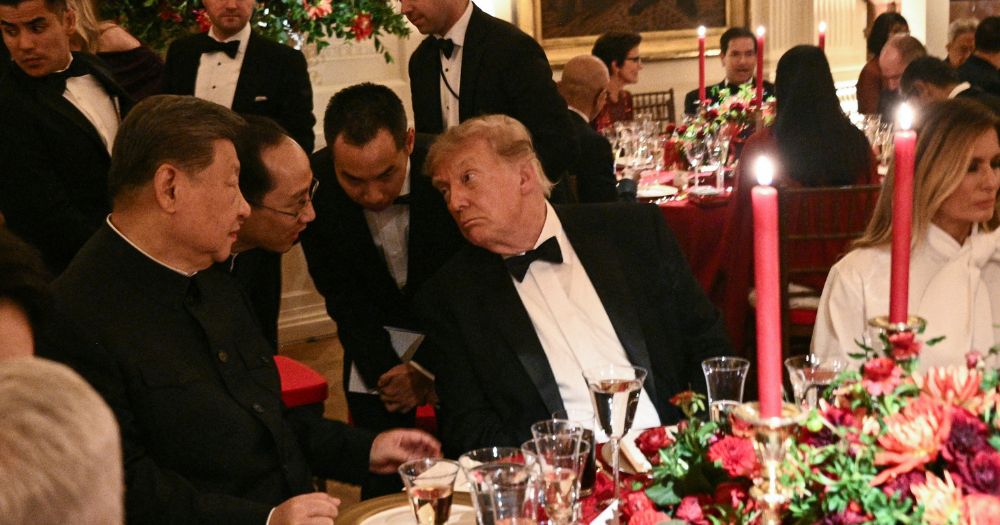
Image via AFP
Xi Jinping’s first and only full day in the United States during his second state visit was capped by a state banquet with 134 guests.
A glance at the guest list was telling: out of those 134, only 19 were from the Chinese delegation, including Xi and his wife.
The remaining 17 were all Chinese government officials, from Politburo standing member Cai Qi, foreign minister Wang Yi, to the ambassador to the U.S. and China’s MFA’s deputy director general for North American and Oceanian affairs.
Guest list
On the U.S. side, there were the senior leaders of the U.S. government, including three supreme court justices, several cabinet secretaries, senators, congressmen, and advisers.
But perhaps of more note was the number of CEOs and business leaders present.
Technology hardware leaders like Nvidia’s Jensen Huang, AMD’s Lisa Su, and former Apple CEO and current Executive Chairman Tim Cook all sat at the head table with Xi and U.S. President Donald Trump.
Then there were the tech leaders, like Sam Altman, Mark Zuckerberg, Sundar Pichai, and Elon Musk, the latter of whom also sat at the head table.
Rounding out the list were aerospace company leaders from the likes of Lockheed Martin and Boeing, financial leaders from Goldman Sachs, and even pharmaceutical companies, like Pfizer CEO Albert Bourla.
But where were the Chinese businesses?
What you wouldn’t have seen was any Chinese tech leaders.
There was a matter of some confusion about this as late as this weekend. There were still rumours that China intended to bring along a sizable business contingent.
The Financial Review said that until days before Xi's arrival, there were discussions about the inclusion of executives from companies such as BYD, Xiaomi, battery manufacturer CATL, as well as the Bank of China.
But as Xi set off, it was revealed that the Chinese delegation would contain no business leaders, immediately sparking speculation as to why.
Did Xi leave them out?
A CNA report indicates that Xi rarely travels abroad with a large business delegation, especially after China's crackdown on tech, education and property sectors, which began in 2020.
This is in contrast to his 2015 state visit, which was overall more expansive in nature.
Not only did his business contingent then consist of a large number of executives from Chinese banks, state-owned companies, but it also included China's own tech giants like Jack Ma of Alibaba and Tencent's Pony Ma.
Both Mas have been investigated for wrongdoing in the years since that visit, and China’s tech leaders have since sought to lower their profile as a response.
Corporate restrictions
The Financial Review also suggested that some Chinese companies were not eager to invest in the United States, quoting The Asia Society Policy Institute's Centre for China Analysis' Neil Thomas.
Thomas said that many Chinese companies were acutely aware of the political risks they face in the U.S. and that restrictions on Chinese investment could tighten further in the near future due to security concerns.
Many of the companies that might have been part of a Chinese delegation were currently subject to U.S. restrictions or intense political scrutiny, such as companies like CATL and BYD due to their links to the Chinese military.
Meanwhile, access to U.S. technology, such as Nvidia chips, by Chinese companies is subject to significant restriction.
As a senior fellow at the S. Rajaratnam School of International Studies Drew Thompson put it, there may have been very little reason for Chinese business leaders to head on the trip.
Protocol issues
But as the visit developed, stories emerged that the lack of representation was not exactly a response from corporate leaders.
By Sep. 24, the day of the state banquet, outlets such as the South China Morning Post and Nikkei both reported that Chinese CEOs had travelled to Washington in the hope that they would be able to attend.
Nikkei reported that senior executives from BYD and Xiaomi both travelled to Washington, despite other reports indicating that no Chinese executives had applied for visas in recent days.
There was even a discussion about a corporate leaders' roundtable at one point before the idea was nixed.
NPR suggested that the reason for the lack of invitations was due to the U.S. leaving planning for the event until very late, with significant details of the visit still to be finalised as much as a week before it started.
U.S. planners had apparently taken a stance of “perfect reciprocity” when dealing with the event's logistics; that is to say, they refused to offer any programming or access beyond what was available to Trump when he visited in May.
One example was a possible speech at a U.S. university by Xi which was abandoned early on, as Trump had not been asked to make a similar speech in May.
Reciprocity
But this would not explain the lack of corporate representation, as one of the more remarkable aspects of Trump's May visit: the number of tech CEOs that had travelled to Beijing with him on Air Force One.
Some had even boarded in Alaska while Trump's plane was being refuelled.
While China’s MFA did not release a full list of attendees of the May banquet, it is known that a number of Chinese business leaders were in attendance, so for them to attend would have fulfilled the “reciprocity” requirement.
CNBC reported at the time that some of the leaders in attendance included the co-founder of ByteDance (TikTok's parent company) Liang Rubo, and Xiaomi CEO Lei Jun.
Insiders that NPR spoke to suggested that Chinese diplomats were chafing at their U.S. counterparts’ tendency to arrange events in an ad hoc manner; one was even quoted as calling their process “half-assed”.
Diplotainment?
Ultimately, trade and commerce between the two superpowers remain a fraught topic, despite the warm welcome Trump has put on for Xi.
One of the most critical topics up for discussion, a resolution to the ongoing trade war, has not yielded a solution, with both countries instead agreeing to extend a current “trade truce” agreed upon in Busan last year until January 2027.
There is a feeling that whatever the reason, whether it was reluctance on the part of the Chinese CEOs or U.S. diplomats not being proactive enough, there was not enough motivation to ensure Chinese business leaders' participation.
It resulted in a very lopsided state dinner attendance, both in terms of ratio and in terms of attendee backgrounds.
It feeds into a sentiment, expressed by Senate Democrats critical of the conduct of the visit, that the event had an air of “diplotainment”, rather than true diplomacy.
Trump, for his part, has been effusive in his praise of Xi and of the summit, describing the meeting as “very productive” and predicting “tremendous things”.