News


Govt reviewing 2007 to 2011 property purchase records of rail planning officers to assess misconduct alleged in study
Reviewing records from 2007 to 2011.
September 25, 2026, 06:31 PM
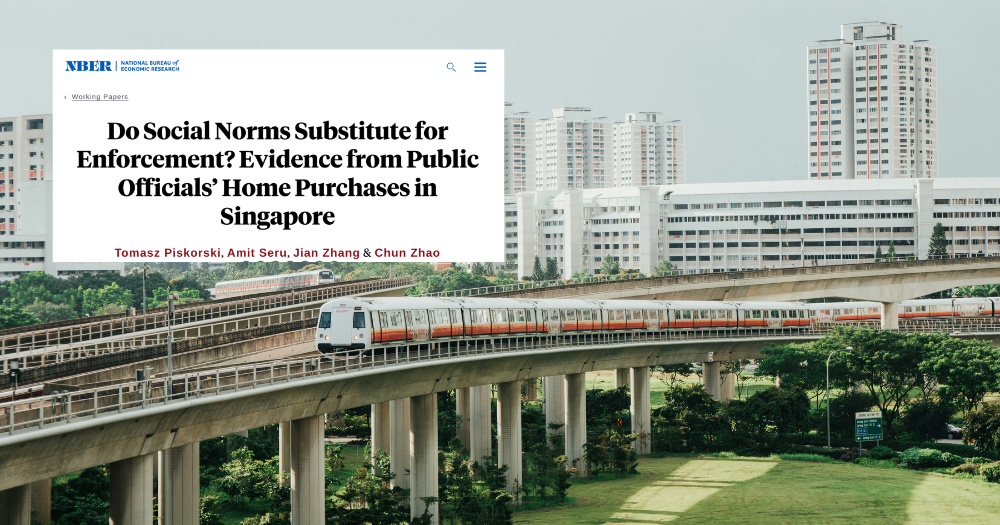
Photo via NBER, Unsplash.


The government is undertaking a review to identify property purchases made between 2007 and 2011 by officers who were involved in rail planning at the time in order to assess if there was actual misconduct as alleged in a recent study.
The review was announced in a press release by the Public Service Division (PSD), an agency under the Prime Minister's Office, on Sep. 25.
The study was a working paper by the American non-profit National Bureau of Economic Research (NBER), which claimed to have found a pattern of mid-level Singapore civil servants purchasing homes near yet-to-be announced MRT stations.
Statistical patterns do not establish fault, but need for scrutiny
In its press release, PSD said that it takes the assertions of the paper seriously and that the statistical patterns reported in the paper are a "concern".
However, PSD clarified, "Statistical patterns do not by themselves establish whether any individual officer actually had access to non-public information on MRT station locations at the relevant time, or whether such information influenced a property purchase."
Explaining further, PSD noted that information or speculation about planned MRT lines and stations may already be in the public domain or used to market new property developments.
"An officer may have purchased a unit in such a development for reasons unrelated to any non-public information," PSD highlighted.
However, PSD reiterated that these "do not remove the need for scrutiny" but underscore the need for each transaction to be examined carefully before any conclusion is drawn.
Government reviewing 2007 to 2011 records among rail planning officers
Hence, the government is undertaking a review to assess "whether there was actual misconduct", PSD said.
It is identifying property purchases made between 2007 and 2011 by officers who were involved in rail planning at the time, and where the properties were close to locations subsequently announced as MRT stations.
This was the period and group of civil servants highlighted in the NBER paper.
"If we find evidence that an officer used non-public information to make a property purchase for personal benefit, the case will be referred to the Police for further investigation," PSD said.
PSD also said that the review will take time as the transactions took place "some time ago" and the records will have to be retrieved and examined.
Paper
The NBER working paper, titled "Do Social Norms Substitute For Enforcement? Evidence from Public Officials' Home Purchases in Singapore", was published earlier in September 2026.
It was authored by researchers from Stanford University, Columbia University and the University of Hong Kong.
In its preface, the co-authors noted that NBER working papers are circulated for discussion and comment purposes and have not been peer-reviewed or reviewed by its board of directors.
The researchers sought to answer whether anti-corruption social norms can substitute for formal enforcement to deter misconduct.
Singapore was selected as a case study as it is widely regarded as one of the world's least corrupt countries and provides a "sharp setting" to examine whether sustained anti-corruption enforcement can produce "self-sustaining norms".
The authors looked at whether civil servants in Singapore had engaged in "informed trading" by using privileged information about yet-to-be announced MRT stations to purchase property, in hopes of making personal gains.
Part of their hypothesis is that legislative changes to the Securities and Futures Act in 2012, as a form of enforcement, may have lowered the likelihood of misconduct.
Using their assembled data, the authors performed a statistical analysis to determine if there was a pattern of civil servants being more likely to have purchased properties near unannounced MRT stations, compared to non-civil servants which the authors looked at.
They claimed to have found such a statistical pattern.
According to the researchers, the fact that they did not find similar patterns among other comparable groups of people, such as corporate board members and property agents, supported their conclusion.