


News


Other country's social media bans will provide vital experience as S'pore seeks to shore up teen online safety
Social media bans in other countries have had disappointing results.
September 01, 2026, 07:04 PM
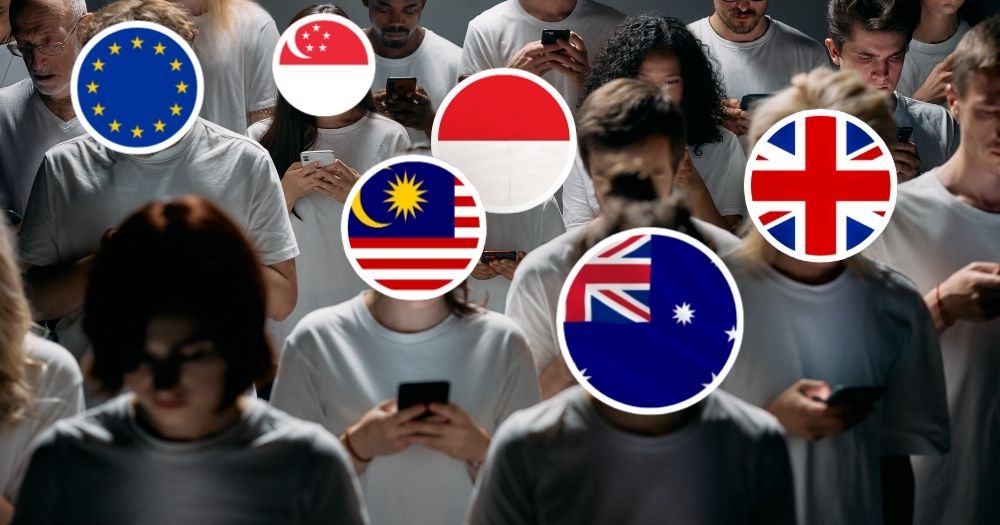
Image via Canva


Over the weekend, Singapore’s Minister for Digital Development and Information Josephine Teo spoke to the press about Singapore’s plans to introduce stronger social media safeguards for children and young teens.
During the 2026 National Day Rally, Prime Minister Lawrence Wong highlighted the need to help parents and children with social media safety.
He also stated that self-declaration by the platforms is just not good enough.
Other countries have attempted stringent social media bans; most famously, Australia was the first in the world when it banned teens under the age of 16 from social media in December 2025.
Malaysia is attempting to introduce similar laws, as is Indonesia, with their bans coming into force in the first half of 2026.
Rather than a blanket age ban, Teo indicated that Singapore’s response was looking to be more targeted, aiming at specific design elements of the platforms, rather than simply attempting to keep minors off the platforms altogether.
Experiences around the world
The Australian ban has been in place since December 2025, with Malaysia's ban coming into place in June 2026.
The UK's Online Safety Act has been in place since 2023, and while it is not a social media ban, some of its concerns overlap with other social media bans, resulting in similar enforcement measures.
But what these three laws and others like them have in common, and what they will have in common with Singapore's experience, is that they all required robust identification measures taken either on the part of the social media platforms or the government.
Australia
Australia, having the longest experience with such control measures, is probably the most informative, and for advocates of such principles, perhaps the most disappointing.
Simply put, it does not appear to be working about nine months in.
In a Bloomberg report published on August 25, children between the ages of 10 and 12, as well as between 13 and 15, were all using the social media platform TikTok in higher numbers now than before the ban was introduced.
An online safety expert Bloomberg spoke to, Yasmin London, said that there was an immediate drop in social media usage right after the ban was implemented, but a slow return to the previous usage number, and then an increase.
London said that young children wanted access to social media because they wanted to be connected just like the rest of us.
ABC News reports that one of the failures of the law appears to be the inability to correctly identify the age of a user.
Users have been able to get around age restrictions by using virtual private networks or what is described as a range of basic disguises, such as a latex mask of an old man's face.
The UK Online Safety Act had a similar problem when it was discovered that users could submit screenshots of a popular video game, Death Stranding 2, to circumvent online verification measures required by the UK government.
Another expert that ABC spoke to suggested that while age verification measures might work initially, if children had enough time, they would eventually find a way around them.
Malaysia
Malaysia, perhaps, might have thought it would be able to circumvent such verification issues, as it, like Singapore, had a robust digital ID system tied to government identification documents.
But a report published by The New York Times on Aug. 10 said that the ban has yet to fully come into force, even as concerns over social media influencing teen behavior boost the proposed ban's popularity with parents.
But implementing such changes in a relatively short time frame has proven difficult, forcing a deadline for major social media platforms to comply set at January 2027.
However, both international and local privacy advocates have warned that Malaysia's social media ban will end up impacting the privacy of both adults and children.
These echo concerns raised by similar advocates in Australia, the UK, and the European Union.
Thus far, the experience of these other states seems to imply that the downsides of such security checks will not be met with the upsides of reduced social media use from young children.
Stakeholder engagement
Perhaps then it is unsurprising that Teo and MDDI appear to be approaching similar concerns with some differences.
The full details of how Singapore aims to work with social media platforms in order to make them safer for minors can be read in the following two articles.
But there are particular aspects worth taking note of, for instance, Targeting platform features rather than taking particular aim at just age verification.
Teo Said that one of the stakeholder groups that the government had spoken to was teenagers who would be most impacted by any changes.
They, tellingly, spoke about their own concerns for the safety of social media users even younger than themselves.
These teens were spoken to and highlighted that social media spaces were where they met their friends and would like to continue doing so, although they acknowledged the safety concerns.
Understanding the concerns of the teens and how they use social media under the best of circumstances will allow for an approach that is less likely to be circumvented by such teens, rather than fruitlessly attempting to design a system that will contain them indefinitely.
Meta analysis
Another thing of note is the reference that Teo made to the recent settlement between Meta and several states in the United States.
Meta had been faced with a US$1.2 trillion (S$1.5 trillion) lawsuit, which was settled in late August, as reported by the BBC.
The settlement agreement was for $18 billion over ten years, but more important than the money, I would argue, were the safety measures that Meta agreed to implement in order to better protect young users.
These measures included daily time limits, hidden lights, muting notifications during school hours, Usage notifications, such as when teens use the platform for more than 15 minutes, and the ability to choose a feed not driven by an algorithm (author’s note: can this adult have this too?).
One feature that was explicitly spoken about was auto-play for videos and content.
Meta had agreed to allow that feature to be turned off with parental consent, whereas Teo noted that Singapore would prefer the alternative implementation that it would only be allowed with parental approval.
Buy in
The opening salvo of social media restrictions taken by other countries appears to have been unsuccessful in this initial phase and all countries attempting such a thing will now likely try to learn from it and implement more workable solutions.
While there are some advocates who would prefer an end to social media use for young children and teenagers altogether, Singapore's authorities appear to have accepted that doing so is extremely difficult and ultimately unlikely to succeed.
It is instead attempting to work more closely with platform owners on the understanding that any curbs that they wish to implement must have the buy-in of the platform users, as well as parents and even teenagers.