



Abroad


S'pore & Uzbekistan can work together to link up central & southeast Asia: SM Lee in speech to Uzbek parliament
SM Lee said the two countries had many opportunities to cooperate at a global, region to region, and bilateral level.
September 01, 2026, 05:47 PM
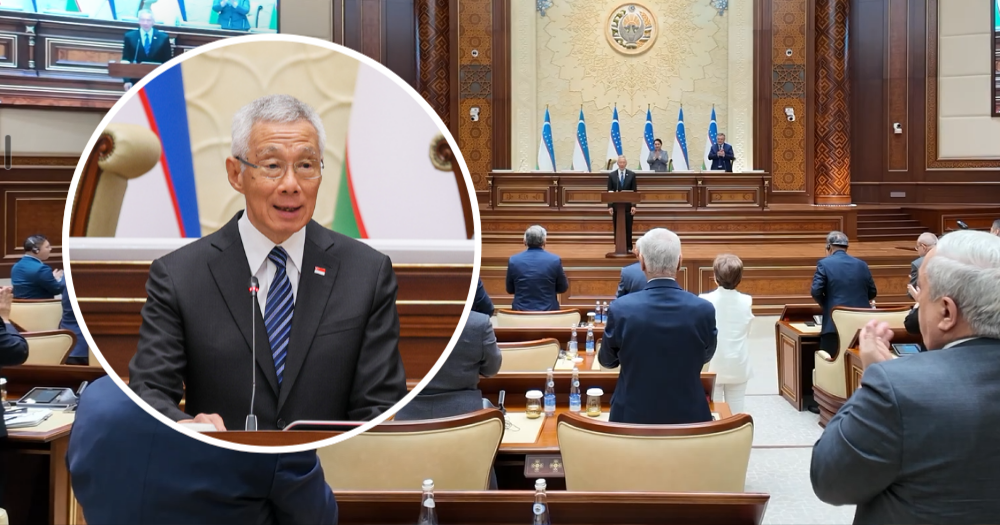
Image via Ministry of Digital Development and Information (MDDI)

 Senior Minister Lee Hsien Loong wrapped up his visit to Uzbekistan on Aug. 31, addressing the Uzbek parliament, the Oliy Majlis.
SM Lee has been in Uzbekistan since Aug. 27, after spending four days in Kazakhstan beforehand.
He was visiting at the invitation of Uzbek president Shavkat Mirziyoyev, back when the two men met in January 2023 while Mirziyoyev was visiting Singapore.
SM Lee spoke about his delight in visiting Uzbekistan, having read about its great cities as a child; he was saying how he had immediately accepted the 2023 invitation and how, after all these years, he had finally made it there.
Similarities beyond differences
Singapore and Uzbekistan differed greatly on the surface, being vastly different in size and in geography, but had significant similarities, both sitting along critical trade routes between China, and the Middle East and Europe.
In Uzbekistan's case, it was the Silk Road which allowed cities like Samarkand, Bukhara and Tashkent to prosper as they opened themselves up to travellers on the trade routes.
Singapore similarly prospered, being situated along the maritime silk route, with its modern incarnation having grown as a free trade port.
SM Lee reflected on the meeting that he had had with the Uzbek president when the latter visited in 2023, after which he realised that Singapore and Uzbekistan, at a fundamental level, face many similar challenges.
Both were tackling these challenges through similar strategies, and therefore had much to gain from exchanging views and learning from each other's experiences.
Multilateral cooperation
SM Lee noted Uzbekistan, in the past decade, had undertaken important reforms and opened itself to the world.
Uzbekistan and Singapore had both benefited greatly from the rules-based international order and from the multilateral trading system, as did many countries in the world.
But now it faced the erosion of that multilateralism, with rivalries and tensions between major powers growing, and many countries emphasising resilience and security over economic interdependence in response.
SM Lee cautioned against responding to such an environment of greater uncertainty and fewer opportunities by closing up.
Smaller countries like Singapore and Uzbekistan, he said, will always have to do business with the world, and closing ourselves off and turning inwards is simply impossible.
We must remain open and outward-looking and seek like-minded partners who will work with us to support and uphold multilateral rules.
In 2023, Singapore co-sponsored a resolution tabled at the United Nations by Uzbekistan on behalf of the Central Asian States called "Central Asia in the face of environmental challenges: strengthening regional solidarity for the sake of sustainable development and prosperity."
On the face of it, SM Lee said that this was a remote concern for a country like Singapore, but that when dealing with global challenges that affect us all, all countries are neighbours to one another.
He also welcomed Uzbekistan's chairmanship of the Non-Aligned Movement, saying that while the global environment was very different from when NAM was first founded, its basic objectives of enabling countries to preserve their independence and constructive relations with all remained relevant.
Connectivity between regions
SM Lee said that both countries could work together to link up Central Asia to Southeast Asia and grow cooperation between the two regions.
Singapore had long been seen as a gateway to Southeast Asia, and Uzbekistan was increasingly becoming a gateway to Central Asia, and it made sense to strengthen links between the two regions.
He welcomed Uzbekistan's early accession to ASEAN's Treaty of Amity and Cooperation, due to take place later this year in Manila, and hoped that other Central Asian states would do more with ASEAN as well.
Singapore will take up the chair of ASEAN in 2027, and it hoped to identify more opportunities for ASEAN to engage with partners beyond its traditional networks.
Bilateral Connections
SM Lee was also keen to highlight what more could be done with each other bilaterally.
On Aug. 28, SM Lee witnessed the signing of a joint statement formalising Singapore and Uzbekistan's intention to launch negotiations on a free trade agreement, as well as a memorandum of understanding to build an agribusiness facility in Tashkent.
He said that partnerships need not be confined to traditional sectors, suggesting shared challenges such as water management or areas where Singapore had developed expertise, such as fintech and financial technology.
He also spoke about cooperation in building institutions and developing people, saying that Singapore was happy to share its own experiences where it was relevant, and that several hundred Uzbek officials had come to Singapore for exposure and immersion.
These officials had received training in public administration, civil aviation, and urban development, and the two countries were exploring launching a dedicated programme for senior Uzbek government officials on leadership and governance.
New possibilities
SM Lee said that smaller countries had to continue to strengthen partnerships and cooperation globally, regionally, and bilaterally.
“This will help us to navigate the uncertainties and hazards safely, spot and exploit opportunities which will arise, and deliver better lives and brighter futures for our people.”
2027 would mark the 30th anniversary of diplomatic relations between Singapore and Uzbekistan, and SM Lee said that both countries should celebrate what they had achieved together and “work to create new possibilities for our partnership.”