Abroad


Indonesia just received a 'free' 40-year-old aircraft carrier from Italy, why?
Cheap to buy, expensive to keep.
September 18, 2026, 06:57 PM
Image via TNI AL/X & TNI AL/Facebook

 On Sep. 16, if you had a view of the Singapore Strait and you looked out over the sea, you would have seen… well, a lot of haze.
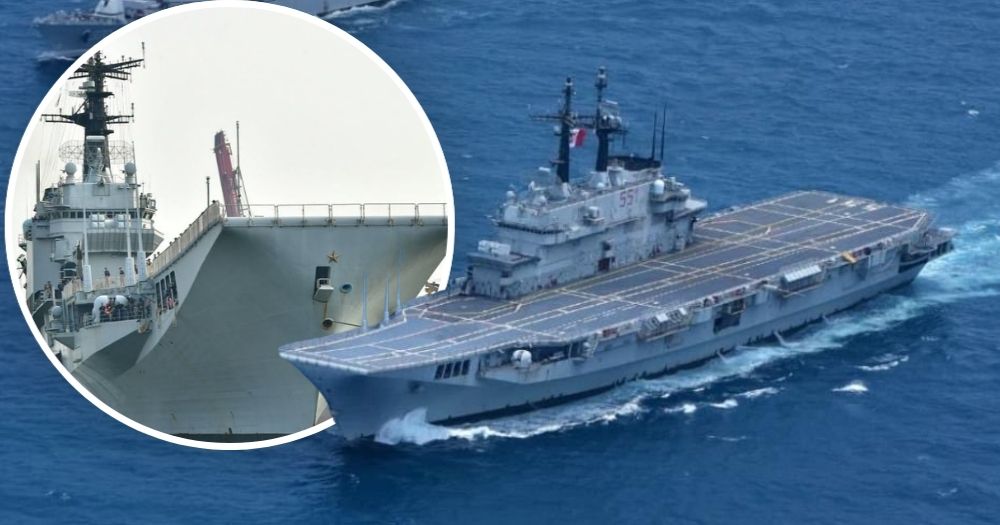
But in the mist you might have seen the ITS Giuseppe Garibaldi, a forty-year-old aircraft carrier, making its way through its final leg of a 20-day journey from Italy to Indonesia, its newest owner.
The Garibaldi is soon to be the KRI Sriwijaya, the latest addition to Indonesia’s navy, and is due to begin its new career as a… firefighter?
Why is Indonesia buying an aircraft carrier, what capabilities does it have, and how much will it cost?
And did you know it's the second Southeast Asian aircraft carrier still in service?
The Garibaldi/Sriwijaya
To answer the first question, one must know a little bit about the ITS Giuseppe Garibaldi, soon to be renamed the KRI Sriwijaya, in honour of the ancient sea-spanning empire that spanned from Java to parts of modern Cambodia.
Entering service in 1985, the aircraft carrier was meant to perform an anti-submarine mission, serving as a base for aircraft to hunt submarines in the Mediterranean.
Like many aircraft carriers, it was meant to serve at the centre of a Naval task force; according to Military Times, it was fitted with full flagship facilities as well as command, control, and communication systems for both naval and air force operations.
It also had the capability of carrying up to 600 troops for short periods.
Under Italian service, the ship's complement was up to 18 helicopters or 16 Harrier II jet fighters, or some combination of the two.
The Harrier II is notable for being able to hover and land similarly to a helicopter.
But aircraft of these types are in short supply nowadays, with the only comparable modern aircraft being the F-35B.
Thousands of islands, and reasons
The reasoning for an Indonesian aircraft carrier is not hard to fathom.
An archipelagic state that counts its islands in the tens of thousands, in recent decades, the Indonesian military understands it needs to bolster its naval forces as it seeks to police the vast maritime network that connects the country.
What is known of Indonesia’s planning for the Sriwijaya acknowledges this.
Several S. Rajaratnam School of International Studies papers, including an op-ed for The Diplomat, look at the procurement of the ship.
The Indonesian military says the Sriwijaya is destined for the humanitarian assistance and disaster relief (HADR) function, and that it can serve as a “floating aid ship”.
Bloomberg suggests that it could even be used to help fight the haze by launching water-bombing missions in Kalimantan.
Mother Ship
In this configuration, the ship is used less as a traditional aircraft carrier and more as a helicopter carrier.
There are plans in place for helicopters from all three branches of the Indonesian military, the army, navy, and air force, to operate from the ship, including tri-service exercises to get used to landing and operating from the ship.
The Diplomat article says the term for an aircraft carrier in Indonesian, “Kapal Induk”, literally means “Mother ship”, implying the Sriwijaya is "a platform designed to support and organise the operations of smaller assets, rather than serving primarily as a strike platform.”
In this sense, rather than having several expensive fixed hubs, the Sriwijaya would serve as a single mobile hub.
Money and personnel
Many observers worry about the cost of operating a ship as complex as an aircraft carrier, especially an ageing one.
The Australian Naval Institute estimated the ship would require at least 550 skilled seamen and an additional 280 personnel to handle the aircraft operations.
Added to that complexity is the ship’s age, meaning that the difficulty only grows.
The War Zone suggests that Indonesia is considering the possibilities for the future, and moots that it might serve as a launching platform for drones such as the Turkish-origin Bayraktar TB3.
That type of drone has operated off Turkish naval ships in the past, and Indonesia bought 60 of the type in 2025.
As for the cost of the ship, Bloomberg reports that Italy is not charging Indonesia for the ship, but will save around €19 million (S$27.9 million), the cost of dismantling the ship.
It also reports that Italy was paying €5 million (S$7.3 million) to operate the ship each year.
Indonesia’s government is planning to borrow as much as $450 million (S$575 million) for repairs and equipment, and Antara suggests modernisation and retrofitting might cost up to US$900 million (S$1.15 billion).
This is a daunting price tag for a country with no shortage of financial commitments at the moment.
The other aircraft carrier
The Sriwijaya will be Southeast Asia’s second domestically operated aircraft carrier, with Thailand operating the first.
The HTMS Chakri Naruebet was built in Spain and commissioned in 1997, designed to operate the first generation of Harrier jets.
But the ship was delivered into the teeth of Southeast Asia’s financial crisis, and the carrier was relegated to a reduced role, with The War Zone saying it served as a “royal yacht".
In recent years, the Chakri Naruebet remains operational, even visiting Singapore in 2017.
Modernisation efforts have also seen the Thai Navy launching drones from its deck, suggesting the nature of its future.
But for the moment, the ship can most often be found in its home dock in Sattahip, Thailand, where tourists can visit it, one of the few operational aircraft carriers that can be easily visited by members of the public.