Parliament


Chan Chun Sing wraps up political salary debate in Parliament
"If a business fails, we can start a new one. But if Singapore fails, we are finished."
September 10, 2026, 10:43 PM
Top image via MDDI Singapore


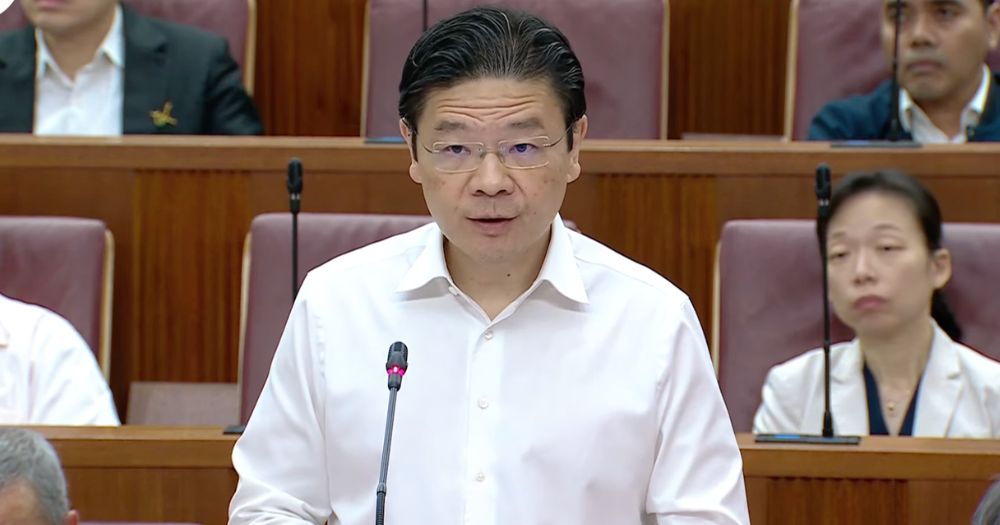
Minister for Defence and Coordinating Minister for Public Services Chan Chun Sing wrapped up the debate on political salaries. In his speech, he laid out how he viewed this debate, and addressed what he said were misperceptions about the numbers.
S$1.8 million is not what every minister gets
Echoing his colleagues Mariam Jaafar and Yeo Wan Ling, Chan said the new MR4 benchmark is a reference point, not an entitlement.
A minister currently on S$1.1 million will receive no more than about S$1.2 million after the one-off adjustment in October, which is capped at 9 per cent and differentiated by individual circumstances including performance and when the person's salary was last adjusted.
That works out to an average of 0.6 per cent a year over the past 15 years.
There is no intention to move all ministers to S$1.8 million in the near term. Most MR4 ministers are expected to be at S$1.35 million by the end of the term.
Only about two-thirds is guaranteed
Chan said the figures being discussed are not guaranteed sums, with about 65 per cent of the annual salary fixed and 35 per cent variable.
A minister at the S$1.2 million benchmark would get about S$780,000 fixed, and up to S$420,000 in bonus depending on individual and national performance. In weaker years, that bonus could be zero.
He said: "That variability is by design. It is what makes the framework accountable and not misleading."
From next year, the targets for all three socio-economic indicators on jobs and incomes will be tightened.
Chan said back-testing showed that applying them over the past decade would have produced a national bonus about one month lower each year on average.
What it costs
Assuming the maximum 9 per cent adjustment, spending on political office holder salaries is expected to stay below 0.05 per cent of government expenditure and below 0.01 per cent of GDP.
Even with the new benchmark fully implemented, Chan said spending would still be a smaller share of government expenditure and GDP than in 2011.
Why money shouldn't be the reason
On why someone might step forward, Chan said financial compensation cannot be the primary consideration.
Someone considering it must first weigh the public scrutiny, the loss of privacy, the uncertainty of being elected, public expectations and the possibility of failure.
But the most important factor, he said, is the burden of responsibility to "get it right" for Singaporeans.
He said:
"This is not a business venture; it is about the lives and livelihoods of Singaporeans. If a business fails, we can start a new one. But if Singapore fails, we are finished."
Chan said after all those concerns, issues of monetary pragmatism might come into play.
"Money should not be the primary consideration but even if it's one of the many practical considerations, we should still discuss this openly, honestly, and frankly, to ask ourselves not just how to get an individual to step forward, but how to build a system that maximises our chances of getting enough people of the right commitment and calibre to step forward."
Chan said the point is not simply finding enough people willing to take on the job, but having enough good people to choose from.
Singapore cannot build a strong team by hoping the people it needs can afford to step forward, he said, and narrowing the field before selection begins makes it harder for any government.
On measuring performance
Chan agreed that the difficulty of setting the right indicators, saying some things are qualitative rather than quantitative, some results take years rather than a single year to appear, and that the wrong KPI could drive the wrong behaviour.
He said:
"I've always learned since young that some important things in life cannot be measured, and we must be careful not to make important only what we can measure."
He added:
"The mark of success is not how well we do the firefighting. The mark of success, very often, more often than not, is how we have prevented the fire in the first place."
"The leadership Singapore needs tomorrow must be built today"
Chan closed by saying the debate was ultimately not about what MPs will get in allowances or what ministers will earn.
He said:
"It is about what Singapore can achieve and want to achieve. Whether our people have opportunities, whether our people can continue to look to the future with confidence, and whether the next generation will inherit a better Singapore so that we can continue to defy the odds of history for us to be a shining beacon in a turbulent world."