Parliament


'A mistaken premise': PM Wong on argument that purpose of salary framework is to entice people to join politics
About giving current and future governments a framework to sustain quality leadership.
September 10, 2026, 06:06 PM
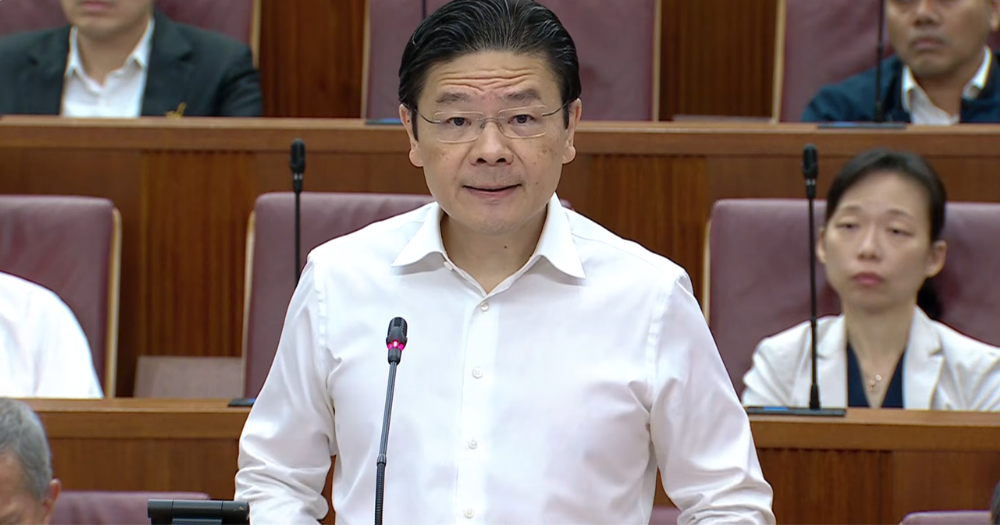
Image via MDDI / YouTube.


Raising ministerial salaries is fundamentally about ensuring current and future governments can sustain the quality of Singapore's political leadership, Prime Minister Lawrence Wong said during the debate on the government's position to raise ministerial salaries by up to 9 per cent from Oct. 15, 2026.
This adjustment was based off the recommendations of an independent review committee and is the first time ministerial salaries were adjusted since 2011.
PM Wong also addressed several questions raised about the ministerial salary increments, such as the effectiveness of money as an incentive.
He also responded to several points raised by Workers' Party chief Pritam Singh, such as whether adjustments beyond the one-off up to 9 per cent figure will be across-the-board.
On the benchmark used to derive salary figure
Speaking during the debate, PM Wong said he was glad that there was "considerable common ground across the house", with "essentially the same principles" affirmed by PAP MPs, Singh, and Nominated Members of Parliament.
PM Wong then addressed two issues that he observed — the structure of political salaries, and how the government has chosen to implement the committee's recommendations.
On the structure for political salaries, PM Wong noted that some members asked if the benchmark should continue to refer to the top 1,000 Singaporean earners, and whether the resulting reference salary is "too high".
"The review committee did not simply take the existing formula as given. It examined the framework afresh," PM Wong said.
He also clarified that the benchmark used did not mean that the government intends to recruit political leaders only from the 1,000 individuals.
"The benchmark is a reference point. It seeks to capture, in a broad and objective way, the opportunity cost faced by the sort of people we hope will step forward," PM Wong explained.
PM Wong also explained the jump from S$1.1 million to S$1.8 million benchmark for MR4 ministers, which he described as a "substantial increase" if seen on its own.
"But we should also understand why the gap has opened up, because the benchmark has effectively remained unchanged for 15 years, while salaries everywhere else in the economy have continued to move," PM Wong explained.
On whether civil servants enjoy a pay increase by joining politics, PM Wong said he wanted to "dispel that myth".
According to PM Wong, the income that civil servants can potentially earn if they stayed on in their careers could be more than joining politics, if they do well in these careers.
He also cautioned against international comparisons of political salaries.
"In many countries, the overall remuneration of office holders extend beyond the official salary. There may be pensions, allowances, housing, or other benefits, as well as arrangements that provide support after political office, these do not appear in the headline salary," PM Wong said.
"In Singapore, we expect our ministers to be effective politicians, effective executives, and effective leaders. That's how we have operated our system, and that's how we have achieved exceptional results," PM Wong pointed out.
In turn, he said the relevant question is not about whether a different model adopted by another country can work for Singapore, but what arrangements will enable Singapore to sustain "high-quality political leadership over the long-term".
On timing
PM Wong acknowledged that there is never going to be a "politically convenient time" to adjust political salaries.
The conflict in the Middle East has not ended and may not end any time soon, but Singapore's domestic economic situation has stabilised, he said.
"We could always hope that next year will bring a better moment, but the world may just as easily become more difficult next year. And if every difficult circumstance becomes a reason not to act, then we will keep putting the issue off, and there will come a point where restraint ceases to be prudence and becomes neglect," PM Wong explained.
Another motivating factor was the "pressing" need for leadership renewal.
Three possible options in response to recommendations
PM Wong also laid out several other options the government could have adopted in response to the committee's recommendations.
First is to defer the increase, but he said that this will only cause the gap between the benchmark and actual salaries, thereby making it harder to correct later on.
The second option was to move all office holders to the new benchmarks immediately, which PM Wong noted that no members of the House suggested.
On this, PM Wong said he did not think this would be right.
He explained that there would be no need to automatically and immediately move everyone to the new benchmark just because the framework has been updated.
"But neither it is reasonable to leave their salaries unchanged indefinitely," he also said.
The third possibility, PM Wong said, was to ignore the formula and choose a lower benchmark, just because "S$1.8 million appears too high".
"If we appoint an independent committee to determine the appropriate benchmark, we should not then arbitrarily change its conclusion because the number is politically awkward," he remarked.
"Instead, we have dealt with the concern through implementation. We are accepting the framework, but moving towards it gradually," he continued.
He further explained that if ministerial salaries were adjusted for inflation, as MP allowances were, then the MR4 reference salary would be S$1.5 million alone.
"So, we are not giving ministers a larger immediate adjustment than MPs. In fact, we are taking longer to catch up," PM Wong said.
Considering these three other options, PM Wong described the government's response to the committee's recommendation as a "measured one".
"We keep the framework relevant for the future, without overcorrecting for the present," he remarked.
The one-off up to 9 per cent adjustment addresses a gap that has been built up over the years, but does so progressively and with restraint, said PM Wong.
PM Wong also responded to Singh's question on whether across the board adjustments will be made following the up to 9 per cent shift, saying that the adjustments are tied to individual performance and will not be general or across the board.
On how a minister's performance is evaluated
PM Wong continued to shed light on how he evaluates a minister's performance.
While some aspects of a minister's work is visible and he receives direct feedback from MPs and members of the public, other aspects are not visible "from the outside".
"So when I assess ministers, I do not do so based on one speech, one controversy, or one set of headlines. I look at their overall performance over time, and I discuss the assessments with my senior colleagues — DPM, the two senior ministers, and the coordinating ministers."
On this, PM Wong said his own experience has led him to recognise that leadership takes time to develop and people can become more effective with experience.
Hence, his approach has been to give new officeholders "time and support to grow" and develop their strengths.
"But if there is unsustained underperformance, then at some point I will have to make a change," he said.
PM Wong also said that the total bill for political officeholder salaries currently stands at S$55 million.
As a share of GDP, this is lower today than it was 10 years ago, according to PM Wong.
He also said he intends to keep it broadly at this level going forward.
PM Wong also shared considering the "greater interest", he will consider whether more information on the distribution of salaries and performance bonuses can be disclosed.
On mayors
PM Wong also addressed the functions of the mayor, which the WP has proposed to abolish as an office.
"Look at the value that the CDCs and mayors have brought to our communities and to Singapore, mobilising a wider network of volunteers, responding to local needs, and contributing to initiatives like the CDC vouchers and the Jobs Nearby scheme," PM Wong listed.
"I would not want to give up any of these contributions. I am proud of all our mayors and what they do for Singapore. I want our mayors to keep strengthening our communities and build a more cohesive and caring Singapore," PM Wong declared.
His comment on mayors invited audible applause from members of the House.
Salary framework not to entice people to join politics
PM Wong also addressed the critique on whether salaries need to be adjusted if the adjusted salary is still insufficient to motivate people to join politics.
"These arguments start from the same mistaken premise, the mistaken premise that the purpose of the salary framework is to entice people into politics with money. That is not the case," PM Wong explained.
He responded to Singh's speech, where the latter said that the MP allowance is not key to recruiting WP candidates.
"That is not unique to the WP. No one has a monopoly on virtue. All PAP candidates, too, step forward because they want to serve Singapore and their fellow Singaporeans," PM Wong said.
He emphasised that all PAP candidates join politics due to their desire to serve, and that that is he "key prerequisite" when fielding candidates in a election.
"No one should enter politics for the money. Competitive salaries do not create the motivation to serve. But they can make it possible for someone who already has that motivation in the first place to step forward."
PM Wong's own experience
PM Wong also relayed his own experience when making the switch from a civil service career to public office in 2011.
Back then, where he might contest electorally was not clear, much less the remuneration he would receive, PM Wong shared.
"Only when I resigned did I fully appreciate one consequence. I was just short of 15 years in civil service. You need 15 years to keep your pension. I was just short. I lost my pension," he quipped.
Despite the trade-offs, PM Wong said he did not regret his decision.
Sharing another anecdote, PM Wong revealed prospective candidates are asked to write something about themselves when they attend tea sessions with PAP leaders.
"I wrote that having worked as a civil servant, I knew that for Singapore to succeed, every generation must throw up its own leaders, people prepared to take ownership of our country and to serve their fellow citizens," PM Wong recalled about what he wrote in 2011.
"And I wrote that I would like to be part of that team to make a difference where it counted, and to contribute to Singapore's development. That's how I felt then. It is still how I feel today," he added.
Continuing, he said, "And I know there will be fellow Singaporeans who feel the same way, people who see a need for our country, who are prepared to answer the call to serve, and who will take responsibility for Singapore."
The government's task is to find such people and persuade them to step forward, he said.
Government will continue to support Singaporeans
Concluding his response, PM Wong said that he deliberated "long and hard" over the ministerial salary decision.
He acknowledged that the cost of living has risen and that many are worried about jobs and livelihoods.
"These concerns are real, and the government will continue to do all we can to support Singaporeans, especially those who need more help," PM Wong said.
Noting that members of Parliament broadly agree with the implementation approach, PM Wong emphasised that the issue is ensuring that a framework is put in place to enable future generations to sustain the quality of Singapore's political leadership.
The next ministerial salary review will take place five years from now, during which the suggestions raised by members during the debate will be studied carefully, PM Wong said during his remarks.