Abroad


Periods of great change must spur countries to work together: Chan Chun Sing at Xiangshan Forum in Beijing
This was Chan's second appearance at the Asia-Pacific security forum.
September 17, 2026, 10:16 AM
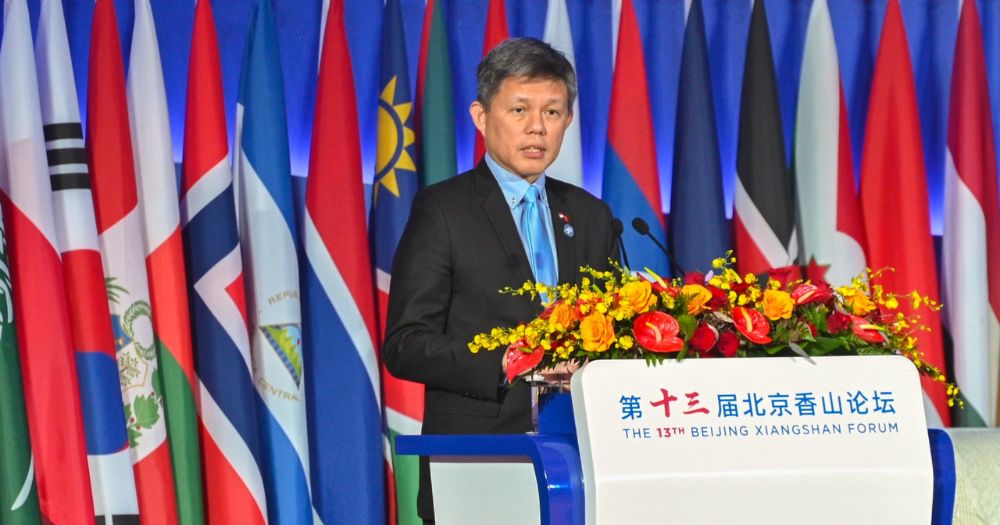
Image via MinDef


Singapore's Defence Minister and Coordinating Minister for Public Services, Chan Chun Sing, spoke at the 13th Xiangshan Forum on Sep. 16 in Beijing, China.
The Xiangshan Forum is a defence and security forum hosted by the China Association for Military Science and the China Institute for International Strategic Studies.
It bills itself as a track 1.5 platform for Asia-Pacific security dialogue, meaning that it draws its participation from official government personnel as well as non-official representatives from academia or think tanks.
Chan spoke about the period of great change that the world was currently undergoing, but also urged countries to “work together to shape the world we want to see”, saying that Singapore welcomed China's aspiration to be a “responsible major country.”
Evolving distribution of power
Chan said that the world was in flux both technologically and economically, and this was shaping and reshaping perceptions of relative power.
The trends that were concerning all nations at present exerted pressures on countries to preserve and advance their own national power at the expense of others.
Chan said that the world's shared challenge was how to enhance a country's own security without being perceived to be threatening the security of others, or without aggravating the insecurity of others.
Three principles to navigate uncertain times
Chan shared three principles that he considered worth bearing in mind as the world navigated uncertain times.
The first was that domestic stability and external security were mutually reinforcing, and that confidence at home enabled a country to cooperate with partners abroad as well as to act in “enlightened long-term interests” internationally.
The second principle was that interdependence bred stability, allowing disparate countries to expand the pool of common interest and create an incentive to cooperate or at least compete within an agreed set of rules.
“Competition and rivalry, if well managed, can spur all of us to do better.”
Chan's third principle was to "first do no harm."
"In order to build trust, it was important to first not break it."
He said that trust was vital but brittle, built by consistency but lost in a single instant.
With trust, difficult issues can be resolved quietly, but without trust, small misunderstandings can simmer and become major problems.
This was true in physical domains like air and sea, but even more so in invisible domains like cyberspace, where intentions were unclear and attribution was not simple.
The power of example
Overcoming the modern security dilemma required rethinking what winning meant, from outgunning or outlasting a rival to winning over the world through “the power of our example” rather than “the example of our power.”
To achieve this, he said he would offer three practical suggestions.
Altering perceptions
The first was that countries needed to be conscious of how shifts in relative power altered perceptions.
Small countries were naturally insecure and needed more assurance, and thus, great powers shouldered high expectations and responsibilities.
A country growing in strength may assert itself to address long-standing grievances and interests, but that growth could look different to those around it.
Chan quoted in Chinese: "When major powers shoulder greater responsibility, smaller countries have less cause for concern."
And therefore, it was necessary for countries to ask themselves: "How do we see ourselves, and how do others see us?"
Strategic patience
Secondly, Chan advised building trust through strategic patience, which he said was the wisdom to choose the course of action that best served long-term interests despite immediate pressures.
“Not every capability needs to be advertised. Not every advantage needs to be immediately pressed, and not every provocation demands an immediate response.”
Creating value together
Thirdly, Chan said that countries must continuously find concrete ways to create value together.
The object of diplomacy, he said, was not to deny each country's own national interests, but to find where it overlapped with others and build real cooperation within that shared space.
He used the example of Singapore's relationship with China, where Singapore supported China's reform and opening up, advocating for its entry into the predecessor to the World Trade Organisation, the General Agreement on Tariffs and Trade, as far back as the 1980s.
“Hence, despite our differences in perspectives and ideology, history, geography, or even the size of our populations, our leaders found common ground to cooperate for mutual benefit.
“The pragmatic approach continues to guide Singapore today.”
Responsible major country
Chan concluded by admitting that periods of great change can be daunting, as they force countries to adapt.
But it was at these moments that countries could and must work together to shape the world that they wanted to see.
He welcomed China's aspiration to be a "responsible major country", and he credited China's reform and opening up for transforming the lives of China's people and contributing greatly to the prosperity of the region and the world.