News


'Save him, please save him': SIA cabin crew perform CPR for 20 minutes to save passenger with no pulse, win service excellence award
Close call.
August 28, 2026, 01:59 PM
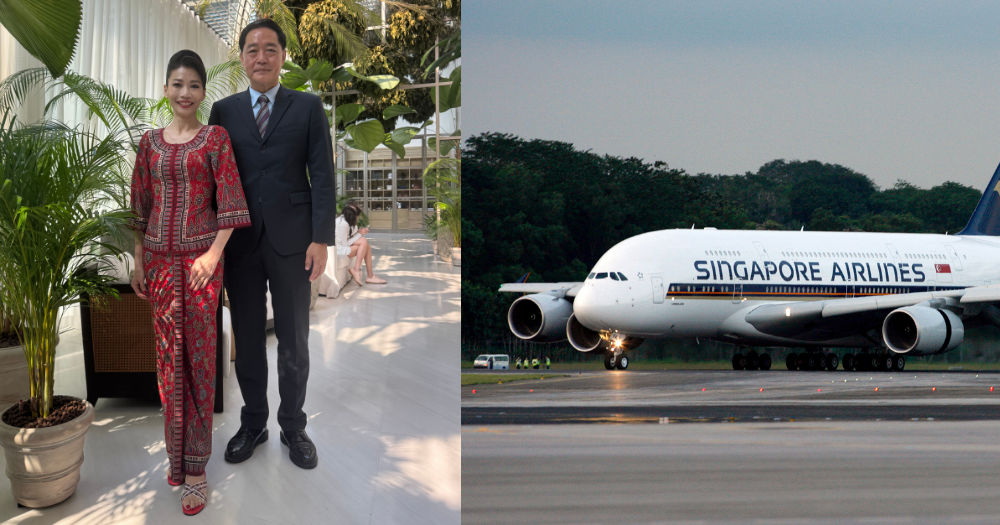
Photo by Mothership and Reuters
On Oct. 13, 2025, just before the flight from Barcelona to Singapore was about to depart, a cabin crew member ran up to chief stewardess Serene Koh.
She looked "very worried", Koh, 48, recalled. "She told me a passenger was unconscious."
Without hesitation, Koh went to check on him. The passenger, an elderly man, was unresponsive.
He wasn't breathing. And he had no pulse.
She remembers how his wife, sitting next to him, begged her and her staff for help: "She was crying... she was pleading with us to save him, please save him. At whatever cost."
20 minutes of CPR
Koh's years of experience as a Singapore Airlines (SIA) cabin crew member kicked in.
The man was placed on the floor, in the narrow airplane aisle, and prepared for cardiopulmonary resuscitation (CPR). Koh instructed her crew to call for medical assistance, get oxygen, and inform the in-flight manager.
Together with the in-flight manager, Kueh Joo Tong, 57, she began performing CPR on the man. Two medical doctors and first-aiders also responded to the call for help; between them, they took turns to try and revive him.
In total, they delivered 20 minutes of continuous CPR and two AED shocks to the man.
"It was very tiring," Koh recalled. "We were praying... that [he'd be OK]."
A well-oiled machine
Kueh added that while it was a shock, it "also felt automatic".
"We went for training every year to be ready for these situations, and it paid off," he said. It was his first medical emergency in his over three decades of years of service with SIA.
Fortunately, after their efforts, the man's pulse finally returned. Koh remembers that it was a just faint pulse; his eyes remained closed and he didn't respond verbally.
But he was breathing. "We managed to bring him back," Kueh said, with the faintest hint of pride.
The man was quickly rushed to the hospital. Thanks to the team's seamless coordination, they'd pre-emptively cleared his immigration and offloaded his baggage, so he could be transferred immediately.
The flight ended up departing just one hour behind schedule.
A close call
It was only a month later that Koh and Kueh finally found out what happened.
The man had arrhythmia, and that day, his heart had stopped. It might have been fatal if not for the efforts of the crew.
After the incident, he underwent surgery for a stent. Today, he's doing well.
On Aug. 28, both Koh and Kueh will be presented with a Fusion Award at the Singapore Airlines CEO Service Excellence Awards ceremony. It is, Koh told me, "the greatest honour".
Both staff have flown for SIA for decades — 26 years for Koh, and 34 years for Kueh. It's the first time they're receiving an award for their service.
But they are just thankful that because of their training, they were able to save a life.
"It's somebody's grandfather, somebody's father," Kueh said. "We were happy that we were able to help."