Abroad


How Trump is using a 1930 law to impose 50% tariffs on Canada, & what this means for the rest of the World
"New" tariffs laws, same old trade war.
August 28, 2026, 02:51 PM
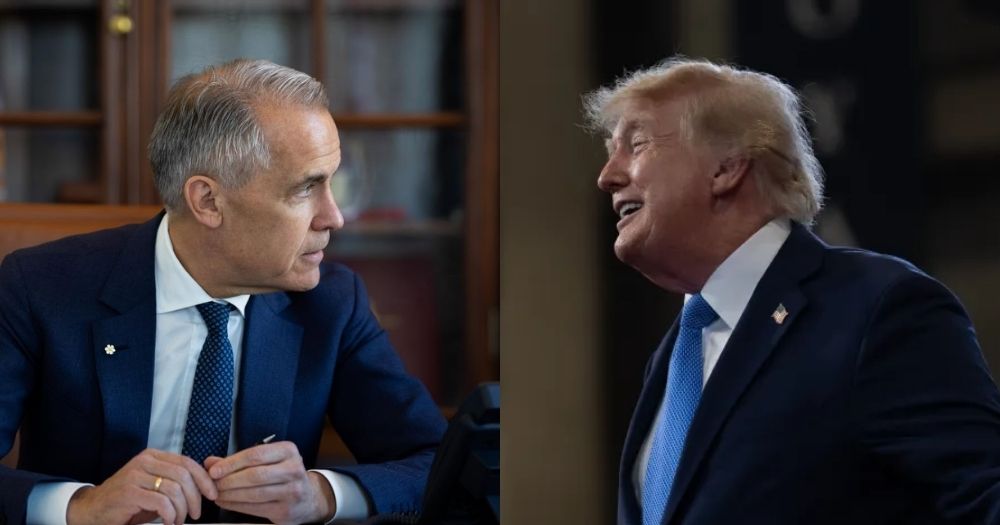
Image via White House/Facebook & Mark Carney/Facebook

 Tariffs have hit the headlines again as U.S. President Donald Trump’s trade policy comes up against Canadian Prime Minister Mark Carney.
Canada and the U.S. have been engaged in a trade war since Trump returned to power in 2025, when Trump levied new tariffs against his northern neighbour, despite having negotiated a wide-reaching trade deal with them during his first term in office.
Trade negotiations between the two countries were underway, seemingly heading to a successful conclusion when they broke down, as Politico reports, over the span of three days, culminating in Carney telling his negotiators to quit and return to Canada.
Ever since then, there has been a rhetorical and tariff war ratcheting up, with Trump renaming Lake Ontario to “Lake America” and both countries leveraging 50 per cent tariffs and import bans on a range of goods.
New tariffs, who dis
The Trump administration has long believed in tariffs as a way to remake the global trading order more in its favour, but this worldview was struck a major blow in February 2026, when the U.S. Supreme Court said they were unconstitutional.
But those tariffs come under the International Emergency Economic Powers Act (IEEPA), despite the administration trying to justify them, saying that trade imbalances and the import of the drug fentanyl represented national threats.
While Canada was not targeted by that set of tariffs, it was accused of being complicit in the fentanyl trade, and the new phase of the trade war is feared to be a testing ground for new approaches and justifications for tariff action by the administration.
The specific set of tariffs that the Trump administration is using against Canada is the Section 338 Tariff Act of 1930, and as the name implies, it's a nearly century-old set of laws.
The act was meant to protect U.S. industry in the throes of the Great Depression, and as The New York Times observes, it has never been tested in a court of law.
This presents a conundrum for all involved:
For Trump, it runs the risk of being overturned like his Liberation Day tariffs, which resulted in the administration having to repay over US$160 billion dollars in collected tariffs.
But it also means that affected parties, whether they be the Canadian government or businesses on either side of the border, are unsure how a case will turn out, or how long it might take.
Border, and broader, concerns
Of course, for Singapore and other countries, concern about the tariffs is not limited to the U.S.-Canada bilateral relationship.
There are at least two other concerns: firstly, the Section 338 tariffs might be utilised as a tool against other countries, and secondly, one of the specific reasons why trade negotiations between the two broke down: trade deals with other countries.
Flexible tool
The first concern is straightforward: the Liberation Day tariffs were based on the nearly half-century-old IEPPA tariffs, creatively adapted to suit the administration’s goals.
So if the new Canadian tariffs are successful or unchallenged, it could be used to target other countries.
An expert the NYT spoke to said that if Trump succeeds in implementing the Canadian tariffs, “you have to expect that we’re going to see a lot of 338 use”, describing it as a “very flexible tool.”
The law is not meant to allow tariffs without cause, and is meant to be used “In response to unreasonable and discriminatory trade practices” by other countries.
And the Trump administration has been able to find such grievances.
Most of the Liberation Day tariffs were justified by Trump suggesting that targeted countries had exploited loopholes in trade law, or disguised countries of origin.
Singapore would be vulnerable to such action, already having been targeted by a 12.5 per cent tariff in July 2026 for ostensibly trading in goods made with “forced labour”, a charge Singapore’s Ministry of Trade and Industry denied.
Trade wars within trade wars
The second aspect is a kind of secondary shadow trade war fought in the shadows of the U.S.-Canada Trade War.
In the aftermath of the trade negotiations, the Canadian side alluded to sovereignty concerns, mainly in French language requirements, but also saying that the U.S. had demanded the ability to interfere in Canada's trade deals with third parties.
This has been widely interpreted to target China, with whom Canada's trading relationship has significantly warmed over the past two years.
The South China Morning Post suggested that chilling ties between the US and Canada could be beneficial for China-Canada trade, with China buying oil that would otherwise be bought by the U.S.
The Global Times published an editorial that backed Canada's reaction, saying that in the face of Washington's tariff stick, Canada had launched a Chinese-style counterattack, by which it meant responding firmly and proportionately while defending its sovereignty without compromise.
“No country has the privilege to monopolise the rules or dictate the fate of others.”
"Foolish" deals with "bad people"
Nearly a week on from the failure of Trade Talks, tensions between the two countries remain high. Although in some areas, such as French language requirements, the U.S. stance has softened, and Canada has said that might open the way to renewed negotiations.
Carney has been forthright about what he thinks is going to happen with the U.S.’s relationship, not just with his country, but the world at large, saying that the world lived in “an age of rupture, not transition” earlier in the year.
He also said that “you can't get a good deal with a bad person” when referring to Trump.
Trump has been equally critical of Canada and Carney, saying that Canada wanted the benefits of being a state without being one.
He called Canada’s stance “foolish", and that Canada clearly relied more on the U.S. economically than the reverse.
Meanwhile, the world watches cautiously how Carney’s attempts to brace against U.S. economic pressure turns out.