News


S'pore man quits S$10,000 software engineering job to sell hokkien mee, now earns a third of previous salary
Rather than wait to lose his job, Tan decided to leave on his own terms.
August 07, 2026, 12:47 PM
Photos from @booksbeyond.borders/Instagram and @sgumamibomb/Instagram.


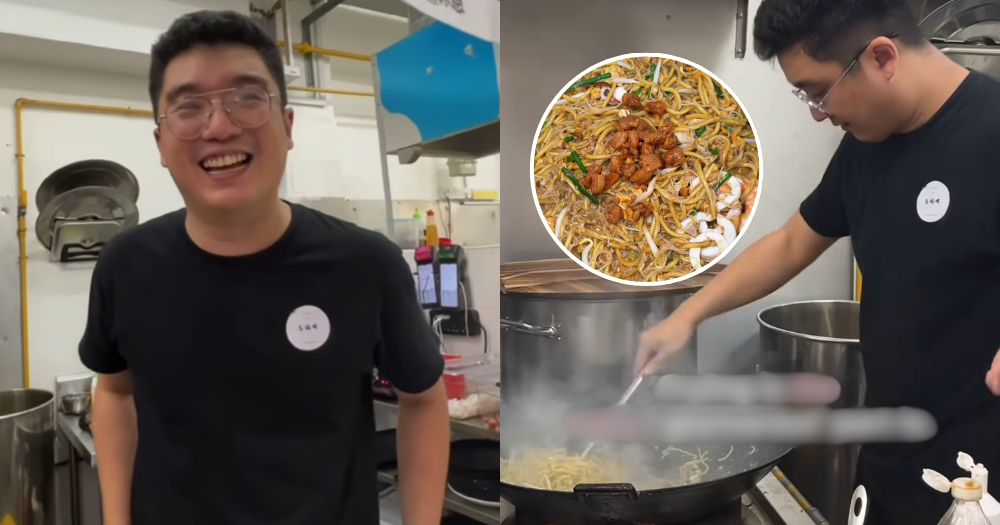
A former software engineer at Meta left his five-figure salary to sell hokkien mee, a fried prawn noodle dish, at a coffee shop in Geylang.
Alvin Tan, who now earns about a third of what he used to, shared his journey in a CNA Insider video on Aug. 5, 2026.
Concerns over getting retrenched
Tan said he began questioning his future in the tech industry as the rise of artificial intelligence (AI) increased the risk of retrenchment.
His previous company had laid off about 10 per cent of its workforce, which made him realise he could just as easily have been part of that 10 per cent.
Rather than wait to lose his job, Tan decided to leave on his own terms.
"If I were to be kicked out by someone, how about I just be kicked out by myself?" he said. "I'd rather be held accountable to my own actions instead of something that is out of my control."
How his journey began
Instead of opening a stall immediately, Tan said he first tested whether people would pay for his hokkien mee.
He started by cooking from home and giving away free plates of the fried prawn noodles, before selling at food events and eventually opening his own stall.
Tan said he believed the skills he developed as a software engineer were also transferable to his new business.
He likened building the business gradually to developing software, starting with a simple product, before refining and expanding it through successive iterations.
Takes home about a third of his previous salary
Tan's hokkien mee is priced between S$6 and S$8 a plate, and the stall generates up to S$19,000 in monthly revenue.
However, nearly half of that goes towards ingredients, with rent, utilities, and manpower further eating into his earnings.
In the end, Tan said he takes home only about 20 per cent of the stall's revenue, or around S$3,000 to S$4,000 a month.
Tan says he needs to sell about 45 plates a day to break even, with every plate sold after that contributing to his income.
For months after opening, however, he sold fewer than half the number of plates needed to cover his costs.
"There were also days that I threw away a lot of my ingredients, which felt very sad," he recalled.
"But once get through that phase, you get more regulars, you get more people knowing your stall, I think that's where the magic starts," he said.
Grappling with costs
Tan said one of the mistakes he made when he started the business was focusing on perfecting his recipe without paying enough attention to costs.
Initially, he said, he did not know how to factor the cost of goods sold into his pricing.
"The first thing (to do) when you start a business is always to protect yourself. Don't just go in and spend your life savings..."
"Try to start something small, and gain traction from there," he said.
For Tan, even after reaching the break-even point, rising costs have continued to squeeze his margins.
With the prices of gas and ingredients increasing, Tan said he has been absorbing the additional costs himself, though he may eventually have to raise prices if his earnings continue to decline.
He also hopes to eventually hire someone he can trust to help grow the business further.
"I can't do this alone. I will definitely need someone that I can trust to walk this journey with me as well, not just as a worker, but someone who can see this as something that can be pushed further in the future."
However, he acknowledged that hiring additional staff would also mean taking home less income in the short term.
While he can afford to hire a part-timer, he said bringing on a full-time employee is not yet financially viable.
Running a business has also changed the way he approaches his finances.
Tan said he is not making CPF contributions at the moment, but intends to do so in the future while saving for his Build-to-Order flat.
He added that whether leaving a salaried job makes financial sense depends on an individual's circumstances.
"I don't have many wants. I just need to be able to afford my meals, public transport, and of course next year will be my BTO. And afford to maybe travel once a year," he said.
Tan added that not planning to have children gives him greater financial flexibility.
"Fulfilling and satisfying"
Since starting his business, Tan said he has had less time for family, friends, hobbies and even sleep.
Still, he views these not as sacrifices, but as opportunity costs.
Although he is earning less, working longer hours and taking on greater financial risk a year into the business, Tan believes the journey will pay off in the long run.
"I think the ceiling is much higher. I guess owning your own stuff is different from working for someone. You won't get retrenched. You will only suffer a more miserable fate," he quipped.
"But you get to be in control and you get to learn and own up to your own mistakes and make changes."
"That freedom actually can be quite fulfilling and satisfying, when you finally make it after so many hours of hard work," he said. "That is magical."
Tan's stall, Umami, is located at 709 Geylang Rd, Singapore 389624.