




News


S'porean seniors have more savings to spend on health, but 'unnecessary treatments' could drive up costs: Ong Ye Kung
To keep healthcare sustainable, he said the government must "lean forward" and build stronger partnerships with the commercial sector.
July 25, 2026, 04:49 PM
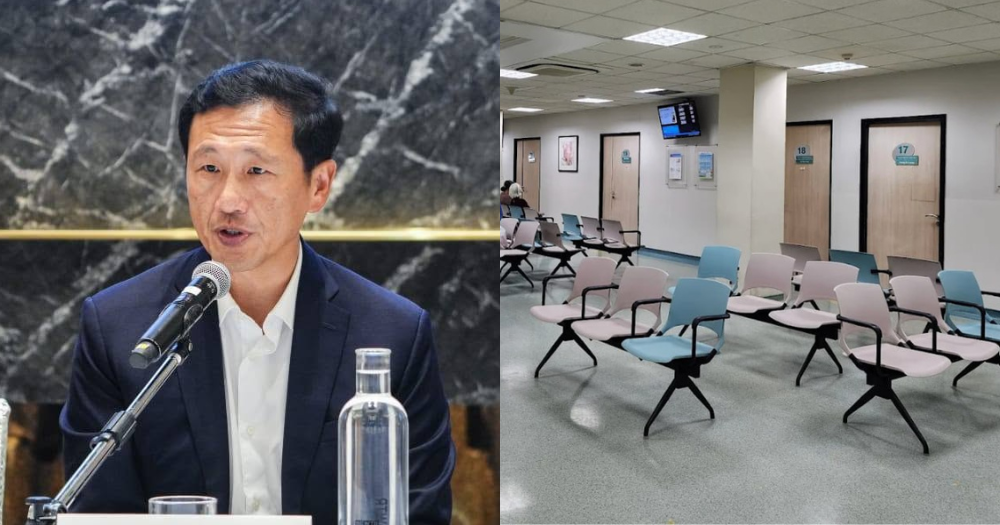
Photos from Ong Ye Kung's Facebook and Jurong Polyclinic/Google Maps


Singapore needs to be wary of over-servicing and unnecessary treatments proliferating in healthcare, as they will make healthcare increasingly expensive and unaffordable, warned Health Minister Ong Ye Kung.
That has been happening around the world, he said.
Speaking at the Business Times Longevity Forum on Jul. 25, Ong shared that Singaporean seniors today are living longer and have more savings and resources to spend on building their health and quality of life.
But many of them will also spend to restore their health or manage sickness, "often in an atmosphere of worry and anxiety", Ong said.
This can lead to over-servicing and unnecessary treatments.
"Anxious patients who are worried about small discomforts may undergo numerous expensive diagnostic scans, which can be unnecessary and do more harm than good," he explained.
He added that this can drive up costs and make healthcare "increasingly expensive and unaffordable".
Ong has previously spoken about over-servicing and over-coverage in healthcare, leading to rising insurance premiums.
https://mothership.sg/2024/03/private-insurance-frustrating/
Avoiding unsustainable healthcare
In healthcare, growth "is not necessarily better", Ong said, pointing out that it is fundamentally a public service.
But in many countries, the healthcare industry is "heading towards unsustainability", with long patient queues and waiting times, and high costs.
In such cases, private sector participation can also inadvertently make things worse, he added.
"Distortions in the healthcare industry exacerbate the risk.
For example, over-generous insurance can create a buffet syndrome and over-consumption of diagnostics, medication and procedures...
If over-servicing and unnecessary treatments proliferate, we have not created health nor wealth. We simply generated cost for everybody."
To prevent this, Ong believes there must be a stronger partnership between the government and the commercial sector in healthcare.
"The government too must lean forward," he said. "We should not just regulate from a distance but work with industry to shape markets in the right direction."
For instance, with over-generous health insurance riders that encourage over-consumption, the insurance sector must "heed the government's call to rein in such products".
This is already happening, Ong said.
The government is also planning to launch a not-for-profit private hospital (like Mount Alvernia) to offer the people a more affordable private healthcare option.
"We hope to have strong private sector participation in this project," he said.
Growing the economy, but not at health's expense
Ong said that there are ways to grow the longevity economy in Singapore while avoiding wastefulness, unnecessary treatment, over-servicing, or "[preying] on anxieties and fears".
The government is working on several such opportunities.
These include encouraging clinical trials to be conducted in Singapore, and building partnerships to anchor global biomedical R&D in Singapore.
To this end, the Health Sciences Authority (HSA) has developed international trust in the safety and quality of health products regulated in Singapore.
Singapore can also be an R&D and manufacturing base for innovative food products, as food and nutrition become more important, he said.
Good health policies and economic policies
Apart from this, the government is also putting in place "deliberate policy interventions" to minimise spending while delivering good health outcomes.
Today, Singapore is in a "relatively good position", with less than 5 per cent of its GDP spent on healthcare.
But to preserve this requires good health policies, as well as sound economic policies, Ong said.
This includes shifting care to the community, investing in preventive care, and maintaining discipline in public healthcare spending through measures such as means-tested subsidies and co-payment.
The system "keeps the whole healthcare system lean and disciplined, and this minimises wastage".
"Co-payment is a very hard thing to explain for a Health Minister. How do you explain to the population, 'you co-pay a bit, it’s cheaper'? Who will believe you? They will say, 'No, in the United Kingdom (UK), you do not have to pay at all, it is cheaper.'
But no, the healthcare bill, ultimately, is paid by the whole nation."