News


Online harms victims can file reports via new agency’s website from Jun. 29, 2026
Dedicated channel to seek timely recourse.
June 28, 2026, 06:01 PM
Photo by Mothership


Starting Jun. 29, 2026, victims of online harm in Singapore can file reports through the newly formed Online Safety Commission (OSC) website (www.osc.gov.sg).
In a joint press release, the OSC, the Ministry of Digital Development and Information (MDDI) and the Ministry of Law (MinLaw) announced that the OSC was established to support the Commissioner of Online Safety, an office created by the Online Safety (Relief and Accountability) Act 2025 (OSRAA).
Additionally, effective Jun. 29, victims gain new rights under OSRAA to pursue civil claims in court through newly introduced statutory torts.
With the establishment of the OSC, Singapore becomes one of only a few countries worldwide to have a government agency dedicated to providing timely relief to victims of online harms.
Five online harms
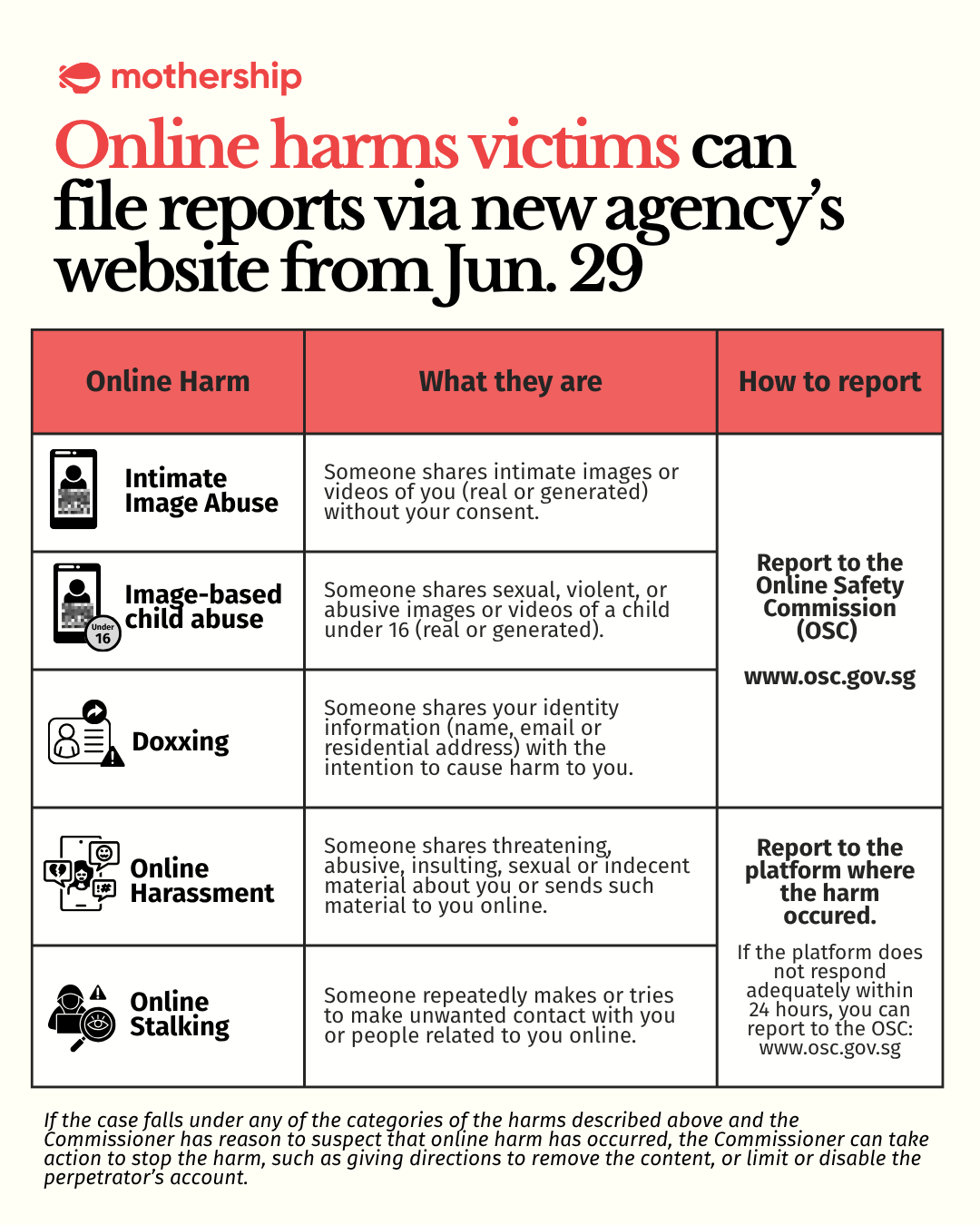
The first phase of operations will tackle the five most prevalent and severe online harms faced by Singapore citizens and residents:
(i) online harassment (including online sexual harassment)
(ii) doxxing
(iii) online stalking
(iv) intimate image abuse
(v) image-based child abuse.
 Screenshot from OSC website
The remaining eight categories of online harms under OSRAA will be progressively implemented, the press release said.
Those who have experienced online harassment and online stalking should first report the harmful content to the platform on which it appears.
If the platform fails to respond promptly or provides an inadequate response within 24 hours, victims may then file a report with the OSC.
For cases involving intimate image abuse, image-based child abuse and doxxing, victims may report directly to the OSC.
How to make a report
 Screenshot from OSC website
Victims who wish to make a report on the OSC’s website will need to provide information about the online harm that occurred to them.
These may include, but are not limited to, a description of what happened and supporting information such as URLs, screenshots, images and videos.
 Infographic by Amirah Khairy/Mothership
Parents and guardians may file reports on behalf of victims who are under 18 years of age.
A report may also be submitted by another individual on behalf of a victim, with the victim's written authorisation.
No fees are required to make a report to the OSC.
 Screenshot from OSC website
Actions that will be taken by the OSC
Once a report has been submitted, the OSC will assess the report. The Commissioner may issue directions to stop or limit the harm if there is reason to believe harm has occurred.
These directions may be issued to the person who posted the harmful content, the administrator of the online group or page where the harmful content appears, or the platform hosting the content.
For example, the Commissioner may direct that access to the harmful content be disabled, or that the perpetrator’s account be restricted.
Non-compliance with a direction is a criminal offence, the authorities said.
Those who wish to get a further review of their reports may do so by making an application for reconsideration of the Commissioner’s decision.
Eligible persons may do so no later than 14 days after the initial OSC decision has been issued.
Parties who remain dissatisfied with the Commissioner’s decision after reconsideration may appeal to an Online Safety Appeal Panel.
The appeal panel acts independently of the OSC and can affirm, revoke, vary, or substitute the Commissioner's decision.
Appeals should also be made no later than 14 days after the Commissioner’s reconsidered decision has been issued.
A S$200 application fee is payable upon submission of an appeal.
Providing support beyond content removal
Beyond content removal, the OSC hopes to provide more support for victims.
“The OSC recognises that experiencing online harms can be deeply distressing, and that victims may need support beyond the removal of harmful content,” the authorities said.
Victims and their families are encouraged to seek help from the OSC’s current community partners – Fei Yue Community Services, Samaritans of Singapore, SG Her Empowerment (SHE), Singapore Children’s Society, and TOUCH Community Services.
These community partners can guide victims on how to make a report to the OSC and provide other forms of assistance, such as counselling.
Resources on online harms, information on what to do when you experience them, and how to keep yourself safe online can also be found on the website.
Applications for End-User Identity (EUI) information
Victims who are thinking of commencing or intend to commence civil proceedings against a perpetrator may apply to the OSC for help identifying the person responsible.
If the application is successful, information disclosed must only be used for its stated purposes and disclosure will be subject to conditions.
Applications must be made within 12 months from when the online harm occurred or when the victim first became aware of it, whichever is later.
New legal rights
For victims who wish to seek damages on top of content removal, they can do so thanks to additional rights under OSRAA to bring civil claims in court.
These rights are provided through new statutory torts, which will cover the five types of online harms.
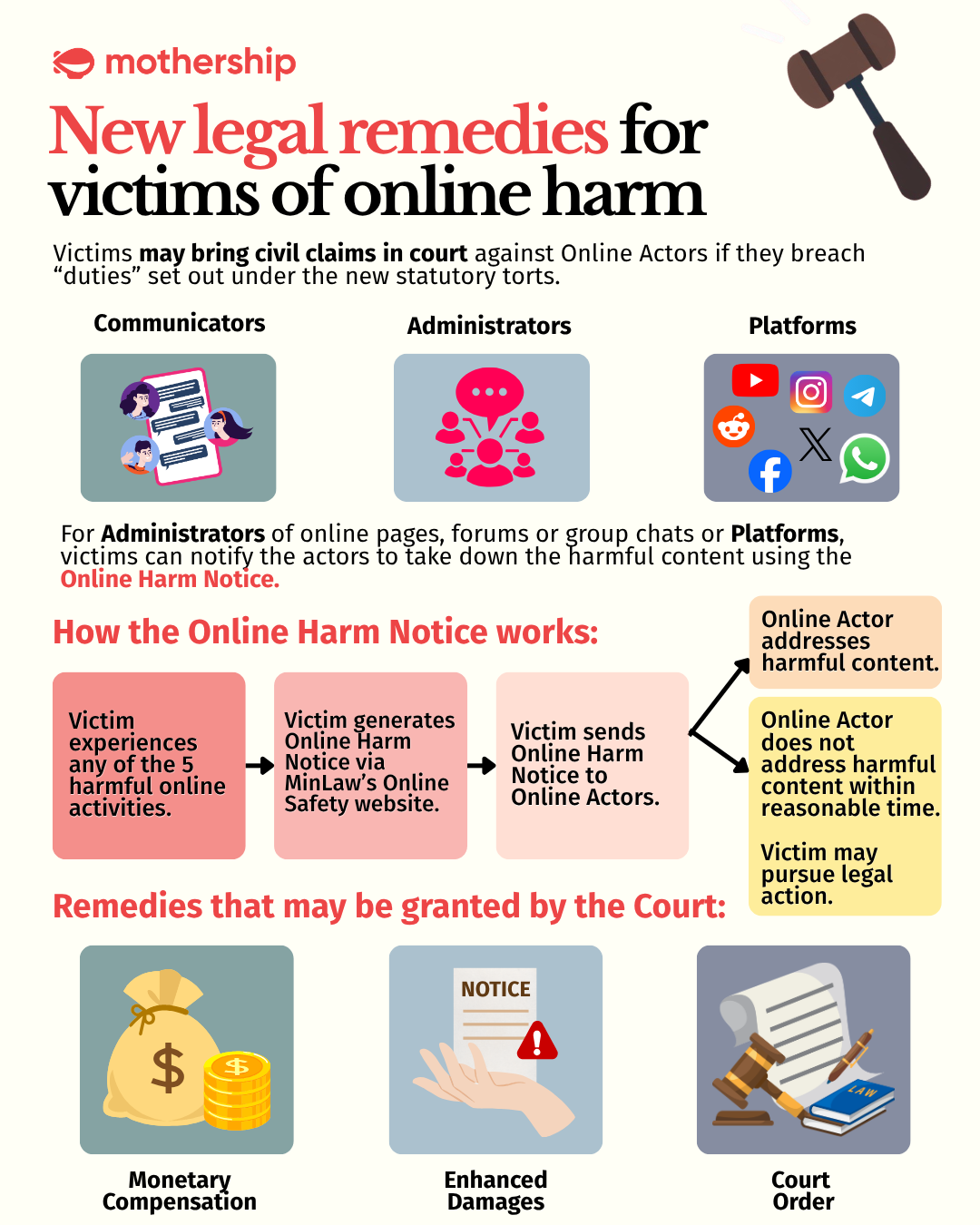
The statutory torts operate by setting out “duties” for different actors in the online ecosystem:
(a) Communicators: A person must not communicate or publish harmful material, or engage in harmful online conduct.
(b) Administrators: This includes persons who administer online groups, pages, forums or other online spaces. They must not set up or run these spaces in a way that facilitates online harm. They must also take reasonable steps to address such harm when properly notified.
(c) Platforms: Platforms must take reasonable steps to address online harm when properly notified, and do so within a reasonable time.
If these duties are breached, victims may bring civil claims in court against those responsible.
 Infographic by Amirah Khairy/Mothership
Victims may also ask communicators or administrators to stop the online harm they are communicating or conducting (for communicators) or facilitating or permitting (for administrators).
If they continue despite being asked to stop, the court may award enhanced damages.
Separately, victims can send administrators of online pages, forums or group chats and platforms an “Online Harm Notice” if it occurs at the relevant online location or service.
Victims may access this form on MinLaw’s Online Safety website.
If an administrator or platform fails to respond reasonably, the victim may take legal action against them.
Legal remedies
Remedies that may be granted by the court include monetary compensation, enhanced damages in certain circumstances and court orders to prohibit the perpetrator from committing harm or further harm.
“The statutory torts are designed with the realities of online harm in mind,” the authorities said.
Where losses may be difficult to prove, OSRAA provides for minimum damages for the intimate image abuse and image-based child abuse cases, such as at least S$5,000 for each image or recording if the claim is made out.
Limits may also apply in certain circumstances, with damages against platforms capped at S$500,000 per set of statutory tort proceedings.
Victims of online harassment, doxxing or stalking may also continue to seek remedies against communicators under the Protection from Harassment Act (POHA), including Protection Orders.
Six online service providers prescribed additional obligations
Six online service providers will be prescribed to have additional obligations under the OSRAA.
They include:
1) Meta Platforms, Inc., in respect of Facebook
2) Meta Platforms, Inc, in respect of Instagram
3) Google LLC, in respect of YouTube
4) X Corp., in respect of X
5) TikTok Pte. Ltd
6) SPH Media Limited, in respect of HardwareZone Forums
They will be prescribed as Prescribed Online Service Providers (POSPs) and can be given additional directions and notices.