News


Family asked to leave AirAsia flight from S'pore to Kuching over special seat for daughter with cerebral palsy
The airline said it is reviewing its policies.
June 03, 2026, 12:42 PM
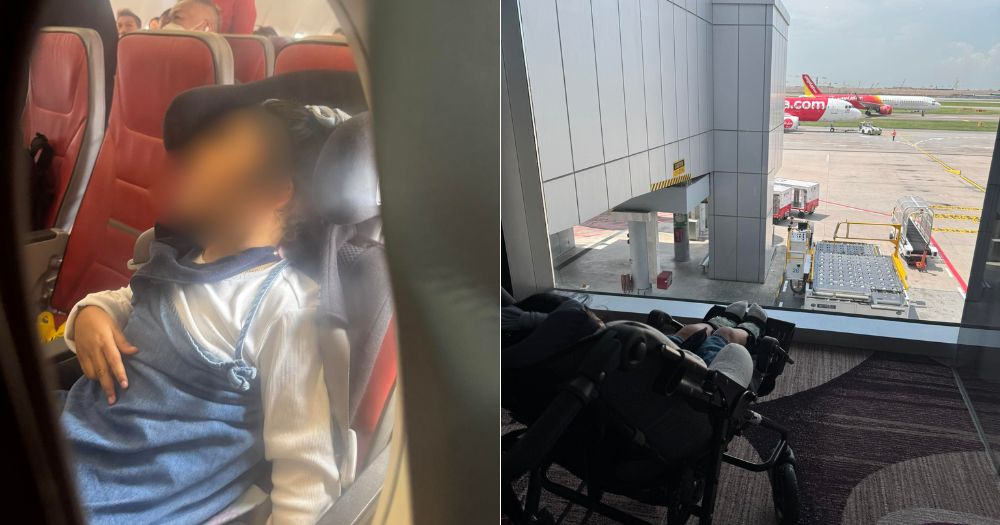
Photo via Syarifah Ella Wan Wahab


A family travelling from Singapore to Kuching said they were asked to disembark an AirAsia flight after boarding because of a special aircraft seat used by their daughter, who has quadriplegic cerebral palsy.
According to the family, they had completed check-in, cleared immigration and boarded the aircraft before being informed that the pilot had decided not to allow the Federal Aviation Administration (FAA)-approved seat on board.
The FAA is the United States' civil aviation authority, and its approval indicates that the device meets certain aviation safety standards.
The family said they were subsequently asked to leave the aircraft.
The incident has since drawn attention online, with AirAsia subsequently saying it is reviewing its policies and procedures relating to specialised child restraint devices.
Family says they were asked to leave flight after boarding
In a Facebook post published on May 28, Syarifah Ella Wan Wahab said she, her husband, their three young children and a domestic helper had boarded AirAsia flight AK1776 from Singapore to Kuching on May 26.
According to Syarifah, her daughter Zara had already been seated in the special aircraft seat when ground staff and cabin crew informed the family that the pilot had decided not to permit its use on board.
Syarifah said the seat had been declared during check-in at Changi Airport.
She added that ground staff had asked questions about her daughter’s age, weight, medical condition and the weight of the seat before allowing the family to proceed with boarding.
Her daughter had previously travelled on numerous domestic and international flights, including with AirAsia, using the same seat without issue.
Handling of incident
While acknowledging that the pilot had final authority over safety decisions, Syarifah said she was disappointed by how the situation was handled.
According to her post, the family was repeatedly told that the decision was based on airline policy, but was not given a detailed explanation of the specific safety concern involved.
Syarifah also sought clarification on AirAsia's policies regarding FAA-approved child restraint systems and how they apply to passengers with disabilities or special needs.
In her post, she questioned whether the policy cited by staff was intended for typically developing infants and toddlers, or whether there were separate considerations for children who require specialised seating because of a disability or medical condition.
She also called for disability-awareness training for staff and a review of how similar situations are handled in future.
AirAsia says decision based on safety requirements
In response to Mothership’s queries, AirAsia said it was aware of concerns raised over the incident.
In the statement, the airline said the decision made at the time was based on safety requirements relating to the suitability of the child restraint device presented for use on board.
AirAsia also said the family may have had different expectations due to previous travel experiences with the airline.
"The safety and wellbeing of our guests will always remain our highest priority," said AirAsia X chief safety and quality officer Captain Saravanan Subramaniam.
"While we empathise with the disappointment experienced by the family, the decision was made in accordance with applicable safety requirements and operating procedures at the time of travel," he added.
Airline reviewing policies
AirAsia added that it is conducting a review of its guidelines and procedures concerning specialised child restraint devices.
He added that the airline had contacted the passenger directly to provide clarification and assistance.
"For future travel, we encourage guests to present the relevant documentation and certification confirming the suitability of the child restraint device for travel, including for guests with disabilities, so our ground and inflight teams can better assess and facilitate the necessary approvals prior to departure"