Features


Comment: With respect to Pete Hegseth, maybe Asia needs fewer ships & more Shangri-La Dialogues
To jaw-jaw is better than to war-war.
June 03, 2026, 04:12 PM
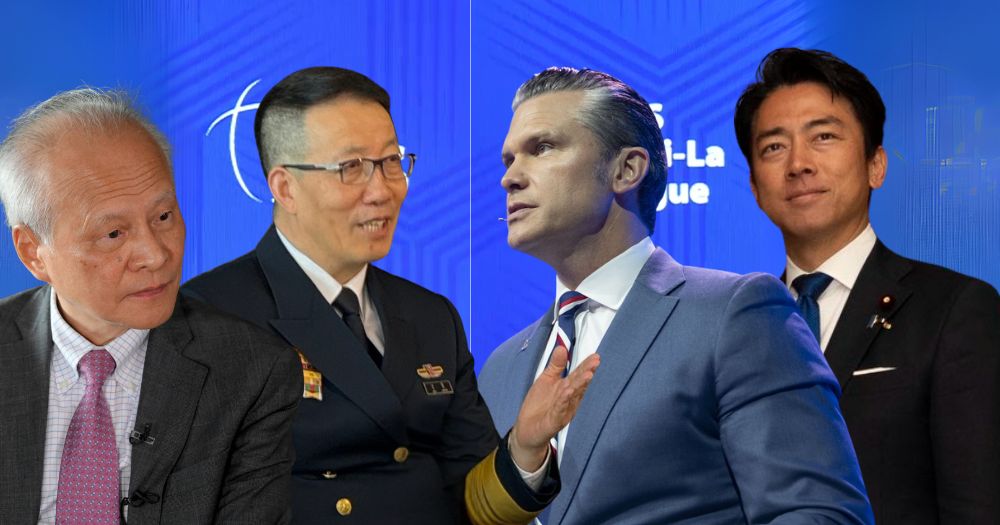
Image via AFP, Mothership, @secwar/x & IISS/YouTube


U.S. Secretary of Defense Pete Hegseth came to Singapore to speak on May 30 with a clear message: U.S. allies needed to spend more on their national defence.
3.5 per cent was the number cited to be considered a “model ally” and be given priority for weapons systems, defence infrastructure collaboration, to name a few things.
Those who fell under that number were accused of freeloading on the back of U.S. taxpayers.
Sic vis pacem
Hegseth referenced that old Roman aphorism “Sic vis pacem, para bellum”, or as he said in English: “those who long for peace must prepare for war.”
Peace is achieved through deterrence, and words do not deter, he might say.
So in front of a conference audience, he advocated: Less conferences, more combat power.
"Sorry to say this here, but more ships, less Shangri-La."
Left unsaid (because it didn't need to be said out loud) was the implication that those countries should buy American.
But East Asia spends more and more every year on its security, IISS estimates that from 2025 to 2026, Asia’s spending grew by 3.5 per cent.
It's not weaponry that East Asian countries yearn for.
It's dialogue and transparency.
With all due respect to the SecDef, Asia needs more Shangri-La Dialogue and fewer ships.
Interlocutor
From the very first moments of 2026 SLD, at Vietnam President To Lam's keynote speech, he lamented a lack of strategic trust, causing states to “interpret one another's actions through a lens of mistrust and anxiety.”
“Where trust declines, defensive measures may even be perceived as provocation.”
To Lam called for transparency, dialogue and substantive information sharing to reduce misunderstandings, a call that was echoed by Australian defence minister Richard Marles in reference to the safety of Australia’s undersea cables.
Since 2024, there have been numerous occasions where undersea cables in the Baltic Sea and the Taiwan Strait were cut under suspicious circumstances.
As this Centre for Strategic and International Studies document details: China is often accused of being responsible for such cuts, the Baltic incidents occurred with China-flagged ships, but as the report itself admits: accidents are common.
In his address on May 30, Marles called on China to be transparent about its maritime operations, saying that it would be a meaningful contribution to regional stability.
Japan and China
China for its part was notable by its so-called “absence”.
For the second year in a row, Minister of National Defense Dong Jun did not make an appearance, but its delegation was impossible to miss.
A fairly large group, they took part in breakout sessions at a fairly high level, including a Major General and a former Ambassador to the United States.
They also made their presence felt by asking questions during plenary sessions, including one incident of chiding Japan’s defence minister for supposedly not apologising for Japan’s Second World War atrocities in Asia, as it did in Australia.
The Guns of August
China and Japan's mutual antagonism is pertinent because it appears as if they are being drawn into what is known as a security dilemma.
A security dilemma describes a situation where two or more countries are suspicious of each other’s military intent and lack the means through which to defuse those tensions.
Instead of engaging in diplomacy to resolve said tensions, they take the logical precautionary step to increase their own security, usually by arming themselves with ever more and ever more advanced weaponry.
Every single weapons purchase, training scheme, or military exercise is interpreted by the rival as a move with offensive potential that must be responded to, drawing both sides into a never-ending spiral of militarisation and conflict, resulting in a situation where war feels all but inevitable.
It can be a scary thought because (and yes, this is what the dilemma is), the very thing a country feels is necessary to ensure its safety is the same thing that endangers it.
The entire pre-First World War period is rife with moments which are explained by the security dilemma, such as the naval arms race sparked by the completion of the battleship HMS Dreadnought.
The excellent book, The Guns of August, documents the final month before the war, where multiple empires took actions that they knew would antagonise other nations, but felt compelled because they could not otherwise assure their security.
And for that, they were drawn into a war they did not want, which ultimately destroyed almost all of them.
So there is literally a historical precedent for fewer ships and more dialogue.
The finger of blame
And so, the week just before SLD saw the Financial Times publish a startling report which detailed China President Xi Jinping “railing against Japan’s remilitarisation” to U.S. President Donald Trump.
And within my group chats, an idea circulated: maybe Xi doesn’t know about the security dilemma.
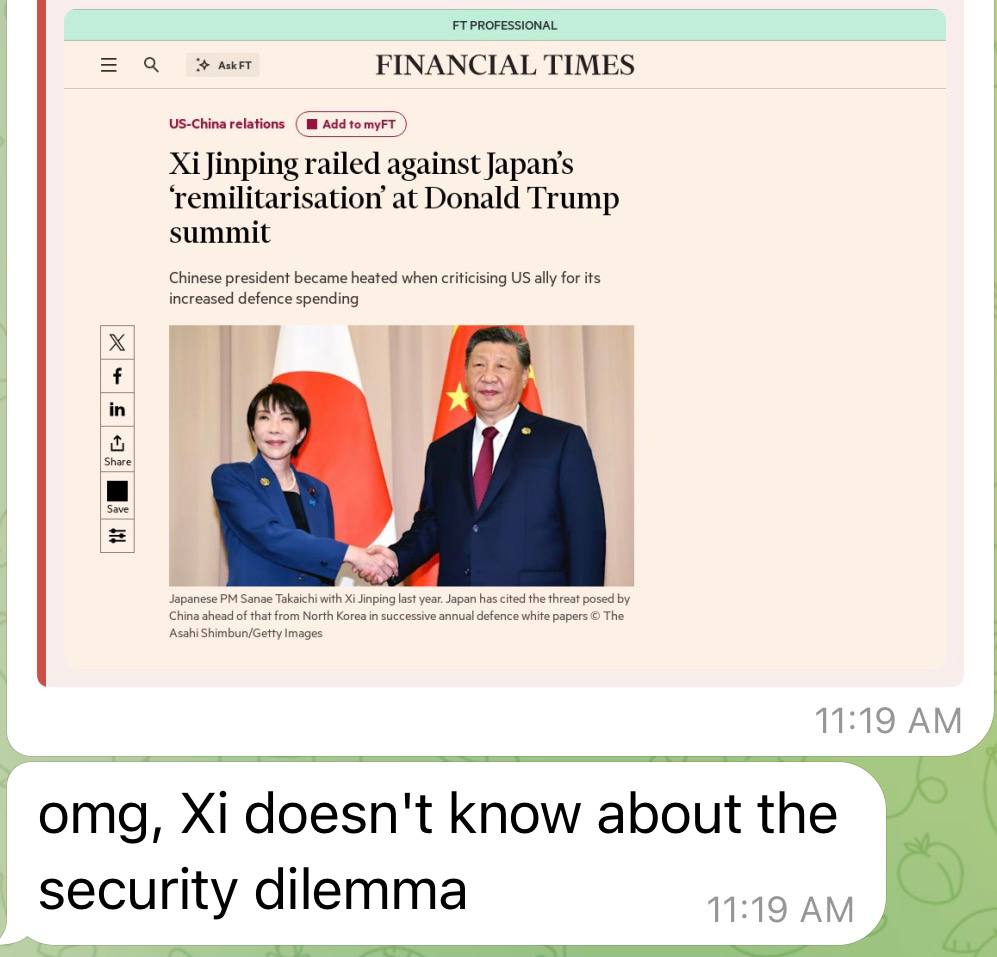 Image courtesy of Mothership
Of course he is probably fully aware of it, but on Sunday morning, Japan Defense Minister Shinjiro Koizumi gave a speech that seemed to confirm the dilemma’s spiral was in full effect.
Koizumi turned the finger of blame around and pointed it at China saying “There is a country that has a huge arsenal of nuclear weapons and strategic bombers. Japan has neither of such weapons.”
“And yet Japan is labeled ‘new militarism’. Isn’t it strange?”
Guns and ships
The Philippines National Defense Secretary Gilbert Teodoro Jr similarly took to the SLD stage to condemn China’s behaviour in the South China Sea, with China biting back later that same day.
And to harken back to the fewer ships theme: one of the friction points between Japan and China is the JS Izumo, a ship that Japan claims was a helicopter carrier when launched in 2015, but China said was an aircraft carrier.
Well, that ship can now launch the F35B short take off stealth fighter, so China had a point.
But China launched its own aircraft carrier… in 2012, the PLANS Liaoning, so another instance where more ships are the literal problem.
As a citizen of Southeast Asia, the best-case scenario here is that it is a security dilemma and that none of these countries actually wants conflict with each other.
But the security dilemma shows that not wanting conflict is not enough. The opposing sides need to find ways of communicating where they do not assume the worst of each other.
To jaw-jaw
And this is where we get back to Hegseth’s words.
East Asia doesn’t really need motivation to spend more on weaponry and national defence, the motivation can be generated at a moment’s notice.
What the region needs are more opportunities to convince each other that they do not intend the worst, that security measures are, in fact, precautionary, not aggressive.
As the former First World War veteran and UK PM Winston Churchill once quipped, “To jaw-jaw is better than to war-war”, and Churchill was not exactly known as a peacemonger.
Breaking the spiral
When regional leaders call for more transparency, dialogue and information sharing, it is a call to break the spiral of aggression the dilemma encourages.
All parties involved clearly need more opportunities to show each other that, regardless of the current level of competition, regardless of historical harms, in the present moment, they mean no outright hostility.
Spending more money on weaponry doesn’t achieve this, and instead deepens the spiral and the dilemma.
Asia’s military spend, to underline the point, is not the issue, the continent is spending ever more money, year after year, decade after decade, and there are no indications that it will go down.
There are already quite enough ships, so let's try more Shangri-La Dialogues.