News


They know they will be punished: S'pore CEO explains why S’poreans don’t speak up at work
"We are tired of being told to be innovative, to have courage and to speak up, because many who have tried have faced backlash."
June 07, 2026, 06:59 PM
Top images via crystallimlange/Instagram


Singaporeans do not stay silent at work because they are disengaged or have nothing to say.
According to leadership expert Crystal Lim-Lange, it may be because they are “damn smart”.
Why Singaporeans don’t speak up
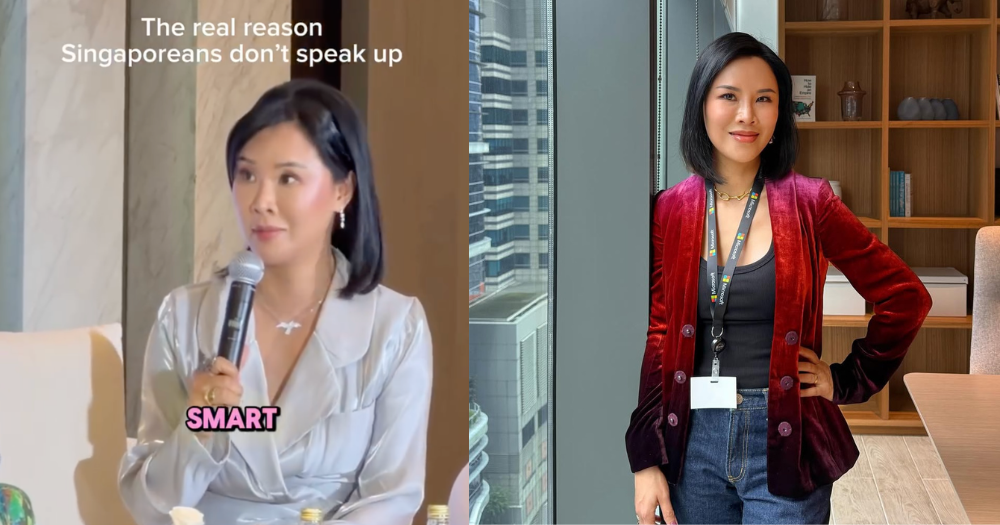
In an Instagram reel posted on Jun. 6, Lim-Lange said Singaporeans often do not speak up because they are aware that their workplaces may not be safe enough for them to do so.
Speaking at Vogue Singapore's inaugural Wellness Day on Jun. 6, 2026, the founder and CEO of consultancy Forest Wolf said employees are constantly weighing one question: "Will I be rewarded, or will I be punished?"
For many employees, she said, the answer is clear.
She added that this is why she is sceptical when companies ask her to conduct “speak up” workshops.
According to Lim-Lange, the problem is not that employees do not know how to speak up, but that the workplace environment itself may not support it.
She said:
“And the reason is because you need to fix your psychological safety, your inclusion, your learner safety, your contributor safety, and your challenger safety."
In the caption of her Instagram reel, Lim-Lange wrote that people are “always scanning the environment” to see what happens to those who take risks.
Not just about teaching employees to speak up
In response to queries from Mothership, Lim-Lange said she believed the reel resonated because it “named something many Singaporeans grapple with every day".
“We are tired of being told to be innovative, to have courage and to speak up, because many who have tried have faced backlash, and are now understandably cynical."
She explained that the issue cuts both ways: employees need to stop self-censoring and learn to challenge others skilfully, while leaders must respect and reward those who do. Without that, the unspoken pressure to "not rock the boat" persists.
Employees have told her they fear being seen as difficult or marked as troublemakers — and that even when feedback is given, nothing changes.
Leaders need to reward thoughtful dissent
Lim-Lange told Mothership that leaders should reward thoughtful dissent because it shows that employees care enough to speak up and improve the final outcome.
“It shows they have skin in the game. I get more worried when there is silence in the room.”
She added that leaders should make space for quieter voices and openly share their own failures and challenges, so that others feel safe enough to be vulnerable.
Psychological safety, she stressed, is not about lowering standards, but rather it is about building an environment where people feel safe enough to speak honestly before small issues become bigger ones.
“Artificial harmony” can make problems worse
Lim-Lange also pointed to the concept of “artificial harmony”, where everything appears polite and peaceful on the surface, but real issues remain unspoken.
She said high-performing cultures tend to have high intellectual friction and low social friction.
In contrast, low-performing cultures may avoid open disagreement, uncomfortable issues and difficult conversations.
Speaking to Mothership, she said while this may appear harmonious in the short term, unresolved issues can later surface as bigger conflicts, passive-aggressive behaviour, poor decision-making, duplicated work or inefficiency.
"Avoiding conflict in the short term can actually create more conflict in the long term."
She added that this extends beyond workplaces into Singapore society, pointing to discussions around casual racism as an example where "OB markers" discourage fully open discussion.
“Many times the message that Singaporeans may receive, consciously or subconsciously, is that we are not a society that is ready for open and constructive challenge."
Reel resonated with many online
The reel appeared to strike a chord with users, many of whom shared their own views on why employees may hesitate to raise concerns at work.
One commenter said that employees often get punished for speaking up, adding that bosses “like obedient people”.
Another user said companies often claim to value employees who speak up and want psychological safety, but may react badly when staff actually raise issues.
Lim-Lange said this reflects a deeper cultural conditioning in Asian societies where people are often cultivated from young to value harmony and respect authority, whether in relation to the government, parents or bosses.
While she acknowledged that it has its strengths, like social cohesion and stability, she argued that Singapore will need to be bolder as AI reshapes the economy.
She drew a comparison with Singapore’s pioneer generation, saying they had to be courageous and bold when survival was at stake after separation from Malaysia.
“The question isn’t whether we can afford to hear dissenting voices. It’s whether we can afford not to.”