




News


Caning in schools 'quite different' from at home, will have positive impact on reducing bullying: Desmond Lee
MOE will also continue to receive feedback and refine its approach to caning, based on ground wisdom and research.
May 05, 2026, 01:06 PM
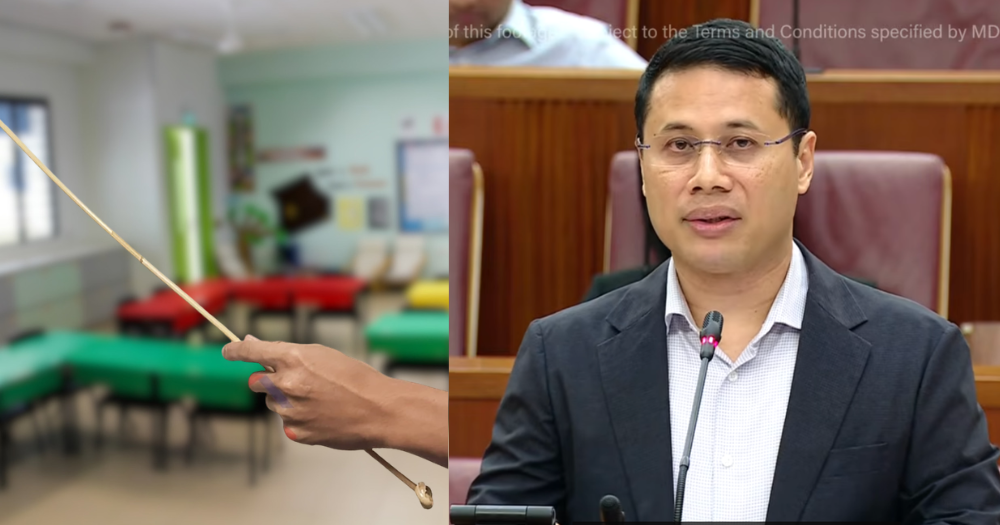
Photo from MDDI/Youtube, Waterway Primary School website, Shopee
Caning in schools is not the same as caning at home, said Education Minister Desmond Lee.
He was speaking in a May 5 parliament sitting, in which he addressed questions about school bullying and methods of discipline.
In response to a questions about caning in particular, Lee explained that it is only used in "egregious" cases, when "all other measures are inadequate".
It is also subject to strict protocols, he said.
Bullying no place in schools
Lee stressed that bullying and hurtful behaviour have "no place" in schools.
That said, schools' approach to bullying and other forms of student misconduct is first and foremost an educative process, he said.
Actions are tiered based on their severity, and harsher measures like suspension or caning are tied to "egregious or repeated serious offences".
Measures are also complemented with counselling and restorative actions, such as helping to repair damaged relationships, and safety plans for victims where needed.
Caning at schools
The minister then responded to questions about caning and corporal punishment at schools.
Studies have shown that "poorly administered and frequent" forms of corporal punishment are associated with negative outcomes.
This is particularly so in unregulated settings, such as at home, he acknowledged.
However, "the context in our schools is quite different", he said.
Any instance of caning must be approved by the principal, and may only be administered by authorised teachers.
It is also never administered in isolation, but always as part of a suite of restorative and disciplinary measures.
Furthermore, schools will consider factors such as the maturity of the student, and the potential effectiveness of the measure in helping the student learn, before prescribing such a measure, Lee said.
The student's wellbeing will also be monitored following caning, and counselling will be carried out to ensure the student learns and reflects.
Doesn't mean girls not culpable
Lee stressed that MOE's approach towards caning is based on research that shows that "clear boundaries enforced by firm, meaningful consequences" help youths to make better choices.
This has a positive impact on reducing bullying, he said.
He acknowledged that caning in Singapore schools is meted out to boys only, taking reference from Singapore's Criminal Procedure Code.
The Code prohibits women from being punished with caning.
"Nonetheless, this does not mean that girls who bully or engage in hurtful behaviour are less culpable," he clarified.
Girls also receive consequences corresponding to the severity of their actions, including detention, suspension, adjustment of grades, and other school-based consequences.
MOE will continue to refine approach
The Ministry of Education (MOE) "regularly reviews" its discipline guidelines to ensure that its discipline measures remain appropriate, Lee said.
MOE will also continue to receive feedback and refine its approach, based on ground wisdom and research.
Lee added that all schools will develop an anti-bullying policy by the end of the year, based on MOE guidelines.
This will ensure that case management processes remain calibrated across all schools.