News


Which of Iran's leaders have been eliminated in airstrikes, & who's left to negotiate for an end to war?
At least 40 senior Iranian leaders have been killed by Israeli and U.S. airstrikes since the beginning of the war on Feb. 28.
March 27, 2026, 10:15 AM

 The current war in Iran started on Feb. 28 with the United States and Israel performing what is known as a “decapitation strike”, the targeting of leaders of the country and of essential organisations, like the military.
U.S. President Donald Trump suggested as many as 48 Iranian leaders had been killed on the first day, and other counts since then have ranged from 20 to 40.
This has carried on to even as recently as yesterday, where Alireza Tangseri, an Iranian naval commander, was pronounced dead.
The exact number depends on what level you decide to start counting; for every leadership position, at least two deputies have been killed.
Because so many leaders have been killed, it is more effective to list the types of leaders than the actual leaders, giving an idea of what the goals of the U.S. and Israeli forces might be.
In this, there are three broad categories, but the nature of Iranian politics means that there is significant overlap between them.
Clergy
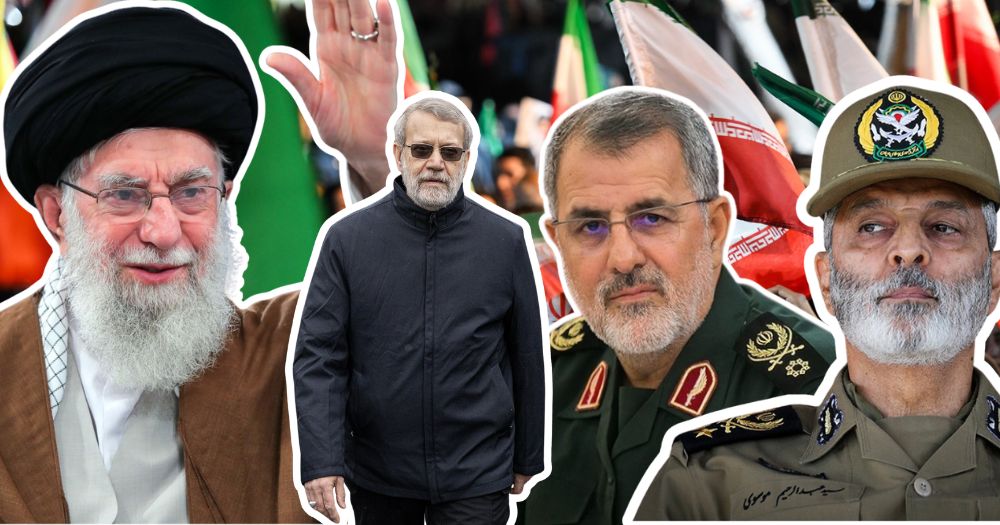
Former Ayatollah Ali Khamenei is a prime example.
The supreme leader of Iran for 37 years, Khamenei was a Shia cleric and politician, rising to the role of president of Iran when Iran's founding leader, Ayatollah Ruhollah Khomeini, died in 1989.
His rise to power is primarily through his position in the religious hierarchy, but at the time of his election to Supreme Leader, he was already Iran’s third president, showing the overlap between government and religious hierarchies.
Khamenei is often painted as the main antagonist of both Israel and the U.S., and the chief proponent of the Iranian proxy armies that beleaguered Israel from Gaza and southern Lebanon, and the militia forces that bedevilled U.S. forces in Iraq and U.S.-affiliated shipping in the Red Sea via Houthi rebels in Yemen.
He is also accused of attempting to advance Iran’s nuclear and missile programme, the former of which he denounced on several occasions, saying that a nuclear weapons programme was antithetical to Islam, even going as far as to issue a fatwa, a religious edict, against the development of such weapons.
An obituary published by the Guardian described him as corrupt, accusing him of amassing billions in personal wealth, as well as authoritarian.
The obituary said he was ultimately responsible for tens of thousands of deaths his regime caused, while attempting to suppress protests that sprang up in 2025, 2023, and during the Persian Spring in 2009.
The Military
Khamenei was ultimately protected from the effects of those protests by the IRGC, especially its ‘volunteer’ paramilitary force, the Basij.
Iran is one of a handful of countries that operate parallel military structures: a national army and an ideological one committed to “protecting the Islamic revolution” of 1978.
The IRGC is essentially a politically motivated army, responsible for policing the security of the regime, expanding its ideological goals abroad through its proxy armies.
It is one of the most powerful organisations in Iran and has sometimes been described as a “state-within-a-state”.
High up on the priority list for Israeli and U.S. airstrikes have been the most senior IRGC leaders, such as Mohammad Pakpour, the commander of the IRGC, and Gholamreza Soleimani, head of the IRGC-run Basij paramilitary forces, responsible for suppressing protests.
Highlighting the regional nature of the IRGC operations are the several deaths of IRGC Quds force leaders killed in Lebanon, where Israel is also conducting a significant military campaign.
National military leaders are also not immune, with the opening day strikes also targeting Iran's Intelligence Minister Esmaeil Khatib and Abdolrahim Mousavi, the Chief of the General Staff of the Iranian Armed Forces, a man who only held his position for about seven months, after his predecessor was killed in the June 2025 Israeli airstrikes.
Political
But perhaps other than the death of Khamenei, no other leadership death has resonated like that of Ali Larijani, who was killed by an Israeli strike on the evening of Mar. 17
As Al Jazeera’s obituary highlighted, he was considered a political moderate and was often drafted in to be the face and voice of Iran in international settings.
Larijani was a critical negotiator who secured Iranian parliamentary approval for the JCPOA. This plan would see sanctions on Iran dropped in exchange for closer scrutiny of its nuclear programme, despite much opposition from Iranian hardliners.
Larijani was as deeply integrated into Iran’s political system as anyone could be.
By marriage, he was connected to some of the most prominent members of the Islamic revolution. He was a member of the IRGC in the 1980s, he was a member of Iran’s parliament, serving as the speaker, and even unsuccessfully running for president three times.
He would be appointed as secretary of the Supreme National Security Council in 2025 and was heavily involved in nuclear negotiations up until the start of the war.
Larijani, just before the war started, described the talks as “positive”, as well as opining that for the U.S., the military option was “not viable”.
The Feb. 28 airstrikes would prove his assessment wrong, and in return, he would threaten U.S. military forces with death and capture.
He would even address Trump directly, warning him that just as the U.S. could assassinate leaders, so could Iran attempt to “eliminate” him.
Despite this fiery rhetoric, outlets such as Al Jazeera lamented his death as making “de-escalation” more difficult than it already was.
Negotiations
The airstrikes have had a deep impact on Iranian leaders, with Khamenei’s son Mojtaba Khamenei being appointed Supreme Leader but yet to make a public appearance in the following weeks.
Also not mentioned are critical non-leadership roles that have been targeted, such as Iran’s cadre of nuclear scientists, although they were more prominently targeted during the June 2025 round of airstrikes, with one even being killed by a remote-controlled machine gun.
Perhaps just as curious are the leaders that have not been targeted, such as Iranian President Masoud Pezeshkian.
It is known that the presidency of Iran is significantly weaker than the presidency of other countries, with less overall responsibility for critical wartime functions like the military.
This might also be due to the fact that those opposing Iran simply need someone to negotiate with when the time to end the war comes.
The U.S. appears to be searching for a negotiated end to the fighting, which would allow for critical shipping lanes such as the Strait of Hormuz to reopen, but has so far signalled that it would prefer to do so with the Speaker of Parliament, Mohammad Bagher Ghalibaf.
Ghalibaf, as well as Iran's Foreign Minister Abbas Araqchi have been taken off an alleged assassination list, after negotiations facilitator Pakistan asked the U.S. to pressure Israel to do so, according to Reuters.
Highlighting the dire situation facing Iran's leadership, Reuters quoted an unnamed source who simply said if they were killed "there is no one else to talk to."
Top image via @khamenei_ir/x, @alilarijani_ir/x, Wikipedia, & Iran Media