News

'Unclear' if Trump will raise tariffs on S'pore to 15%, global 10% rate is about the same as before: Gan Siow Huang
The impact of Trump's global 10% tariffs on Singapore's economy is not expected to be significant, she said, as it is no change from the rate previously imposed on Singapore.


It is still unclear if the 10 per cent global tariffs imposed by the United States will be raised to 15 per cent, as Donald Trump previously promised to do, said Minister of State for Manpower Gan Siow Huang.
Speaking at the Committee of Supply debate in Parliament on Mar. 5, she responded to questions by fellow Members of Parliament Choo Pei Ling and Saktiandi Supaat on the progress of the U.S. tariffs.
Trump tariffs
Gan said that the U.S. began collecting the 10 per cent tariffs on Feb. 24.
Trump had announced new global 10 per cent tariffs for 150 days on Feb. 20, invoking Section 122 of the U.S. Trade Act of 1974.
Hours later, he said on Truth Social that he would raise it to 15 per cent.
However, the U.S. has yet to issue an official directive on this increase, Gan said, which has created considerable uncertainty.
"It is unclear if the current 10 per cent Section 122 tariff will be raised to 15 per cent," she said. "It is also unclear what the overall tariff landscape will be after the current 150 day timeline."
Impact on Singapore's economy
Under the current 10 per cent tariffs, the immediate, direct impact on Singapore's economy is not expected to be significant, according to Gan.
This is because there would be broadly no change from the previous 10 per cent so-called "reciprocal" tariffs imposed on Singapore's exports to the U.S. since April 2025.
Singapore does not impose a broad-based tariff on exports of U.S. goods to Singapore.
Nonetheless, Gan noted that sectors with a greater dependence on the U.S. for final demand, and whose exports are covered by the Section 122 tariffs, could see a greater impact from any tariff increase.
Such sectors include the precision engineering cluster, and some segments under the general manufacturing cluster.
At the same time, Singapore may get hit by sectoral tariffs from the U.S., and tariffs imposed by other different legal authorities in due course.
"We will continue to monitor such developments closely, and engage our U.S. counterparts to ensure that our economic interests are safeguarded," Gan said.
Available support
The government will also work with tripartite and industry partners to gather feedback on how businesses and workers are affected by the tariff developments.
Gan went on to outline current initiatives to help affected businesses and workers, including the Business Adaptation Grant (BizAdapt) and GRaduate Industry Traineeships (GRIT).
During the Budget Statement 2026, Prime Minister Lawrence Wong also announced raising support on eligible costs to up to 70 per cent for small and medium enterprises (SMEs) going international, and up to 50 per cent for non-SMEs doing so.
In a follow-up question, Saktiandi asked whether Singapore has a clear contingency playbook to support businesses should global trade conditions deteriorate further.
Gan reiterated that the impact of the tariffs on Singapore's economy has been assessed to be rather limited, and various sectors have shown some resilience.
She pointed out that the Singapore Business Federation (SBF) has also published a playbook to guide companies on key actions to take, such as how to make sense of the tariff impact through risk mapping, reconfiguring their supply chains, and innovating.
"We stand ready to roll out further measures to support sectors that are affected where necessary," she said.
Diversifying trade
Choo also posed a follow-up question about how Singapore is strengthening trade resilience in light of the tariff developments.
The government has continued to deepen and diversify trade links with all of Singapore's trading partners, Gan said in response.
It is also working to pursue closer trade relations with emerging markets such those in Latin America, South Asia, the Middle East, and Africa.
Businesses are encouraged to continue tapping on Singapore's 29 free trade agreements, Gan added.
Related stories:
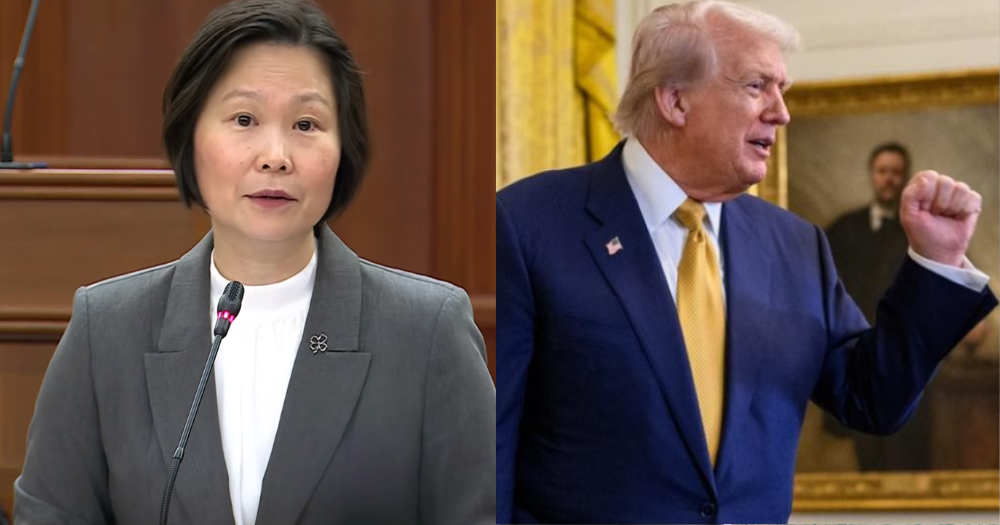
Top images from MDDI/YouTube and The White House's Facebook