Features


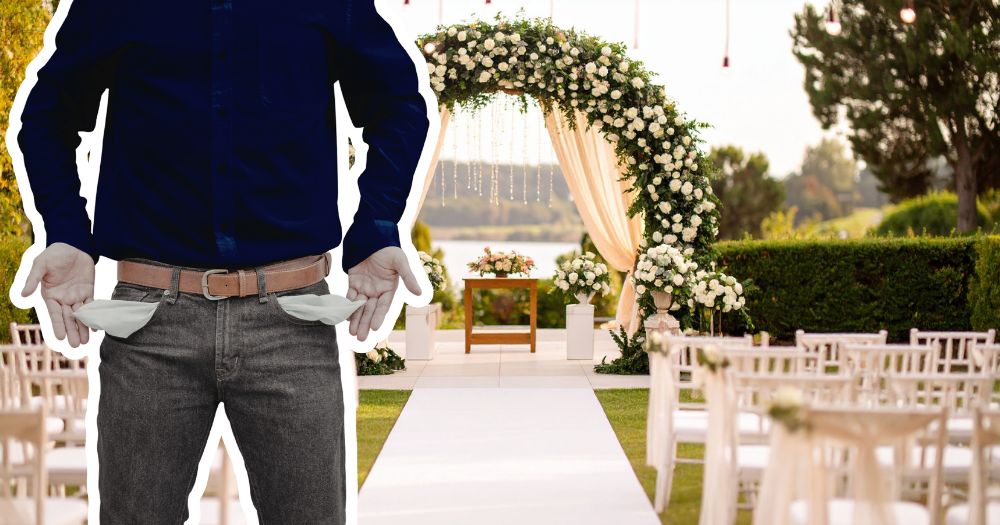
Comment: If you can’t afford your wedding, you don’t deserve my ang bao to 'cover cost'
If I'm not considered in the wedding planning, maybe don't consider my ang bao for the costings?
March 28, 2026, 05:59 PM


I think by now, most of my friends are through their marrying days.
I only have expectations for two or three more, so I feel relatively safe moaning about the rising costs of weddings.
(And if you're one of those two or three more, rest assured I look at this academically, free of interest.)
"Profit", not exploitation
I respectfully disagree with my colleague from several years ago.
I do expect, and hope, for you to make a “profit” off my ang bao, and for it to help cover the cost of the wedding.
To me, it's kind of the whole point of the ang bao.
The first year after a wedding can be fraught with difficulty, especially if it's a young couple, just starting in their careers and moving out of the family home for the first time.
Some of these issues are deep and require significant soul-searching and emotional adjustment.
But some things just need money.
The ang bao is a very simple gift that can most straightforwardly help make things just a little bit easier for the new couple.
I, for one, have always been proud to be able to take part in that.
So by all means, factor in profit.
How do you rate this market?
Lots of people have a dream wedding, or at least an idea of what it would look like.
I'm all for that. Hold the wedding you want — if you can afford it.
The problem is when people choose the ceremony they can't afford, and set the price of a wedding without considering whether the guests can.
It feels terribly like taking advantage of the affection of friends and family.
Which brings us to the whole discussion of "market rate".
If you're lucky enough not to have heard of it, it's essentially a nebulous bunch of lists that tell wedding attendees how much they should put into an ang bao to “cover cost”, depending on the venue.
There are several such lists. The latest one I’ve seen starts at S$160, and goes as high as S$800, with the mean amount running somewhere between S$250 and S$350.
Some of them are more than the price of a meal at a Michelin-starred restaurant. But that's not really the point.
Rather, by pinning the ang bao to the venue, and in turn to the couple that chose it, the guests get very little autonomy over how much they get to give.
You either cover costs like a good wedding guest, or you're a terrible friend/relative/colleague who's condemning the happy couple to starting married life in debt.
Whether or not the guest can afford it matters very little at all.
Which feels kind of strange considering that, you know, they're the ones giving it.
How much in the red for this packet?
When I first heard the term "market rate", in more innocent days, I thought it was pretty straightforward.
Surely it represented how much guests were willing to pay, on average, depending on emotional or familial proximity.
It never occurred to me that the "market rate" was never determined by the guests at all.
It might seem naive. But there is precedent to it.
When I received ang bao during Chinese New Year as a child, I was instructed to regard the amount as purely symbolic.
Appreciate larger sums because they symbolise a close relationship, and appreciate lower amounts because someone made the effort on your behalf.
But it was clear that the ang bao was a reflection of the relationship.
(If you wanted to flex at the same time: go ahead, but that's a decision you make as a giver).
If we take CNY ang baos as the standard, then the culture of wedding ang baos is the anomaly.
It really feels like couples that end up complaining about ang baos not covering costs are revealing that they failed to take into account the nature of their guest list.
Your guests have no relationship with the venue; there is no earthly reason why they should fill an ang bao on that basis.
A good wedding
I know a wedding is for the bride and groom, and please be as extravagant or modest as your vision compels you to.
But if you fear that a wedding must be grandiose to evoke awe from your audience, I have some good news.
Personally, in my experience, the fanciness of a wedding has very little to do with my enjoyment of the event.
The best wedding I ever attended was one with free seating, a biryani buffet, and it was held in the badminton hall of a local CC.
It was the best because it gave me what I actually valued at these sorts of events: solid, uninterrupted facetime with the couple.
I got to meet my friend, meet his new wife for the first time, get to know each other a bit, congratulate them profusely, take a picture, and then go home right away.
But as I left, I knew that suggesting something similar for myself would be next to impossible, due to expectations (I cleverly circumvented this by never getting married).
At any cost
I have a knack for being in the wrong part of the world at the wrong time for weddings.
Two of my closest friends got married ten years apart.
One got married in Singapore while I was studying in the UK, the other got married in the UK while I was studying in Singapore.
You can bet I spared no expense to be there for them, even though one time I spent more time travelling than I spent in the country for the wedding.
I was fortunate enough to be able to afford it, but even more fortunate to have them as friends.
And for me, attending their weddings was a reflection of that relationship.
Neither asked for nor expected any gift or present for their ceremonies (I had to explain to one what the meaning and purpose of ang bao was).
The ang bao I gave? I chose to give it: out of love, not obligation.
Covered cost.
Best money I ever spent.
Top image via Canva