






Branded
S’pore man, 38, made his childhood dream a reality & is building a new generation of kids who love to swim
Just keep swimming.
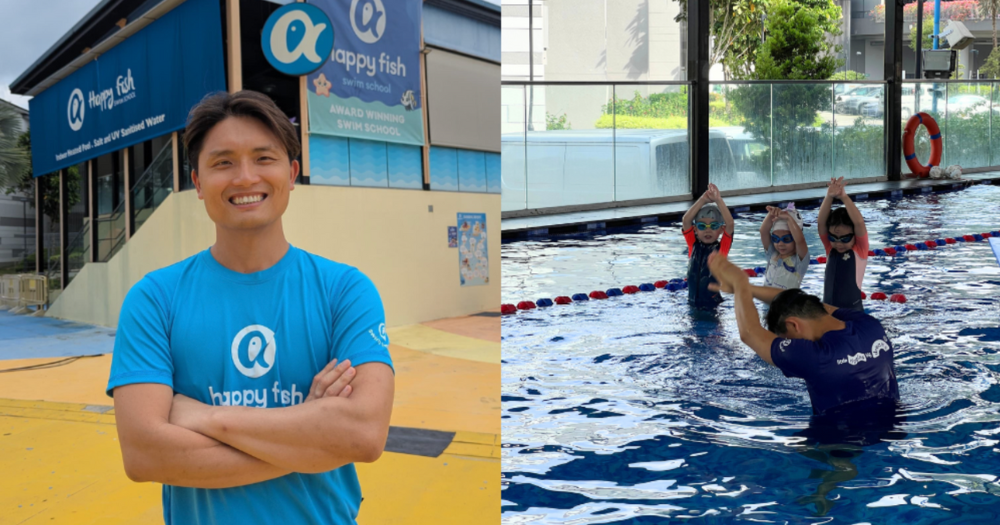
Tan Jian Yong’s journey with swimming began early – his father taught him how to swim when he was only three years old and swimming soon became an indispensable part of his life.
As he grew older, he began to wonder why swimming wasn’t something more children were exposed to.
That question eventually became the starting point of his entrepreneurial journey – it nudged him into becoming a lifeguard, then a swim coach, and ultimately toward founding a swim school called “Happy Fish”.
Tan, in his own words, wanted to “do something for the swimming community”, and help families introduce swimming at an early age.
The first splash of Happy Fish
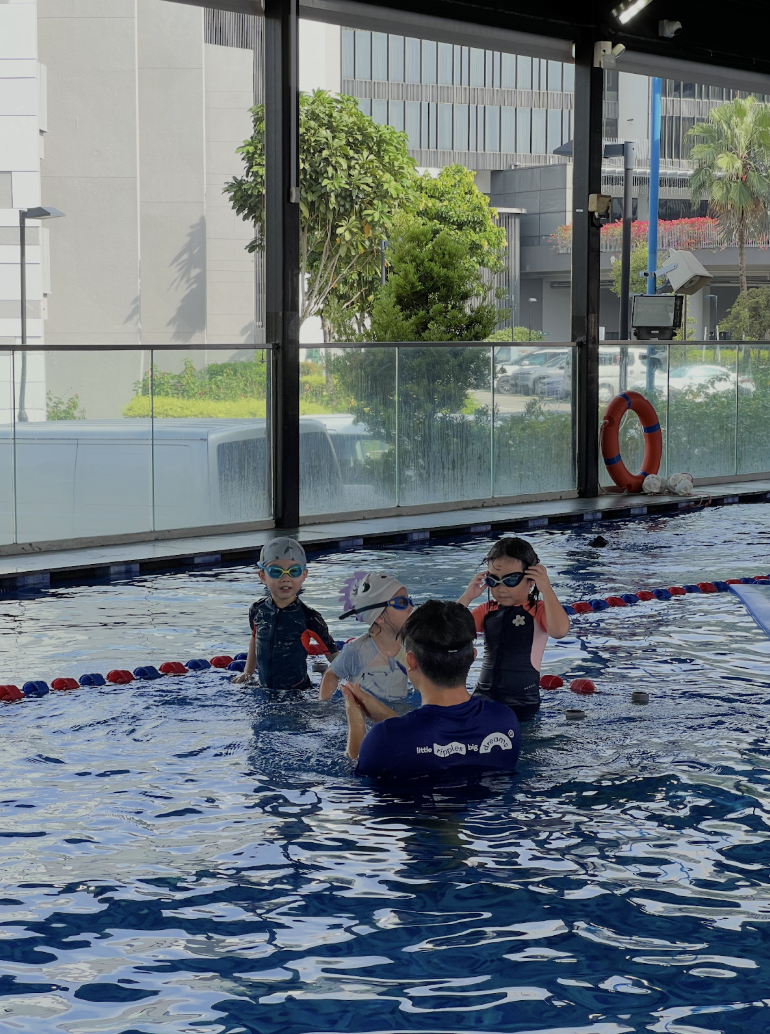 Tan teaching a class. Photo via Mothership.
While coaching, Tan noticed a gap: coaches struggled to find students, and students were also shy in asking them about fees and class availability.
As such, he decided to build a platform in 2007 to connect both sides, and this sparked a bigger realisation.
He believed that the best time to learn swimming is during early childhood when children are developing their fine and gross motor skills such as rolling, crawling and grasping skills.
Movements from swimming can help develop their muscles and confidence in water.
This encouraged him to take a bold leap by turning his platform into a swim school with a strong focus on babies and toddlers, while still offering lessons for older children and adults.
This marked the start of Happy Fish.
 Tan teaching a class. Video via Mothership.
What makes Happy Fish different
When I asked Tan about the school’s facilities, I could instantly tell that this was the part of his work that meant the most to him.
His eyes brightened immediately, and he went on to highlight key features of the pools, which include indoor heated pools, salt-chlorination and UV purification systems.
“Babies can’t wear goggles, which is why we decided to have low-chlorinated water,” Tan explained. “I needed to be sure the water was safe enough for the children.”
The school also makes a conscious effort to keep students with the same coach to build trust and familiarity – some of Tan’s students followed him for about seven years.
Nearly went bankrupt before the school opened
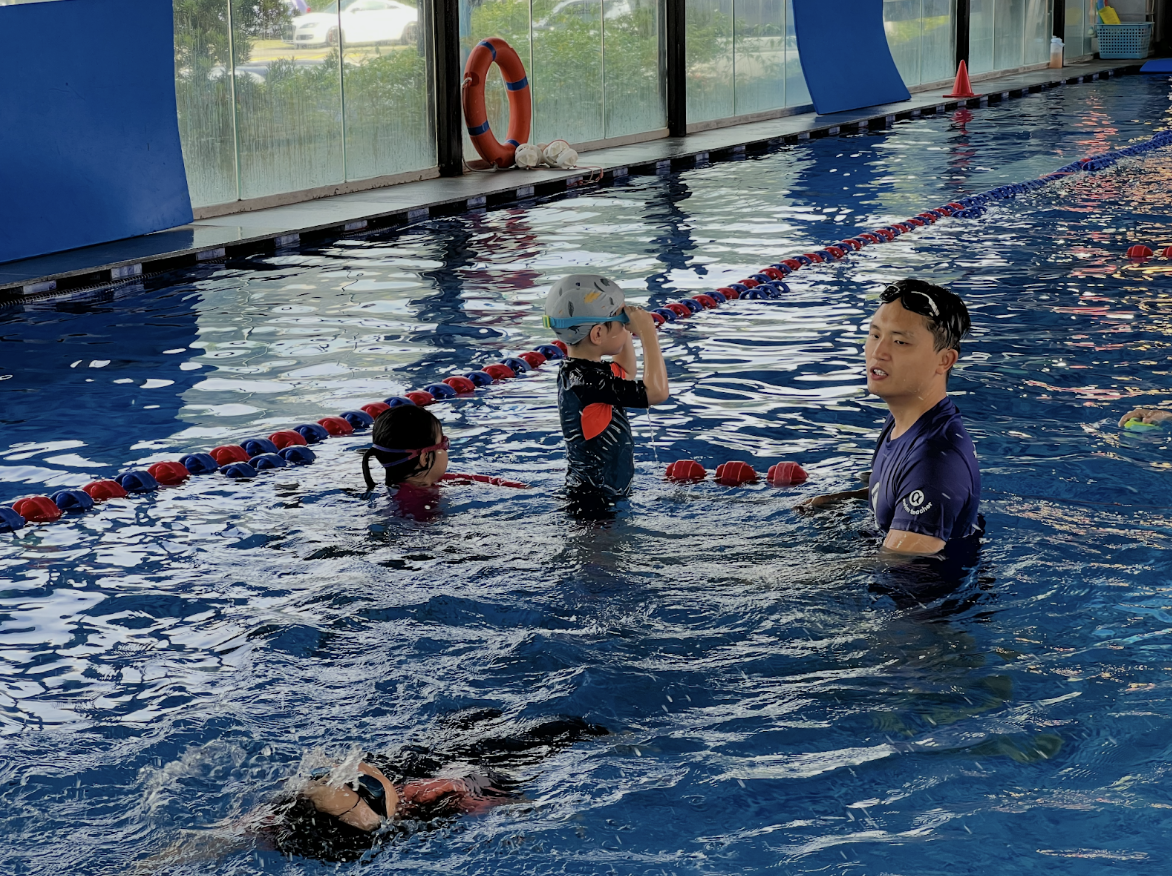 Tan teaching a class. Photo via Mothership.
Unbeknownst to most, the school’s early days were far from smooth.
To keep Happy Fish afloat, Tan came close to bankruptcy even before the school officially opened.
Unexpected delays and construction setbacks drove costs far beyond what he had planned – he had to spend close to S$400,000, almost twice his initial budget of S$200,000 for the school’s first indoor heated pool.
Tan shared that he had to negotiate an installment payment plan after going through all of his savings in order to complete the pool.
And even after the doors opened, his difficulties were far from over.
As it was his first foray into building a swim school, Tan had to earn trust both within and without the school.
Sign-ups were slow at the start as Singapore had never seen a dedicated baby swim school before, and parents were hesitant.
It also took time for Tan to train instructors and gain rapport with coaches who were older and more experienced than himself.
The school also took a hit from the pandemic which forced Tan to shut Happy Fish’s doors for 10 months.
“I just wanted an advisor or somebody to talk to, who can give me advice (on) what I should do,” he said as he recalled the times when he felt lonely in this entrepreneurial journey.
The right partner
It was during this period of uncertainty that Tan crossed paths with Daniel Ang, a Business Development Advisor at the SME Centre at Singapore Malay Chamber of Commerce and Industry (SMCCI).
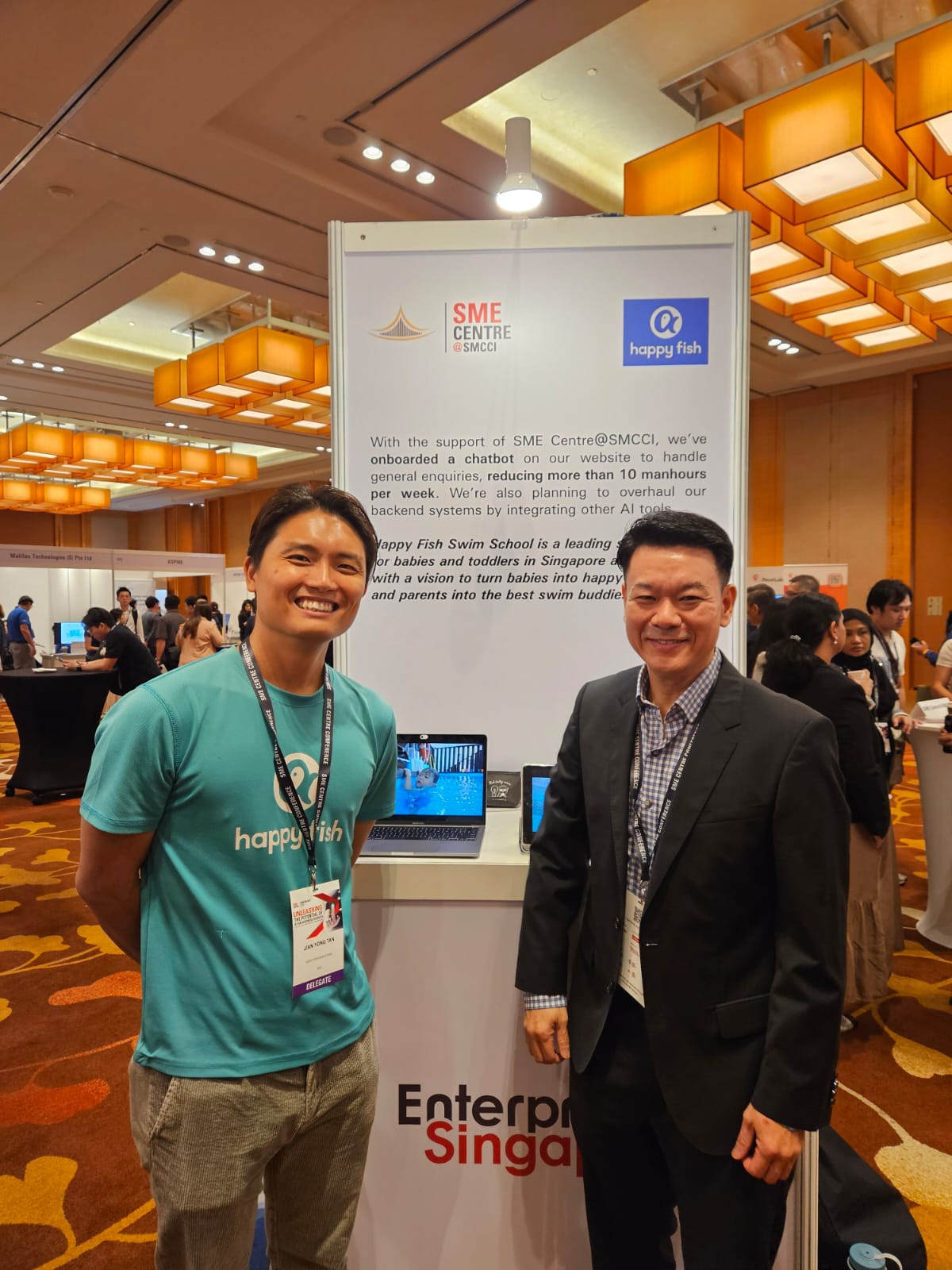 Tan and Ang. Photo courtesy of Tan.
Tan was first introduced to Ang during the pandemic, when he approached one of Enterprise Singapore’s (EnterpriseSG) SME Centres for guidance.
Tan later joined EnterpriseSG’s Partners for Business Growth programme – an initiative that aims to help selected Small and Medium enterprises (SMEs) develop growth plans and implement projects in areas such as productivity and artificial intelligence.
The conversations between Tan and Ang quickly became a pivotal part of the school’s journey.
What struck me was how Tan talked about those early conversations – not as consultations, but as the sounding board he’d needed.
Ang didn’t dictate solutions. Instead, he asked questions which got Tan thinking about what he really wanted for the school.
Drawing from his experience across other industries, Ang would often share parallels from other sectors to spark new perspectives.
One conversation, in particular, stood out to Tan.
Ang spoke about how pickleball had grown rapidly by building a strong community and culture around it, and this prompted Tan to see the swim school as something more than just as an enrichment provider.
Tan was subsequently inspired to build a culture that families believe in through Happy Fish.
Now, the 5Cs of the Happy Fish culture – Compassionate, Collaborative, Committed, Creative, and Courageous – are one of the first things you see on their website.
“Daniel helped me turn my ideas into reality,” Tan said.
Innovating with GenAI to manage enquiries
The other challenge that Tan managed to resolve after the programme was to streamline operational matters so that manpower could be better optimised.
Previously, the school’s coordinators spent a huge bulk of their time replying to a stream of queries. The process was not only time-consuming, but was also difficult to scale and prone to errors as the business grew.
Ang advised Tan to explore scalable solutions that could improve productivity and reduce the time spent on handling enquiries.
This led him to GenAI Sandbox, a programme jointly launched by Infocomm Media Development Authority (IMDA) and EnterpriseSG to help SMEs pilot generative AI (GenAI) solutions.
Though Tan knew nothing about GenAI, he trusted the process – and trusted Ang.
Today, the chatbot handles not only general enquiries, but also the rescheduling of lessons.
Expanding overseas
Happy Fish now has 10 branches in Singapore and 11 in Malaysia, with its first Jakarta branch slated for the first quarter of 2026.
Tan hopes to eventually open at least 50 branches in both Malaysia and Jakarta, with future expansion into Vietnam, Thailand and Japan.
Expanding into Malaysia was a natural choice for Tan who was born there. He wanted families in Malaysia to also have access to the same facilities and standards that Happy Fish had built in Singapore.
On the other hand, Jakarta presented a practical need: with pollution and unpredictable weather making outdoor swimming unsafe for babies, Tan’s pools could meet a real demand, especially with 4.5 million babies born there each year.
To support their expansion into Indonesia, the school tapped on EnterpriseSG’s Enterprise Development Grant to develop a franchise model with FD consulting – a model which they plan to replicate in new markets.
Ang, who had experience supporting businesses to grow into the Indonesian market, also helped Tan understand potential pitfalls and identify the right overseas partners.
Over time, their business-advisor relationship has deepened into a reliable partnership built on trust and openness.
Why advisory support matters
For Tan, EnterpriseSG’s support wasn’t just about tools or grants, it was also about partnerships.
The partnership between Tan and Ang has connected Tan to other useful contacts and opened doors to other opportunities that the latter may not be able to think of by himself.
Thanks to Ang, Tan gained clarity on his strategic direction and confidence in decision-making.
Know a local SME owner who could use a sounding board? Have a chat with a business development advisor at one of EnterpriseSG’s 10 SME Centres across Singapore.
This branded article by Enterprise Singapore has this writer contemplating if she should launch a start-up as a side-hustle.
Top photos courtesy of Tan Jian Yong and Mothership.