News

S'pore MRT reliability falls to lowest level since 2020, LRT reliability improved from 2024
Based on a 12-month moving average between July 2024 to June 2025.
September 05, 2025, 02:33 PM


The reliability of Singapore's MRT network in the past 12 months has fallen below 2024 levels and is at its lowest since 2020.
This is based on a 12-month moving average measuring the mean distance travelled by trains between delays of more than five minutes.
The Land Transport Authority (LTA) released the updated rail reliability statistics on Sep. 5.
The Sep. 5 figures are subject to adjustments, pending ongoing incident investigations.
Rail network reliability
Between July 2024 to June 2025, the mean distance travelled between delays of more than five minutes, measured in train-km, stands at 1,598,000.
In 2020, the 12-month moving average for the same period was 1,451,000.
In 2024, it was 1,982,000.
 Screenshot via LTA.
Comparing MRT lines
Comparing the MRT lines, the Downtown Line (DTL), North South Line, and East West Line saw a decrease in rail reliability compared to the previous year.
North East Line (NEL) and Circle Line (CCL) saw improvements, with the reliability of NEL being at its highest level since 2020.
 Screenshot via LTA.
As for the number of service delays lasting more than 30 minutes, there were two in total during the first and second quarter of 2025.
One occurred along the CCL while another was on the DTL.
There were seven such delays in all of 2024, five in 2023, seven in 2022, three in 2021 and six in 2020.
 Screenshot via LTA.
LRT network
The reliability of the LRT network improved, clocking a mean distance of 534,000 before experiencing a delay of more than five minutes.
This is the second-highest level since 2020 and is close to surpassing 2023 figures.
 Screenshot via LTA.
Improvements were experienced on both the Sengkang-Punggol LRT and Bukit Panjang LRT networks, with the former experiencing a larger improvement, surpassing 2023 levels.
 Screenshot via LTA.
In the first two quarters of 2025, LTA recorded no service delays of more than 30 minutes on the LRT network.
There were four such delays in all of 2024, three in 2023, two in 2022, four in 2021 and five in 2020.
Global comparison
LTA explained in the report that rail reliability is tracked by looking at mean kilometres between failure, which is the average distance that a train travels before it encounters a delay of more than five minutes.
LTA has set a target of one million train-km before it encounters a delay.
Going by this marker, LTA compared Singapore's rail reliability to that of rail networks in other countries.
Singapore's MRT network is more reliable than Hong Kong's MTR but far less so than Taipei's Metro.
Japan measures rail reliability by tracking disruptions that result in delays of more than 30 minutes.
Going by this standard, in 2023, Singapore's MRT was less reliable than Nagoya's subway, but fared better than Osaka's metro and Tokyo's metro and subway.
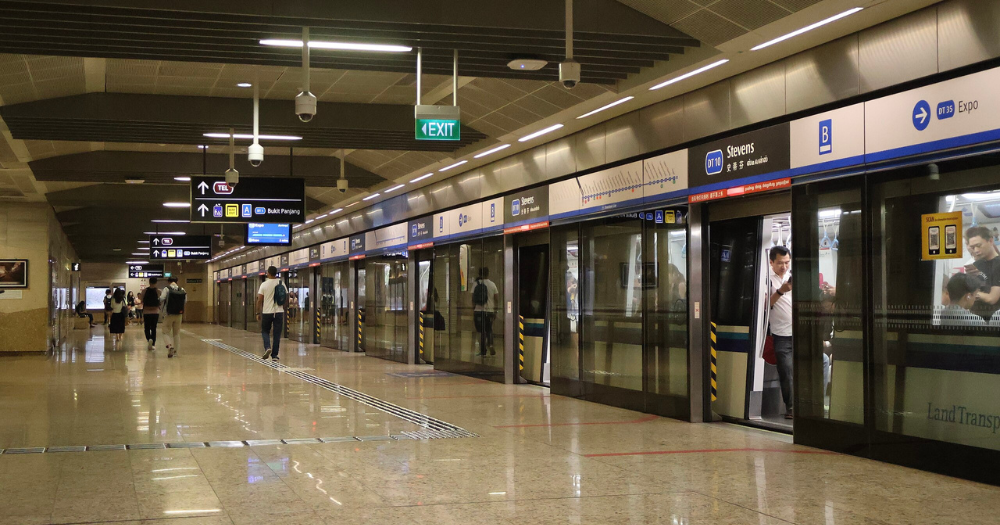
Top image via Wikipedia